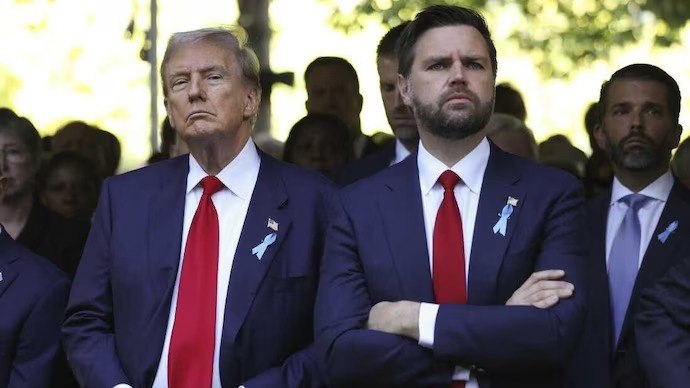
United States Vice President JD Vance finds himself in a politically precarious position, spearheading high-stakes peace negotiations with Iran while President Donald Trump has repeatedly, albeit in jest, suggested Vance would be held responsible if the talks falter. This dynamic has led many to question whether Trump has successfully made his deputy the public face of what some are already calling America’s humiliation by Tehran.
The immediate public spotlight intensified during recent talks in Geneva, where the Iranian delegation, led by chief negotiator Mohammad Baqer Qalibaf and Foreign Minister Abbas Araqchi, abruptly walked out of a scheduled photo-op with American negotiators. This incident left Vance to absorb the immediate public backlash, a clear indication of his front-and-center role in the contentious diplomatic efforts.
President Trump’s proposed 14-point tentative peace framework, signed last week in Versailles, has already ignited a political firestorm within his own Republican Party. Critics on Capitol Hill view the proposed concessions, which include lifting oil sanctions and unlocking frozen assets, as a significant capitulation to Tehran. Senator Bill Cassidy, for instance, declared on X that "Ronald Reagan is rolling over in his grave," warning that Iran’s nuclear ambitions remained unchecked and maritime coercion was being rewarded. Senator Ted Cruz focused on the financial aspects, cautioning that released funds would ultimately "be used to murder Americans," while Senate Armed Services Committee Chairman Roger Wicker argued the proposed $300 billion international reconstruction fund made the 2015 Obama-era nuclear deal "look like a pittance by comparison."
Adding to the domestic pressure, the New York Post, typically an administration-friendly outlet, published a scathing editorial on June 19 titled: "With Strait of Hormuz held hostage, Trump’s Iran deal is worse than Obama’s." Despite this mounting criticism from within his own party, Trump appeared largely unfazed. When asked on June 17 who would bear responsibility if the preliminary agreement collapsed, the president turned to Vance with a grin, quipping, "If it works out, I’m going to take the credit. If it doesn’t work out, I’m blaming JD. You better be careful, JD."
What makes Vance’s current role particularly striking is his past stance. Until recently, he was known as the administration’s most vocal skeptic of Middle Eastern entanglements and had been a strong internal voice against a war with Iran. Yet, it is Vance who has been thrust forward as the deal’s chief public champion, while traditional hardliners like Secretary of State Marco Rubio and Secretary of War Pete Hegseth have quietly retreated to the background, leaving Vance isolated at the forefront.
A White House statement last week further solidified Vance’s exposure, describing him as the president’s "right-hand man" and crediting him with leading the negotiations "alongside Special Envoy Steve Witkoff and Jared Kushner." This official endorsement ensured Vance’s name was inextricably linked to the deal in black and white. Vance has embraced the role with visible energy, strongly defending the interim framework, pushing back against Republican critics, and even warning Israel, which has publicly condemned the deal, not to attack its "only ally." He insisted that lifting sanctions would be "a real benefit to the American people" and flatly rejected the notion of Washington surrendering leverage.
Within Republican circles, the interim Iran deal is already being branded "Vance’s deal," a convenient way to create distance between President Trump and any potential fallout should the talks collapse. Conservative commentator Marc Thiessen described the agreement on X as "the Vance peace deal," while Ben Domenech derided it as a pact negotiated by "some kind of Hillbilly Obama," a pointed reference to Vance. Even podcaster Ben Shapiro weighed in on Fox News, stating that "the vice president, the chief negotiator on this project, has not well-served the president." The framing consistently points to Vance’s perceived failure rather than issues with Trump’s overall strategy.
Republican strategists confirm this deliberate political maneuver. Matt Mackowiak told the BBC that it’s "not in the president’s nature to cede the limelight, and he’s done that here. That does feel like a deliberate choice." A longtime Republican operative, speaking anonymously, was more direct, telling the BBC, "It’s classic Trump to throw JD under the bus." This strategic positioning highlights the high stakes for Vance, who is widely considered a potential contender for the 2028 Republican presidential nomination. Should he succeed in extracting a credible, lasting agreement with Iran, it would undoubtedly bolster his political career significantly.
However, if the US-Iran talks collapse, as Sunday’s walkout in Geneva suggests remains a real possibility, the scapegoat for any perceived Iranian humiliation has already been clearly identified. As one White House insider reportedly told Politico, "The vice president will get credit. Whether that’s good or bad remains to be seen." Vance’s political future now hangs directly on the outcome of these fraught negotiations, making him the central figure in a high-stakes gamble orchestrated by his own president.
TL;DR
- US Vice President JD Vance is leading contentious peace talks with Iran, a role President Donald Trump has publicly linked to potential blame if negotiations fail.
- The Iranian delegation recently walked out of a photo-op in Geneva, leaving Vance to face immediate public scrutiny.
- Trump’s 14-point peace framework, involving lifting sanctions and unlocking assets, has drawn sharp criticism from Republican hawks and media outlets.
- Vance, a former skeptic of Middle Eastern involvement, is now the deal’s chief public defender, while traditional hardliners have receded.
- The White House has officially named Vance as a lead negotiator, further cementing his association with the deal.
- Republican commentators and strategists are already branding it "Vance’s deal," suggesting a deliberate strategy by Trump to distance himself from potential failure.
- Vance’s political future, including potential 2028 presidential ambitions, is heavily tied to the success or failure of these negotiations.