US Ambassador to India, Sergio Gor, has been widely credited as the architect behind a remarkable turnaround in the critical US-India relationship, steering it back from a period of significant diplomatic turbulence. His strategic efforts, spanning just eight months, culminated in a visibly warmer interaction between President Donald Trump and Prime Minister Narendra Modi at the recent G7 Summit, signaling a renewed commitment to what many consider the 21st century's most vital geopolitical partnership.
The diplomatic ties between Washington and New Delhi had entered a period of severe strain following an initial optimistic meeting in February 2025. Hopes for a landmark trade agreement quickly evaporated when India declined to sign a preliminary framework, coinciding with the Trump administration's aggressive tariff measures. This initial friction was compounded by a series of escalating crises, including a terrorist attack in Pahalgham, which saw Washington urging Pakistan to cease hostilities, creating uncomfortable optics for India. Further exacerbating the situation, voices close to President Trump publicly disparaged India and delved into sensitive domestic issues, leading to a complete diplomatic freeze by late summer 2025.
It was against this backdrop of fracturing strategic momentum that Sergio Gor entered the scene. His confirmation hearing before the Senate Foreign Relations Committee on September 11, 2025, marked the quiet beginning of a calculated pivot. Gor meticulously prepared for his role, consulting his predecessor, Eric Garcetti, and deeply analyzing the historical fault lines to understand not just what had broken, but what could still be salvaged. His appointment signaled a deliberate shift in Washington's approach.
Just six days after his hearing, on September 17, President Trump's birthday call to Prime Minister Modi, though seemingly routine, was recognized in diplomatic circles as the crucial first step toward a thaw. Gor wasted no time in making his first public move after Senate confirmation, addressing attendees at the Indian Embassy's Diwali celebration in Washington on October 9. He candidly acknowledged the existing challenges but delivered a carefully calibrated message: India still had a friend in the White House. He emphasized his direct, high-level channels with Indian Ambassador Vinay Kwatra, sending an unmistakable signal that lines of communication were open once more.
The very next day, Gor was in New Delhi, personally delivering a message from President Trump to Prime Minister Modi. This wasn't an immediate breakthrough, but it was a vital opening. Gor understood that genuine diplomacy advances not through grand pronouncements but through the painstaking restoration of trust, one granular step at a time. His presence and direct engagement began to mend the frayed edges of the relationship.
Upon Gor's return to Washington later that October, a noticeable shift in the political climate began to occur. The virulent anti-India rhetoric that had previously saturated American cable news channels suddenly evaporated. Pundits who had spent months criticizing New Delhi went conspicuously quiet. While no official memos were leaked or announcements made, seasoned Beltway insiders recognized that the diplomatic damage was being contained, a testament to Gor's growing internal capital and influence within the administration.
Gor's significant sway became fully apparent at his November 10 reception at the Kennedy Center. The event drew a powerful cross-section of Trump's inner circle, including Secretary of State Marco Rubio, Commerce Secretary Howard Lutnick, Chief of Staff Susie Wiles, and USTR Jamieson Greer. Secretary Rubio's remarks at the reception offered a telling anecdote about Gor's audacious and direct approach, recounting how Gor fearlessly approached music legend Mick Jagger on Rubio's behalf. This story served as a perfect geopolitical metaphor, highlighting Gor's willingness to initiate conversations others might avoid, a barrier-breaking trait indispensable for navigating complex Indo-Pacific diplomacy.
Returning to New Delhi in January 2026, Gor put the diplomatic machinery into overdrive. Within weeks, the US and India struck an interim trade framework, a crucial step that saw punitive tariffs reduced from 25 percent to 18 percent, a face-saving metric lower than those imposed on India's western neighbor. He also championed India's integration into the Pax Silica initiative, recognizing its immense technological and strategic gravity. Concurrently, Gor maintained a relentless ground game in Washington, meeting with over sixty senior officials across the Pentagon, State Department, and White House during an April visit to ensure India's priorities remained central. He even facilitated an unplanned meeting between India’s Foreign Secretary, Vikram Misri, and Secretary Rubio at the White House.
This intensive groundwork laid the foundation for Secretary Rubio’s highly anticipated visit to India in May. Gor meticulously ensured that a Quad Foreign Ministers meeting would anchor the trip, restoring the Indo-Pacific’s premier strategic framework to center stage. Throughout Rubio's demanding four-day itinerary across Delhi, Kolkata, Agra, and Jaipur, Gor operated behind the scenes, ensuring flawless choreography and messaging. Rubio's mandate was clear: reassurance. He emphasized to his Indian counterparts that this was not a 'reset' but a 'continuation,' underscoring India's indispensable role as an ally.
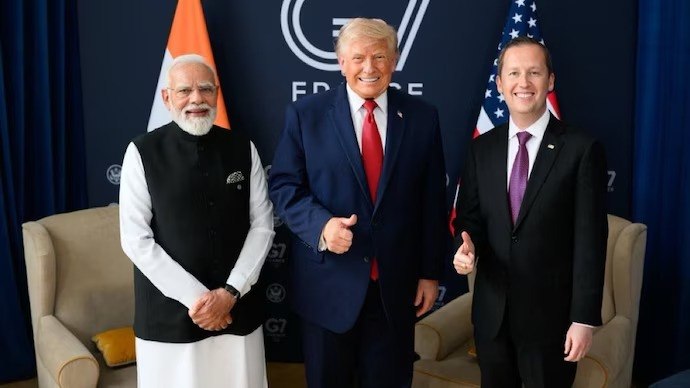
The true test of Gor's diplomatic craftsmanship arrived on June 17 at the G7 Summit. The chemistry between President Trump and Prime Minister Modi, once thought deeply damaged, was visibly restored. Modi raised maritime security concerns, and Trump offered condolences for lost seafarers. Significantly, President Trump went further than anticipated, unequivocally declaring that the United States would come to India's defense if it were ever attacked. Gesturing to his high-level delegation, Trump delivered the ultimate verdict on the administration's renewed posture: "Ask them. They all like India." Seated quietly in the room, Ambassador Sergio Gor smiled and nodded, the moment speaking volumes about the success of his efforts.
Alliances of this magnitude do not mend themselves; they demand strategic patience, arduous back-channel maneuvering, and relentless engagement. In a mere six months, Sergio Gor successfully halted a geopolitical tailspin and repositioned the Washington-New Delhi axis onto a trajectory of aggressive growth. While skeptics and institutional caution in New Delhi are understandable, the undeniable momentum, with a comprehensive trade agreement potentially looming as early as July, points to a robust future. Both Secretary Rubio and Ambassador Gor have strongly hinted at a monumental presidential visit to India on the horizon, a prospect Trump himself teased at the G7. Such high-caliber visits are historically built upon foundations of massive strategic announcements, and if the past eight months are any indication, Sergio Gor is already laying the groundwork for the next significant chapter in US-India relations.
TL;DR
- US Ambassador to India, Sergio Gor, is credited with orchestrating a significant turnaround in the US-India relationship after a period of diplomatic strain from February to September 2025.
- The relationship had deteriorated due to trade disputes, US responses to a terrorist attack in Pahalgham, and public anti-India rhetoric from figures close to the Trump administration.
- Gor's quiet pivot began with his Senate confirmation in September 2025, followed by strategic actions like facilitating a birthday call from Trump to Modi and publicly signaling open communication channels.
- He personally delivered messages, worked to contain anti-India rhetoric in Washington, and leveraged his internal capital, as demonstrated by a high-profile reception at the Kennedy Center.
- Key achievements under Gor's tenure include an interim trade framework reducing tariffs, India's integration into the Pax Silica initiative, and extensive lobbying in Washington for India's priorities.
- Gor meticulously planned Secretary of State Marco Rubio's visit to India, ensuring a Quad Foreign Ministers meeting and flawless choreography to reassure India of its indispensable ally status.
- The culmination of his efforts was a visibly positive interaction between President Trump and Prime Minister Modi at the June 2026 G7 Summit, where Trump pledged US defense if India were attacked.
- The diplomatic rescue has set the stage for potential future developments, including a comprehensive trade agreement and a monumental presidential visit to India, signaling aggressive growth in the partnership.