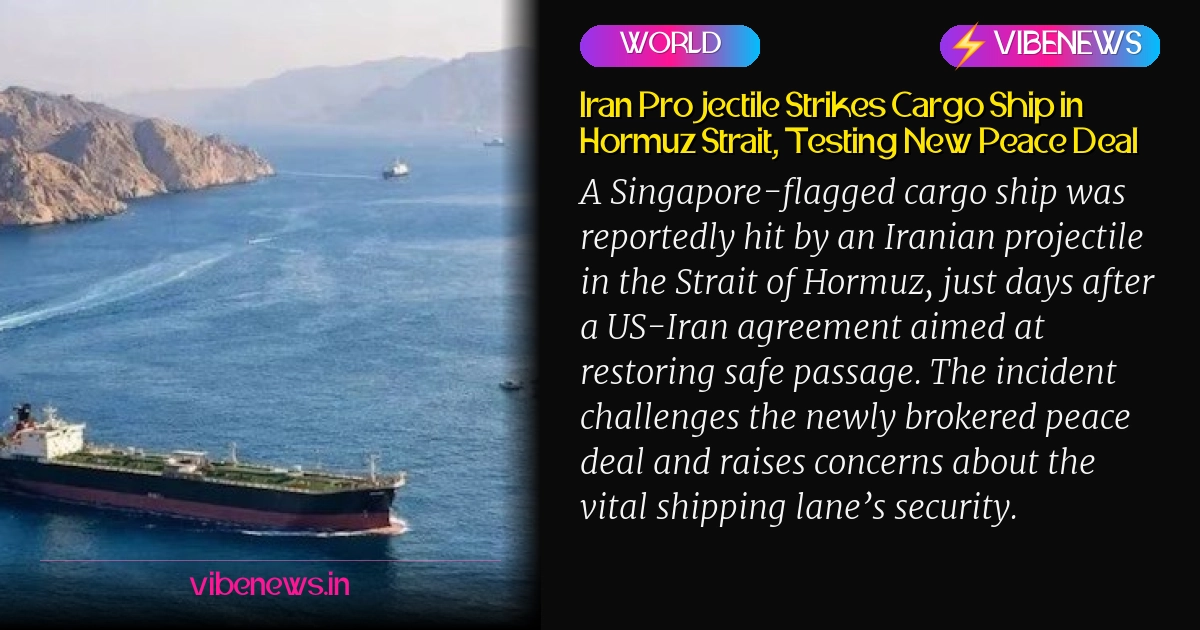
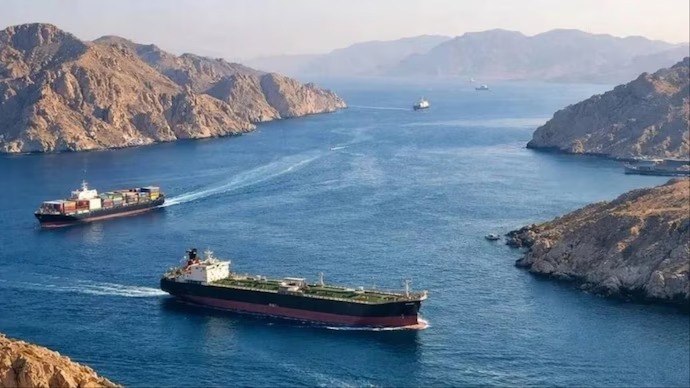
A Singapore-flagged cargo vessel, identified as the Ever Lovely, reportedly sustained damage from a projectile strike while navigating the strategically critical Strait of Hormuz on Thursday. The incident, which caused damage to the ship’s bridge but no casualties, is being viewed as the first significant test of a recently signed US-Iran agreement intended to end hostilities and ensure safe passage through the vital waterway.
US officials, cited by The Wall Street Journal and Reuters, attributed the attack to Iran’s Islamic Revolutionary Guard Corps (IRGC). This alleged strike occurred mere hours after Tehran issued a warning that vessels not adhering to its designated routes could face action. The timing of the attack, so soon after the peace deal, immediately casts doubt on the agreement’s effectiveness and raises questions about future stability in the region.
According to the UK Maritime Trade Operations (UKMTO), the vessel reported being struck near the coast of Oman. While the ship’s structural integrity was compromised at the bridge, all crew members remained safe. The Ever Lovely was later confirmed as the affected ship by four independent sources, highlighting the specific nature of the incident.
The attack places President Donald Trump’s newly brokered peace deal with Iran under immediate and intense scrutiny. The interim agreement was designed to de-escalate months of conflict and restore unimpeded navigation through the Strait of Hormuz, a choke point for a significant portion of the world’s oil supply. With a cargo ship coming under fire so quickly, international attention has now shifted to how Washington will respond if Iran is definitively found to have violated the terms of the deal.
Minutes before the reported strike, Iran’s Revolutionary Guards had issued a stark warning, stating that ships would only be guaranteed safe passage if they used routes specifically designated by Tehran. This message was subsequently reinforced by the Persian Gulf Strait Authority (PGSA), a body established by Iran to oversee navigation, in a post on X. The PGSA explicitly stated that "Consequences arising from passage through unauthorised routes shall be the responsibility of the owner, operator, and vessel commander," underscoring Iran’s assertive stance on maritime control.
While Iran has not officially commented on the reported attack, the Revolutionary Guards had earlier on Thursday reiterated their intent to take action against vessels that failed to comply with Iran’s designated transit routes. This pre-emptive warning suggests a deliberate policy, irrespective of the broader peace agreement.
The incident also prompted the UN’s International Maritime Organisation (IMO) to temporarily suspend its recently launched program. This initiative was designed to help ships and seafarers safely depart the Gulf after months of conflict had left hundreds of vessels and thousands of seafarers stranded since fighting erupted in late February. IMO Secretary General Arsenio Dominguez stated the pause was necessary "to reconfirm that the necessary safety guarantees continue to be in place for the ships on our evacuation list and all those in the region." The IMO clarified that the Ever Lovely was not part of its evacuation program.
Under the IMO’s initiative, ships could voluntarily leave the Gulf using one of two designated routes – one through Iranian waters and another through Omani waters – with US oversight. The suspension of this program further complicates efforts to normalise shipping in the area and highlights the immediate impact of the alleged Iranian action.
This latest incident casts fresh uncertainty over the future security of the Strait of Hormuz, which had only recently reopened under the preliminary US-Iran agreement. Before the attack, US Secretary of State Marco Rubio, concluding a Gulf tour aimed at reassuring regional allies, had warned of consequences for any Iranian interference with shipping. "If Iran threatens or blocks ships in the strait, then we’re going to have a problem," Rubio told reporters, a statement that now appears prescient.
Despite the reopening agreement, Iran has consistently signaled its intention to retain significant control over navigation through the waterway. Earlier on Thursday, US Energy Secretary Chris Wright had noted that oil shipments through the strait were approaching pre-war levels, with over 20 million barrels passing through in the preceding 24 hours. The attack now threatens to reverse this progress, potentially impacting global energy markets and reigniting regional tensions. The international community will closely watch how the US and its allies respond to this direct challenge to the fragile peace deal and the freedom of navigation.
TL;DR
- A Singapore-flagged cargo ship, the Ever Lovely, was reportedly struck by a projectile in the Strait of Hormuz on Thursday, damaging its bridge but causing no casualties.
- US officials, citing The Wall Street Journal and Reuters, attributed the attack to Iran’s Islamic Revolutionary Guard Corps (IRGC).
- The incident occurred just days after a US-Iran agreement was signed to end hostilities and reopen the strategically vital Strait of Hormuz.
- Iran had issued warnings earlier on Thursday that ships must use its designated routes or face consequences, a stance reinforced by the Persian Gulf Strait Authority (PGSA).
- The attack is seen as the first major test of the newly brokered peace deal, raising questions about its durability and Washington’s potential response.
- The UN’s International Maritime Organisation (IMO) temporarily suspended its program to evacuate stranded ships and seafarers from the Gulf following the incident.
- The Strait of Hormuz is a critical global shipping lane for oil, and the attack casts fresh uncertainty over its security and the broader stability of the region.