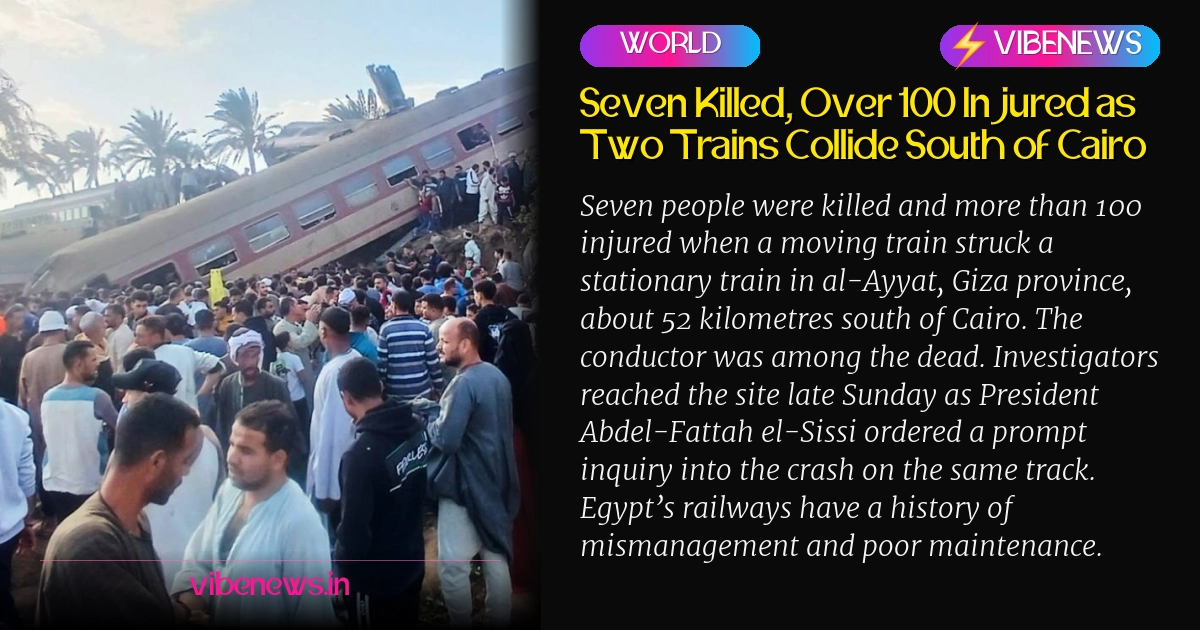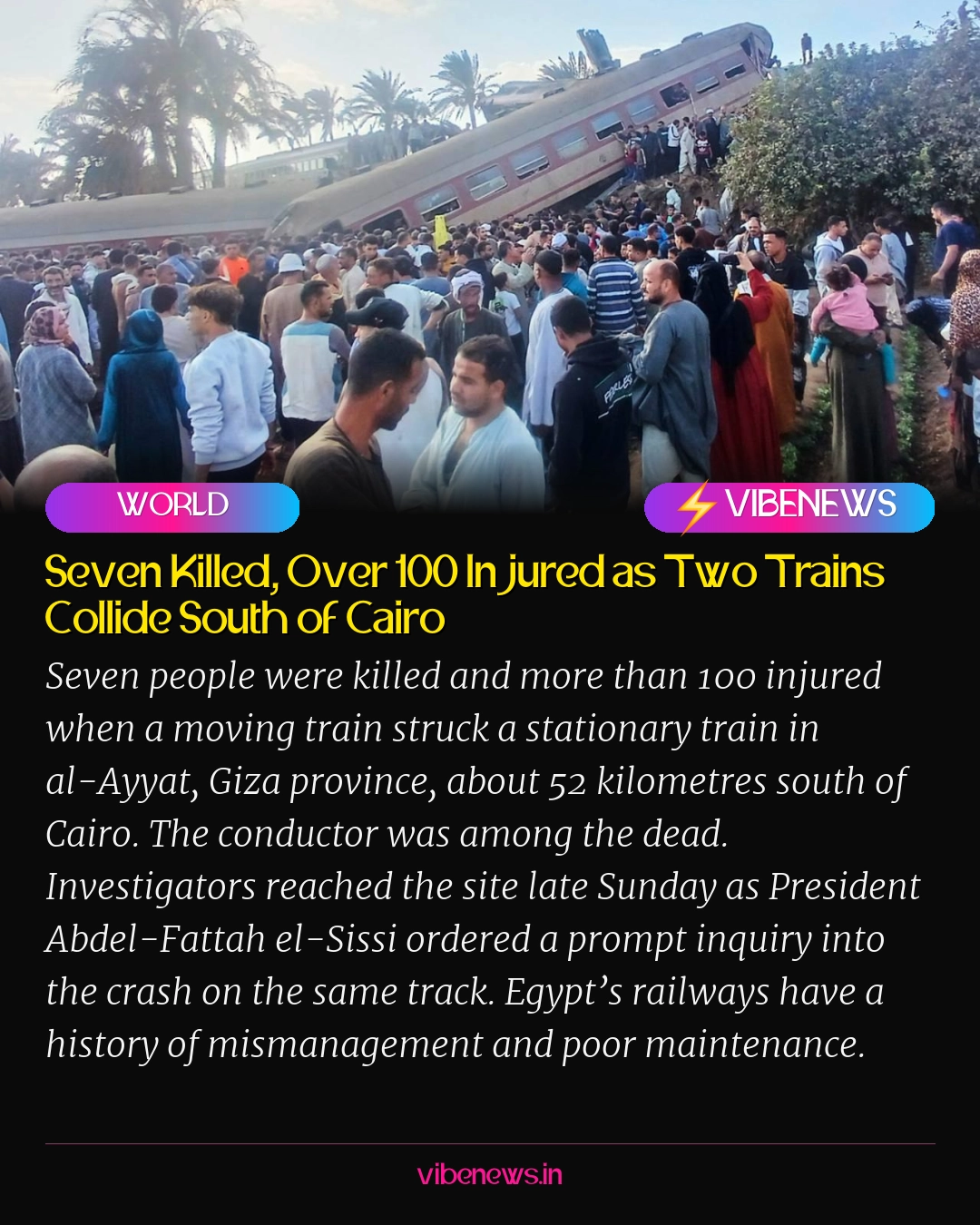
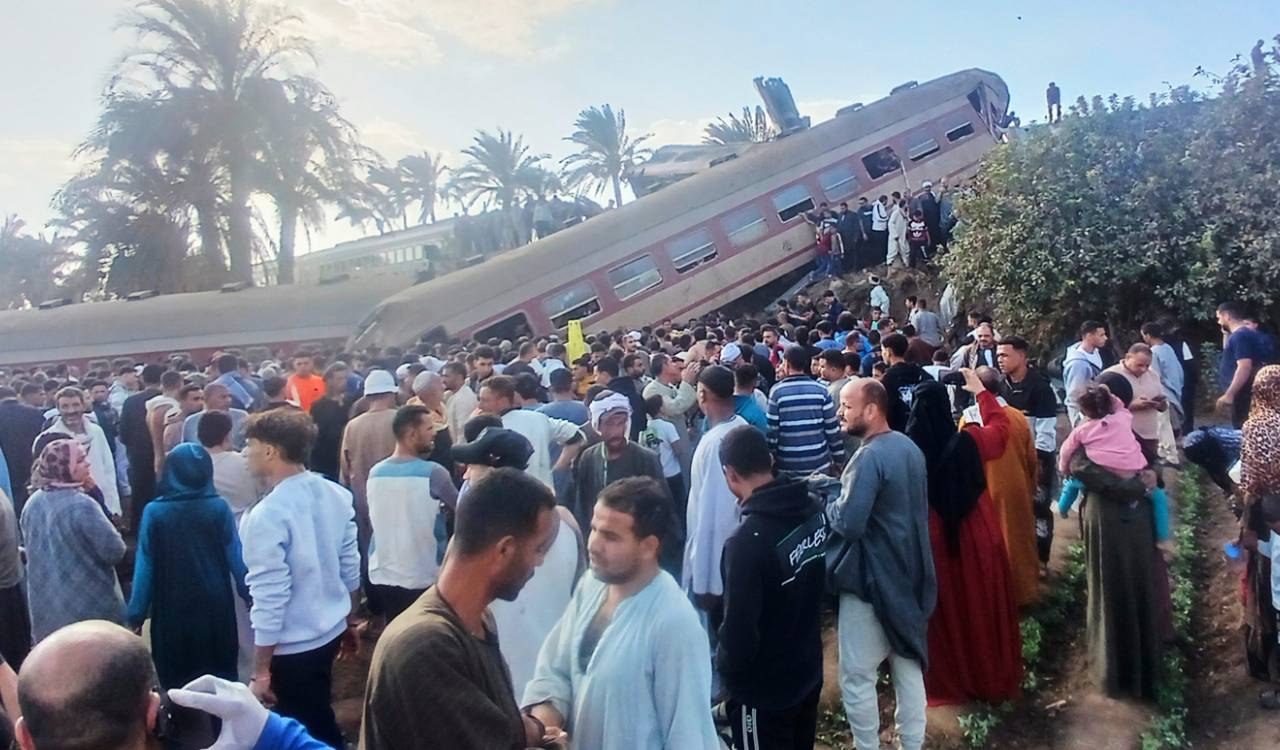
Seven people were killed and more than 100 were injured on Sunday when two trains collided in Egypt’s Giza province, south of Cairo, the Chief Prosecutor’s office said in a statement. The train’s conductor was among the dead.
The crash happened in the al-Ayyat district, about 52 kilometres south of the capital. A train heading to the southwestern province of Fayoum ran into the rear of a train bound for Aswan in the south, according to the Transportation Ministry.
How the collision happened
Investigators who reached the scene pointed to a simple but deadly mistake of position. The Giza-Fayoum train hit the last carriage of the Cairo-Aswan train, which was stationary on the same track and moving in the same direction. Officials have not said why the moving train was on that track with a stationary train ahead of it, and the investigation is still under way.
The Chief Prosecutor’s office said its investigators arrived at the site late Sunday. The crash is now the subject of an official inquiry, and the prosecution has not yet released a cause.
Residents became the first rescuers
Before ambulances and emergency crews could work through the wreckage, people who live nearby were already at the scene. Ayman Gamal, a resident of Kafr Girza in al-Ayyat, said neighbours rushed to the tracks, pulled out survivors and called for ambulances.
Gamal said he saw around 80 of the injured taken away by ambulance to hospitals nearby. His account describes a scene of chaos in the minutes after impact, with local people doing the work of rescue while official teams were still on their way.
“Some passengers were trapped inside one of the carriages of the stationary train and were dead when they were pulled out,” Gamal said.
That detail is the hardest part of the account. Gamal’s description suggests that some of the dead were found inside the carriage that was struck, not on the platform or the track. The death toll of seven was confirmed by the Chief Prosecutor’s office.
The president orders a probe
President Abdel-Fattah el-Sissi said in a social media post that he had ordered a prompt investigation into the crash. The order puts the government’s response on record and signals that the probe is a top priority for the state, not a routine review.
On the operational side, the Egyptian Railway Authority said emergency teams and cranes were sent to the scene. Their job is to clear the wreckage and bring train services back to their normal schedule as soon as possible. For commuters and travellers on the Cairo routes, the disruption is likely to continue until the tracks are cleared and safety checks are complete.
A railway system with a long record of problems
Train derailments and crashes are common in Egypt. The railway system has a history of mismanagement and poor maintenance of its equipment, and that background is what makes this crash so hard to read as a one-off failure.
In recent years, the government has announced modernisation initiatives meant to improve the railways. Sunday’s collision raises a direct question about how far those efforts have reached the tracks and the signalling systems that keep trains apart.
The crash also comes in a country where rail disasters have a grim past. Egypt’s deadliest train crash happened in 2002, when a fire broke out on an overnight train travelling from Cairo to southern Egypt. More than 300 people died in that disaster.
Recent incidents on the same district
This is not the first accident in the al-Ayyat area. Last September, a train driver and his assistant were injured when two freight trains collided in the same district. That incident was far smaller, with two injured crew members, but it points to a pattern of collisions in the same stretch of track.
Put side by side, the two crashes show how close the danger sits to daily life for people living along the line. Sunday’s collision, with its seven deaths and more than 100 injuries, is far larger in scale than the September accident.
What comes next
The immediate questions are simple. Officials need to confirm the cause, identify all the dead, and explain how a moving train came to strike a stationary one on the same line. The Chief Prosecutor’s office and the Transportation Ministry will be central to that work, along with the Egyptian Railway Authority.
For now, the number of injured remains above 100, and the number of victims who will require ongoing treatment has not been reported. Families of those on both trains will be waiting for confirmation and answers, and the investigation will decide whether this crash becomes another entry in Egypt’s long railway record or a turning point in how the network is run.
TL;DR
- Seven people were killed and more than 100 injured when a moving train hit a stationary train in Egypt’s Giza province on Sunday.
- The Chief Prosecutor’s office said the train’s conductor was among those killed.
- The crash happened in al-Ayyat, about 52 kilometres south of Cairo, when a train bound for Fayoum struck the rear of a train heading to Aswan.
- Residents rushed to the scene, pulled out survivors and called ambulances, while about 80 injured people were taken to nearby hospitals.
- President Abdel-Fattah el-Sissi ordered a prompt investigation, and emergency teams are working to clear the wreckage.