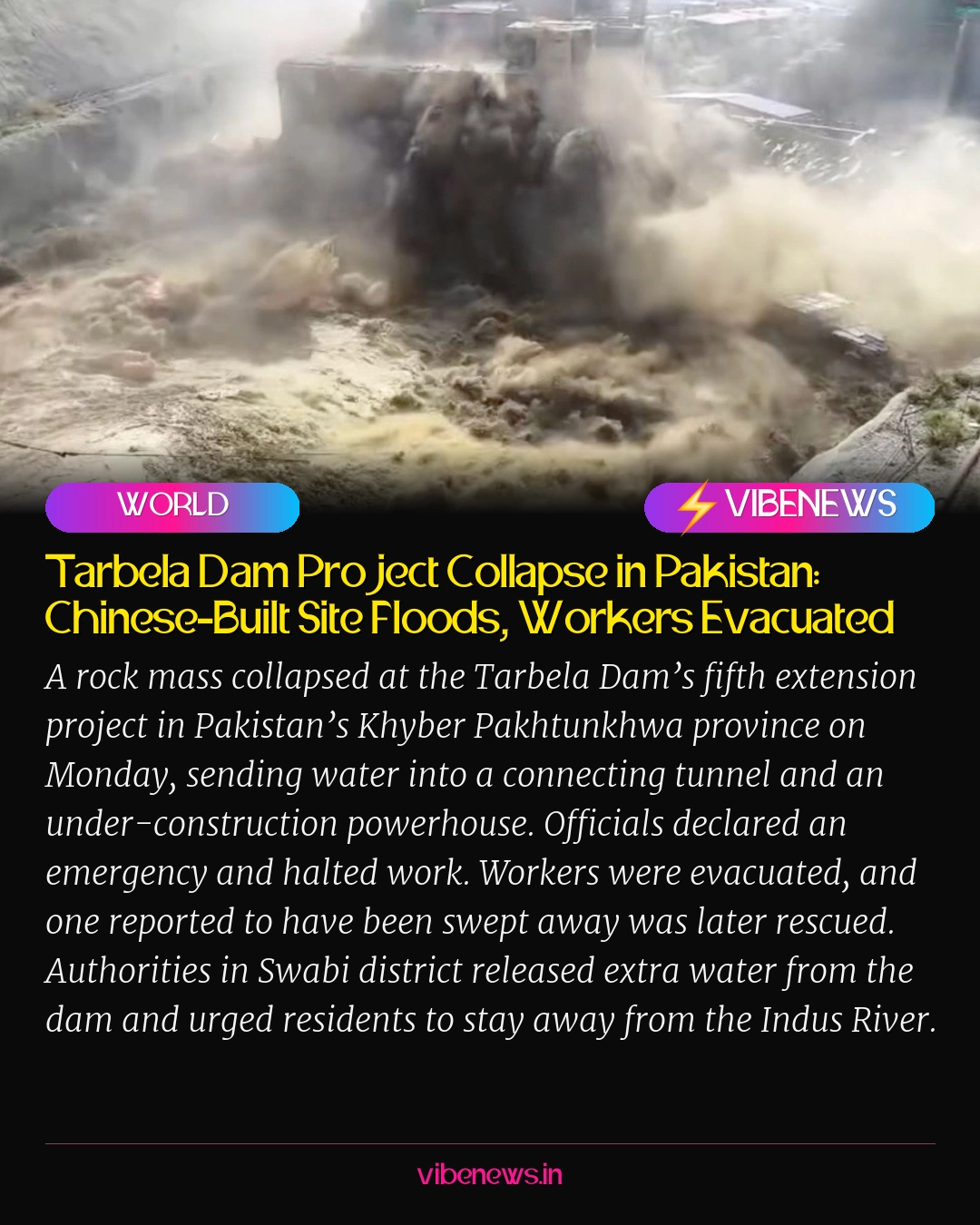
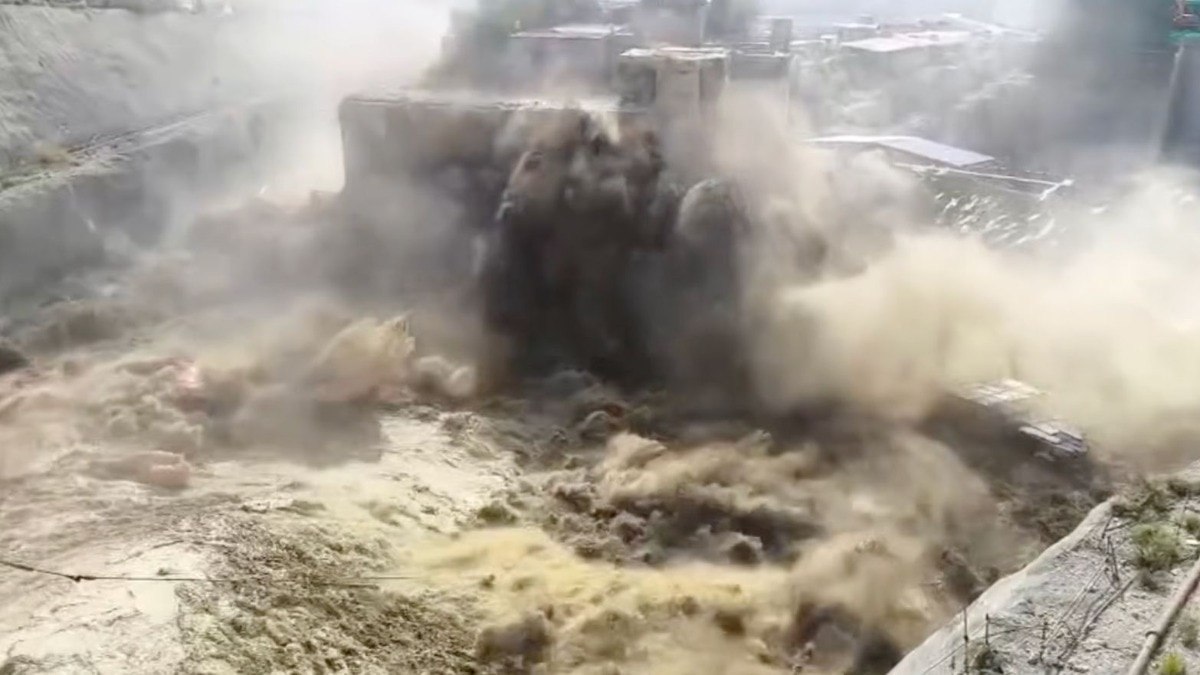
A rock mass collapsed at the fifth extension project of the Tarbela Dam in Pakistan’s Khyber Pakhtunkhwa province on Monday, pushing water into a connecting tunnel and an under-construction powerhouse area. The Water and Power Development Authority, known as WAPDA, has confirmed the incident. The project is being built by China’s Power Construction Corporation of China Limited, known as PCCCL.
According to WAPDA, weak rock gave way while crews were excavating the connecting tunnel. Water rushed in almost immediately. Authorities declared an emergency at the site and stopped construction work right away.
Reports say one worker was swept away in the flow. He was later rescued. WAPDA’s spokesperson has said that all workers were evacuated safely and that water has been drained from the intake pit. Social media posts shared on the day described a dramatic rush of water near the site, and at least one showed people running from the area.
The more alarming development came from downstream. Nasrullah Khan, the deputy commissioner of Swabi, said that extra water had been released from the dam for what he called mandatory reasons. That release could increase the flow and level of the Indus River. He told residents to stay completely away from the river and avoid bathing, swimming or taking out boats.
Residents should completely avoid bathing, swimming or boating in the Indus River.
That warning turns a construction accident into a public safety problem. Swabi sits downstream, and people living near the river have a direct stake in what happens next. Officials have not said how much the water level is expected to rise or how long the release will last, so the uncertainty is real.
A video published by Dawn, a Pakistani newspaper, shows a sudden surge of water after the section of the dam gave way. Crowds appear to scramble as the water spreads. The footage has been widely shared, and it explains why the collapse has grabbed attention well beyond Pakistan.
This is not the first setback for the project. In July, a cofferdam collapsed at the same site. Officials assigned responsibility for that failure to the contractor, the consultant and WAPDA. The fact that a second failure has now occurred within months raises obvious questions about oversight and construction quality, though no official has yet linked the two incidents in a formal finding.
The project has also grown far more expensive than first planned. Its cost has risen from 82 billion Pakistani rupees to 317 billion rupees, and the completion date is now set for June 2028. The World Bank and the Asian Infrastructure Investment Bank are providing funding for the dam.
The stakes of finishing the project are large. The fifth extension is a 1,530-megawatt hydropower project. Once complete, it would raise Tarbela’s total generating capacity from 4,888 megawatts to 6,418 megawatts. Pakistan depends heavily on power infrastructure like this, and any delay pushes back the gains that policymakers have promised.
Some social media accounts have suggested that the dam was built with more than one billion dollars in Chinese cooperation. Those claims have not been verified in the material available so far, and they should be treated as unconfirmed. What is confirmed is narrower but still serious: a rock collapse, a flooded tunnel, an evacuation, an emergency declaration and a downstream warning that asks people to keep their distance from a major river.
For now, the most urgent question is how much water will reach the Indus and how quickly. Residents in and around Swabi are being told to stay off the water. Engineers and officials will have to explain what caused the rock to give way and whether the rest of the project can be made safe. Until those answers arrive, the collapse stands as one of the most dramatic failures yet on a project that was supposed to strengthen Pakistan’s power supply.
TL;DR
- A rock mass collapsed at Pakistan’s Tarbela Dam fifth extension project in Khyber Pakhtunkhwa on Monday, flooding a connecting tunnel and powerhouse area.
- The dam is being built by China’s Power Construction Corporation of China Limited, and work has been halted under an emergency declaration.
- WAPDA says all workers were evacuated, and one worker reported swept away was later rescued.
- Swabi’s deputy commissioner released extra dam water and urged residents to avoid the Indus River.
- The 1,530-megawatt project has seen costs rise from 82 billion to 317 billion rupees, with completion now set for June 2028.