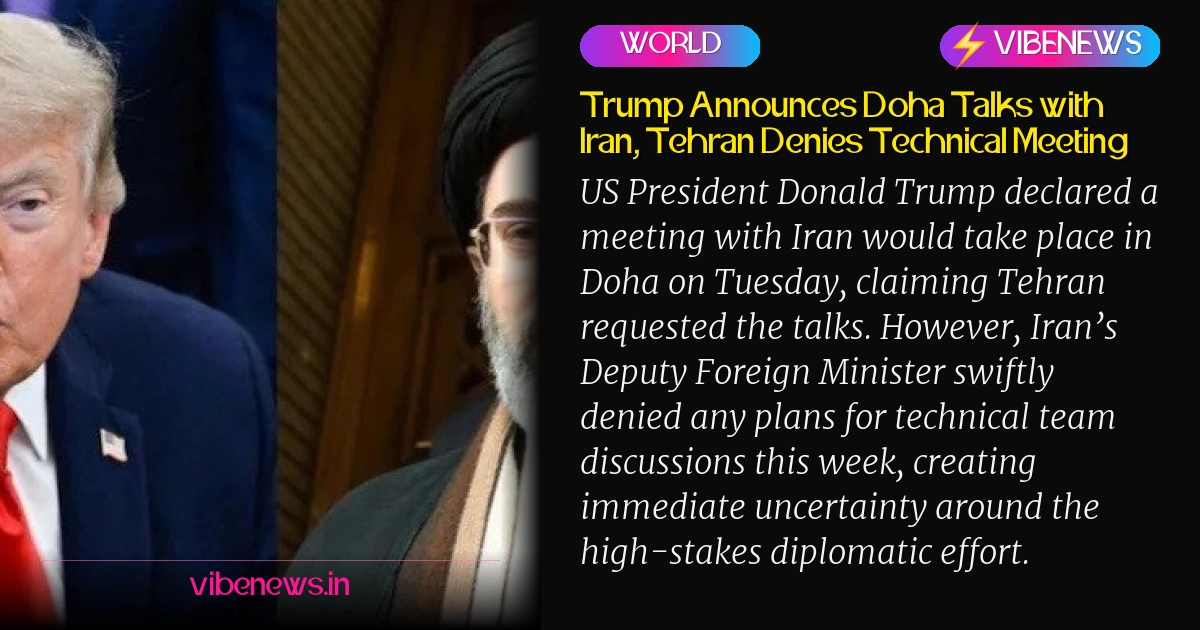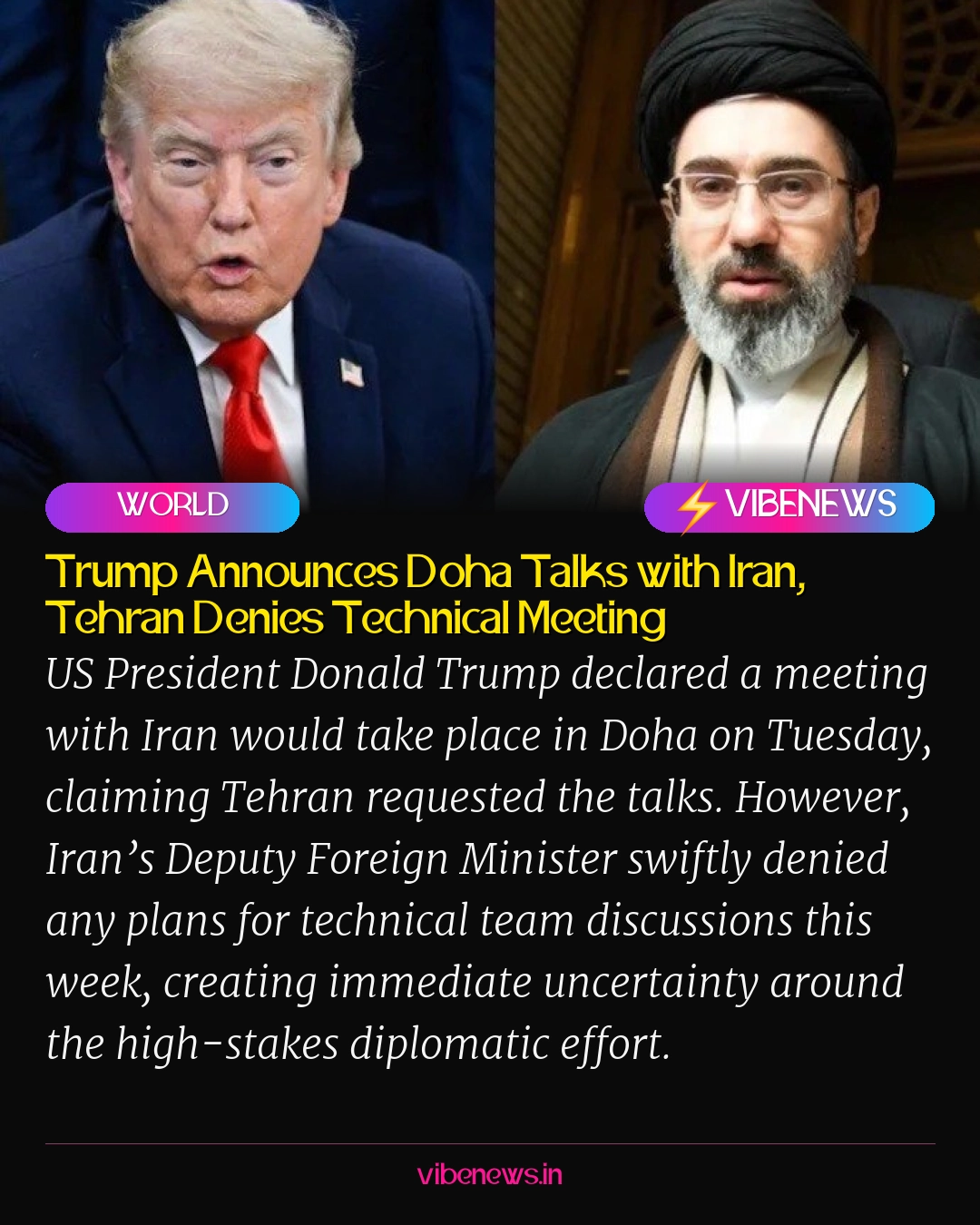
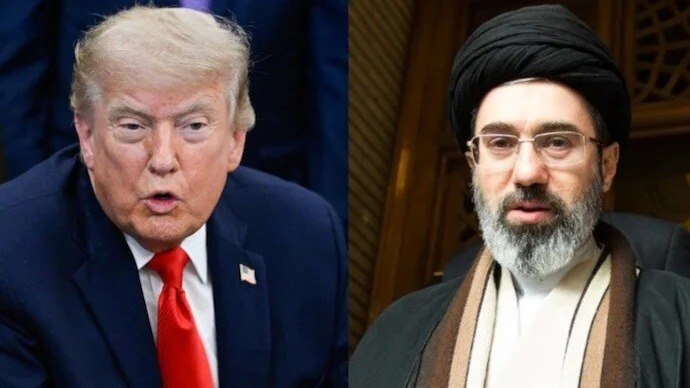
US President Donald Trump announced on Monday that a meeting with Iranian representatives would be held in Doha on Tuesday, June 30, 2026, stating that Iran had requested the discussions. The unexpected declaration, made via social media, quickly set the stage for a high-stakes diplomatic encounter aimed at de-escalating tensions between the two nations.
The White House later confirmed that US Special Envoy Steve Witkoff and Jared Kushner would attend the Doha meeting. It also indicated that technical talks would occur on the sidelines of these high-level discussions, signaling a multi-faceted approach to the complex relationship. Trump, in an interview with Fox News, expressed his desire for the peace process to unfold.
However, Iran’s Deputy Foreign Minister Kazem Gharibabadi promptly contradicted parts of the US narrative. Gharibabadi stated there were currently no plans for meetings between Iranian and US “technical teams” in Qatar this week. While acknowledging ongoing consultations with Qatar regarding commitments, he clarified that reports of working group technical talks in Doha could not be confirmed.
He further elaborated that the first round of technical talks within designated working groups would only proceed once specific conditions were met and an agreement on the date and location was finalized. Gharibabadi confirmed that consultations on this matter were continuing through intermediary countries, underscoring the delicate nature of the diplomatic back-channels.
This diplomatic flurry follows an earlier report by Axios, which indicated that both Washington and Tehran had agreed to suspend all ‘kinetic activity’ – a term referring to military operations – while technical negotiations continued over the critical Strait of Hormuz. This development emerged barely eleven days after an interim agreement was announced, intended to end months of conflict between the two adversaries.
The truce, however, was immediately thrown into doubt after both countries exchanged fresh strikes, stemming from competing interpretations of the initial deal. Senior US officials confirmed the agreement to halt military operations ahead of Tuesday’s proposed meeting, with one official telling Axios, "We decided to stop all the kinetic activity." Another official added that both sides would stand down "for now," allowing vessels to move freely while technical discussions progressed.
The Strait of Hormuz is a strategically vital waterway, connecting the Persian Gulf with the Arabian Sea and the open ocean. Approximately one-fifth of the world’s total oil consumption, and a significant portion of its liquefied natural gas, passes through this narrow choke point. Any disruption in the Strait has immediate and far-reaching implications for global energy markets and international trade, making its stability a paramount concern for world powers.
Initially, the broader negotiations over Iran’s nuclear program were planned for Switzerland. However, following the recent military exchanges over the weekend, diplomats shifted the venue to Doha and significantly narrowed the agenda. The focus for these new talks is now specifically on resolving disputes surrounding the Strait of Hormuz, highlighting the immediate need to address the recent military flare-ups rather than the more expansive nuclear issues.
The conflicting statements from Washington and Tehran introduce considerable uncertainty into the prospects for de-escalation. While the US asserts a meeting is imminent and requested by Iran, Tehran’s denial of specific technical talks suggests a potential disconnect or a strategic maneuver. The coming days will reveal whether these high-level discussions proceed as announced by the US, or if the Iranian stance on technical meetings holds, impacting the fragile truce and the stability of a crucial global shipping lane.
TL;DR
- US President Donald Trump announced a meeting with Iran in Doha on Tuesday, June 30, 2026, claiming Iran requested the talks.
- The White House confirmed US Special Envoy Steve Witkoff and Jared Kushner would attend, with technical talks also planned.
- Iran’s Deputy Foreign Minister Kazem Gharibabadi denied any plans for US-Iranian ‘technical team’ meetings in Qatar this week.
- Gharibabadi stated technical talks would only occur after conditions are met and a date/location agreed upon, confirming ongoing consultations through intermediaries.
- The proposed talks follow an agreement to suspend ‘kinetic activity’ (military operations) over the Strait of Hormuz, aimed at reviving a fragile truce.
- This truce was previously jeopardized by fresh military exchanges between the two nations over conflicting interpretations of an interim agreement.
- The meeting venue shifted from Switzerland, where broader nuclear talks were planned, to Doha, with the agenda narrowed to resolving disputes concerning the Strait of Hormuz.