The United Arab Emirates has initiated early-stage talks with India to procure the formidable BrahMos supersonic cruise missile and the sophisticated Akashteer air defence system. This strategic move by the Gulf nation aims to significantly enhance its defence capabilities in the wake of recent conflicts in the Middle East, particularly those involving Iran, Israel, and the United States.
Sources familiar with the ongoing discussions confirmed that the UAE has expressed keen interest in several Indian weapon platforms, with BrahMos and Akashteer at the forefront. These negotiations are progressing swiftly, reflecting a mutual desire to deepen defence cooperation between the two nations. Neither the Indian nor the UAE government has officially commented on these developments, but the intent to strengthen military ties is clear.
The UAE’s reassessment of its defence procurement strategy stems directly from facing missile and drone threats during the recent regional unrest. Securing vital waterways like the Strait of Hormuz, through which a substantial portion of its energy exports pass, has become a paramount concern for Abu Dhabi. This acquisition strategy is part of a broader effort to fortify its national security infrastructure against evolving aerial threats.
Diversifying its defence suppliers is a key component of the UAE’s strategy, aiming to achieve greater strategic autonomy. Earlier this year, the UAE signed a memorandum of understanding with South Korea, signaling its intent to expand defence cooperation beyond traditional partners, with agreements potentially exceeding USD 35 billion. Analysts suggest that closer defence ties with India offer the added benefit of not antagonizing the United States, given that both India and the UAE maintain strong alliances with Washington.
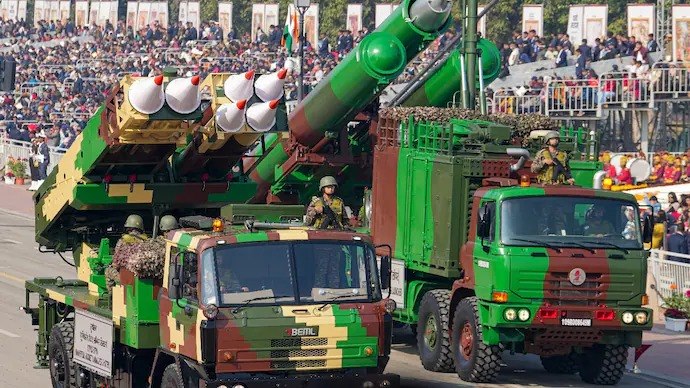
At the heart of these discussions are two of India’s most advanced defence systems. The BrahMos missile, a joint venture between India and Russia, stands as one of the world’s fastest operational supersonic cruise missiles. Capable of being launched from land, sea, and air platforms, it boasts an export range of approximately 290 kilometers. Any export of BrahMos would necessitate approval from Moscow, though sources indicate this is unlikely to pose a hurdle due to Russia’s close relationship with Abu Dhabi.
Complementing the offensive capabilities of BrahMos is Akashteer, an integrated air defence system developed by state-run Bharat Electronics Ltd in collaboration with the Indian Army. This fully automated command-and-control system is designed to process battlefield information from multiple sensors and weapon platforms, enabling faster detection and engagement of aerial threats. Defence experts believe Akashteer could significantly enhance coordination among the UAE’s existing advanced US-made defence systems, such as the THAAD and Patriot missile defence systems, by integrating surveillance and response mechanisms.
These defence discussions are unfolding amidst rapidly expanding strategic ties between India and the UAE. Over the past few years, the two countries have forged multiple agreements spanning trade, energy, investment, and defence manufacturing, including a pact focused on jointly developing military hardware. This robust framework provides a fertile ground for advanced defence sales.
New Delhi views these proposed defence sales as a critical component of its broader strategic objective to deepen its partnership with Abu Dhabi. This is particularly relevant in the context of wider regional geopolitical dynamics, including the competition between Riyadh and Abu Dhabi for regional leadership, and strengthened defence cooperation between Saudi Arabia and Pakistan. Pearl Pandya, an expert in armed conflict in South Asia, noted that expanded defence ties between India and the UAE serve as a form of strategic signaling, showcasing the strength and depth of their partnerships.
India’s defence exports have seen a significant acceleration in recent years, driven by the government’s push to expand indigenous defence manufacturing. While the UAE’s interest is a testament to the growing global appeal of Indian defence technology, it also underscores India’s strategic intent to become a more prominent player in the international arms market. This potential deal represents a significant step in solidifying India’s position as a reliable defence partner in a geopolitically crucial region.
Should these early-stage talks materialize into concrete agreements, it would mark a substantial upgrade to the UAE’s defensive posture and further cement the strategic alignment between India and the Gulf nation. The acquisition of such advanced systems would not only enhance the UAE’s ability to deter and respond to threats but also signal a new era of defence cooperation in the Middle East, with India playing an increasingly vital role.
TL;DR
- The UAE is in early-stage talks with India to acquire BrahMos supersonic cruise missiles and the Akashteer air defence system.
- This move is driven by the UAE’s need to bolster its defence capabilities following recent conflicts in the Middle East and to secure strategic waterways like the Strait of Hormuz.
- The acquisition aligns with the UAE’s strategy to diversify its defence suppliers and achieve greater strategic autonomy.
- BrahMos, jointly developed by India and Russia, is one of the world’s fastest operational supersonic cruise missiles, requiring Russian approval for export.
- Akashteer is an automated air defence command-and-control system developed by Bharat Electronics Ltd, designed to integrate with and enhance existing UAE defence assets.
- The potential defence sales reflect rapidly expanding strategic ties between India and the UAE, including existing agreements on trade, energy, and defence manufacturing.
- Experts view the expanded defence ties as a form of strategic signaling within regional geopolitical dynamics, particularly concerning competition for leadership in the Gulf.
- This deal would further solidify India’s growing role as a defence exporter and a strategic partner in the Middle East.