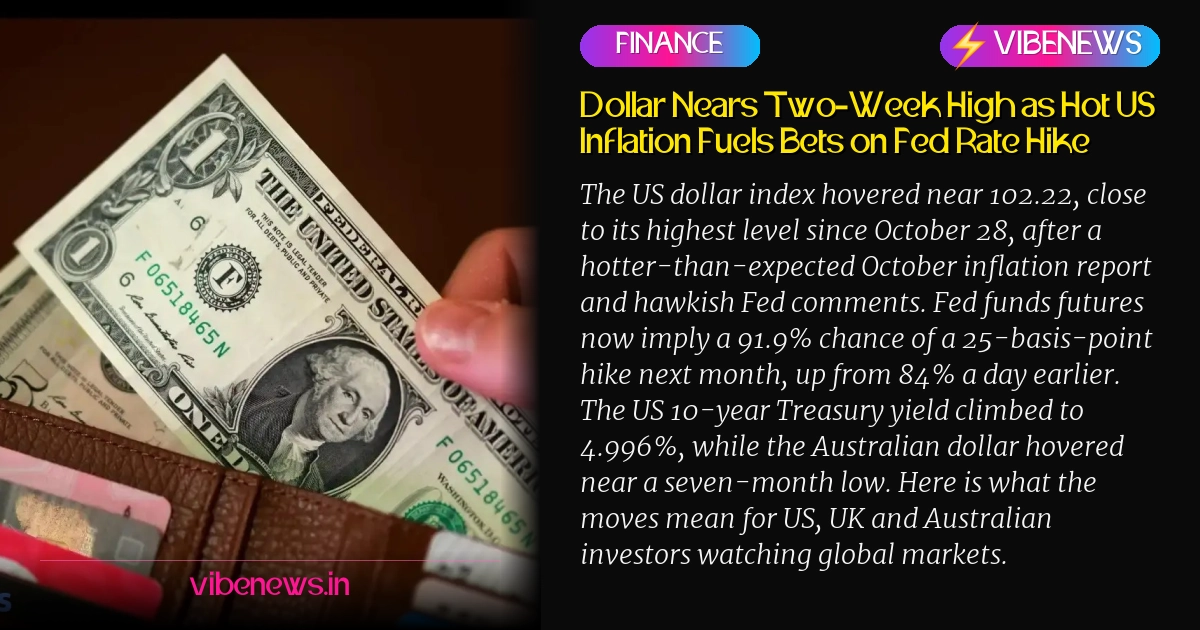
The US dollar held near a two-week high in early Asian trade on Wednesday, as a hotter-than-expected inflation report and hawkish comments from Federal Reserve officials pushed traders toward another interest rate hike next month.
The US dollar index, which measures the greenback against a basket of six currencies, was steady at 102.22. It was closing in on its highest level since October 28. The gauge had already risen 0.5% on Tuesday, after data showed US consumer prices increased by more than expected in October. Higher costs for food and accommodation drove much of the increase.
Traders read the data as a sign that the Fed may have more work to do. That reading has shifted the debate in bond and currency markets. As one strategist put it:
“The rates market isn’t simply pricing another hike,” said Chris Weston, head of research at Pepperstone Group Ltd in Melbourne. “It’s questioning how restrictive US monetary policy may ultimately need to become, and that’s a far more consequential debate for risk assets.”
Weston’s point goes to the core of the story. The question is no longer only whether the Fed will raise rates. Markets are now asking how far the central bank may need to go to bring inflation under control.
Comments from voting members of the Federal Reserve’s rate-setting committee signalled unease over high inflation. Those remarks firmed expectations for further rate increases. They also prompted traders to all but abandon bets that the central bank would stand pat at its next policy meeting, which concludes on December 9.
Pricing in the futures market tells the same story. Fed funds futures now imply a 91.9% chance of a 25-basis-point rate hike next month, up from 84% a day earlier, according to CME Group’s FedWatch tool. Markets have fully priced out the possibility of a pause. They also see a 9.1% chance of a larger 50-basis-point move. Traders are assigning better-than-even odds to a second hike in January.
For readers who do not follow central bank jargon, a basis point is one-hundredth of a percentage point. A 25-basis-point hike lifts the policy rate by a quarter of a percentage point. A 50-basis-point move would be double that step. The futures numbers are essentially a live price on what the Fed will do, and right now that price points firmly upward.
Central banks typically raise interest rates when prices rise faster than they want, because higher borrowing costs cool spending and hiring. That is the logic behind the current repricing. When inflation surprises to the upside, traders move quickly to bet on tighter policy, and the dollar tends to benefit.
Bond markets moved in the same direction. The yield on the US 10-year Treasury bond rose 13.8 basis points to 4.996%. Higher yields make borrowing more expensive across the economy and often draw investors toward the dollar, which is why currency and bond traders watch the Fed so closely.
Elsewhere in currency markets, the euro was flat at $1.1168. The British pound was also flat, at $1.3345. Against the Japanese yen, the US dollar was unchanged at 158.715 yen. The New Zealand dollar was flat at $0.5605.
For Australian investors, the picture is more mixed. The Australian dollar was up 0.1% at $0.6870, edging back from a seven-month low. That small bounce still leaves the local currency weak against the greenback. A firmer dollar makes overseas assets and dollar-priced goods more expensive for Australians, so the trend matters for anyone holding US shares or funds.
UK investors face a similar set of trade-offs. The pound held at $1.3345 while the dollar firmed. That means sterling-based investors holding US assets can see their returns shift when the currency moves, even if the underlying investments do not change.
Risk assets beyond traditional currencies also felt the pressure. Bitcoin was down 0.3% at $73,566.45, while ether was 0.5% lower at $2,044.61. Both cryptocurrencies were trading near three-month lows.
The next major checkpoint is the Fed’s December 9 policy meeting. Until then, traders will weigh every central bank speech and every inflation figure against their current bets on another hike. For investors in the US, UK and Australia, the direction of the dollar and Treasury yields will shape returns across stocks, bonds and currency-exposed holdings.
TL;DR
- The US dollar index sat near 102.22, close to its highest level since October 28.
- A hotter-than-expected October inflation report and hawkish Fed comments drove the move.
- Fed funds futures now imply a 91.9% chance of a 25-basis-point rate hike next month.
- Markets have fully priced out a pause ahead of the December 9 policy meeting.
- The US 10-year Treasury yield rose 13.8 basis points to 4.996%.
- The Australian dollar edged up to $0.6870, still near a seven-month low.