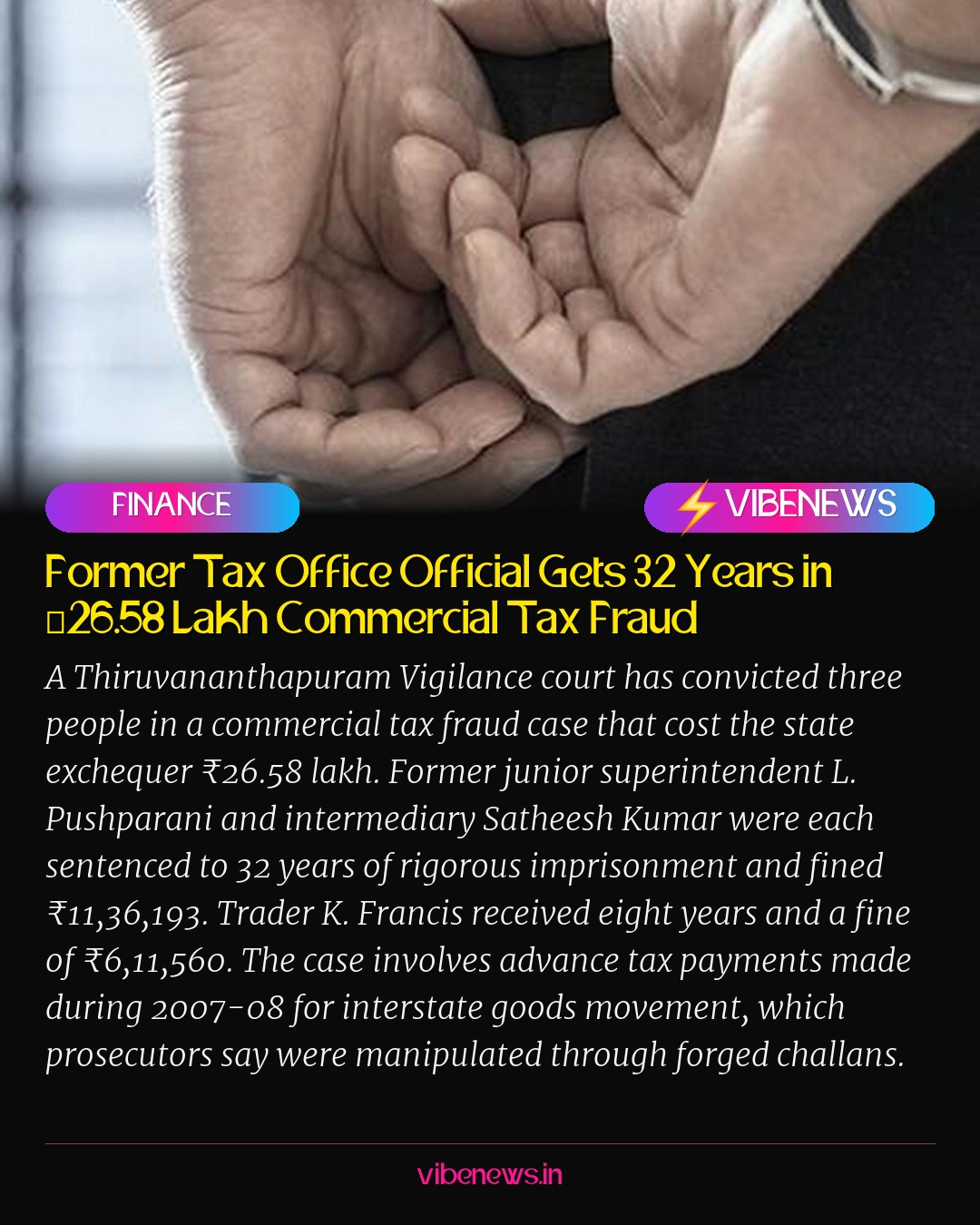

A Vigilance court in Thiruvananthapuram has sentenced three people in a commercial tax fraud case that drained ₹26.58 lakh from the state treasury. The verdict came on Tuesday, November 10, 2026, when Enquiry Commissioner and Special Judge (Vigilance) Manoj A. pronounced sentence.
Former junior superintendent L. Pushparani, 58, and Satheesh Kumar, 47, each received 32 years of rigorous imprisonment and a fine of ₹11,36,193. Trader K. Francis, 66, was sentenced to eight years of rigorous imprisonment and fined ₹6,11,560.
How the scheme allegedly worked
The case goes back to 2007-08, when traders engaged in interstate commerce were required to pay advance tax on the goods they moved across state lines. According to the Vigilance and Anti-Corruption Bureau (VACB), some of those payments were never properly recorded. The accused allegedly conspired to use forged challans, the payment slips that show money has been deposited into the government treasury. On those forged slips, the amounts were written higher than what had actually been paid in, and the entries were duplicated and triplicated across copies.
Put simply, the paperwork claimed more tax had been paid than actually reached the Treasury. That gap is where the money went missing, and it is the core of what the court found.
The role of the officer
Pushparani was responsible for verifying and confirming the tax amounts that traders remitted to the Treasury. That job made her the check on whether the numbers matched the money. The VACB alleges she facilitated the irregularities, which means the safeguard meant to catch this kind of manipulation was allegedly the very point where it happened.
Satheesh Kumar is described as an intermediary who allegedly worked between traders and officials. Investigators say his role connected the businesses that wanted to reduce their tax bills with the people inside the office who could make the paperwork look right.
The businesses that benefited
The Vigilance alleged that the manipulated challans allowed four business establishments to evade tax. The total loss to the government came to ₹26,58,595. Francis, the trader, was among those convicted, and the court’s sentence against him is considerably shorter than the terms handed to the two others.
The sentencing details matter here. Pushparani and Kumar each face 32 years, while Francis faces eight. The court’s breakdown suggests the roles of the three were judged differently, though the source material does not explain the reasoning behind each term.
Who built the case
The Thiruvananthapuram Special Investigation Unit-I of the VACB registered the case and filed the chargesheet after completing its investigation. That chargesheet set the stage for the trial that ended with Tuesday’s verdict. The case shows how a long-running financial irregularity from 2007-08 can still end in a courtroom almost two decades later.
The office where Pushparani worked, the Commercial Taxes Office in Neyyattinkara, sits in Thiruvananthapuram district. The verdict is a reminder that tax officials and private intermediaries can both face criminal consequences when public revenue is allegedly manipulated.
Why the amount still matters
A loss of ₹26.58 lakh is not the largest fraud the state has seen. Still, the case stands out for the method. Forged challans produce paperwork that looks official on the surface, and that is exactly what makes them hard to spot in routine checks. The VACB’s account suggests the scheme depended on someone inside the system confirming figures that were never actually paid.
For the state exchequer, the outcome is a conviction and a set of fines, which the court has imposed on each of the three accused. The source material does not say whether the money lost in the case has been recovered, so readers should not assume any repayment has taken place.
What the court has and has not said
The verdict confirms that the court found the three guilty of the charges brought by the VACB. The allegations about forged challans and the manipulation of duplicate and triplicate copies were central to the prosecution’s case. The sentences are the court’s decision, and any further appeal or legal step is not described in the material available.
The VACB’s version of events came from its investigation and chargesheet. Those are the official findings of the prosecuting agency, and the convictions now give them legal weight.
The case also makes clear that the people involved were not strangers to the tax system. One was a senior officer responsible for verification, one was a middleman who knew both sides, and one was a trader who benefited from the arrangement. Each role was necessary for the scheme to work, according to the prosecution.
Tuesday’s sentencing closes a chapter that began with tax payments made nearly two decades ago. For the people of Thiruvananthapuram and the wider state, it puts a number and a name on a fraud that allegedly cost public money at the point where public money was supposed to be protected.
TL;DR
- Three people, including a former tax office junior superintendent, were convicted by a Thiruvananthapuram Vigilance court on Tuesday.
- The fraud allegedly cost the state exchequer ₹26,58,595 through manipulated advance tax payments.
- Pushparani and Satheesh Kumar each received 32 years of rigorous imprisonment and fines of ₹11,36,193.
- Trader K. Francis was sentenced to eight years of rigorous imprisonment and fined ₹6,11,560.
- The accused allegedly used forged challans showing amounts higher than what was actually paid into the Treasury.
- The Vigilance and Anti-Corruption Bureau registered the case and filed the chargesheet.