El Niño is persisting at an extraordinary intensity, and experts now say the weather pattern could stay in place until May or June 2027. Pacific Ocean temperatures have crossed a major threshold, and the effects are already reaching farms, water supplies and household budgets across the world, including India.
The alarm centres on the equatorial Pacific. Data from the United States National Oceanic and Atmospheric Administration showed sea surface temperatures in the equatorial Pacific reached 30 degrees Celsius on October 22 of this year. No earlier reading had ever reached that level. Scientists are treating this as a turning point because the heat is still building, and its effects are expected to carry into next year.
From weak warning to something far bigger
Only a few months ago, the event was described as a standard El Niño. It then intensified into a super El Niño and later into what some reports call a Godzilla El Niño. Weather agencies had projected last month that the event would peak around February before weakening. That forecast now looks too optimistic. Rising Pacific temperatures and the influence of climate change could extend El Niño’s grip, experts warn.
The World Meteorological Organization has cautioned that temperatures in the central and eastern tropical Pacific could hit record levels between October and December. That warning matters because heat in those waters feeds directly into weather patterns far from the ocean itself.
How long it could last
Dr J Rajeshwar, head of the Environment Protection Training and Research Institute, said the current El Niño conditions could continue until March or April next year. If temperatures keep climbing at this pace, he said, the event could stretch as far as June. Officials at the Indian National Centre for Ocean Information Services said conditions in the central Pacific are strengthening and are likely to remain steady until May or June 2027.
Experts have also said that once El Niño weakens, its next direction cannot yet be predicted with confidence. What they do expect is that 2027 could rank among the hottest years on record.
The global economic warning
The United Nations has warned that a powerful El Niño could shake economies in Latin America, Africa and across Asia, including India. The message from the UN was blunt: governments and communities need to prepare now rather than react later.
Economies across Latin America, Africa, India and other Asian nations could be shaken, and everyone must be ready for it.
For agriculture, that warning lands hard. Crop cycles, irrigation planning, food prices and rural incomes all depend on predictable rain. When the ocean heats this sharply, those predictions break down, and the costs travel from farm gates to supermarket shelves.
India’s monsoon has already faltered
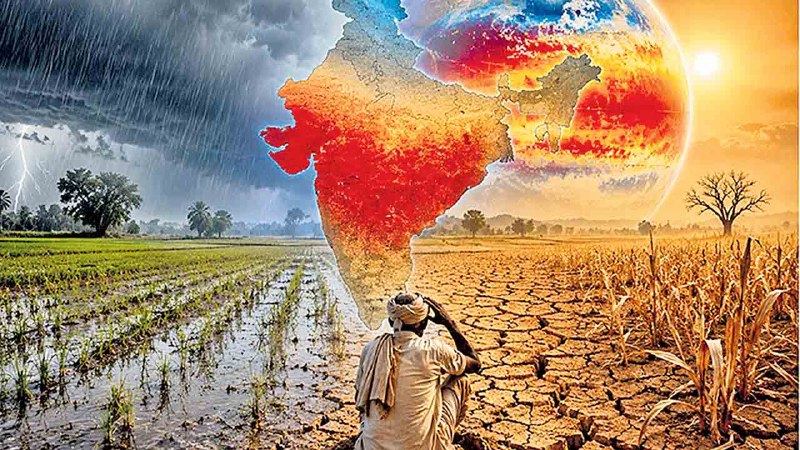
The southwest monsoon has failed to deliver in a way not seen in the past decade. Rainfall across the country is 13 percent below normal. In 44 percent of India’s districts, the shortfall is even more severe. Experts link these conditions directly to El Niño.
What it means for Andhra Pradesh and Telangana
For Andhra Pradesh and Telangana, the stakes are immediate. Drought signs have already appeared in both states, along with Karnataka, Rajasthan and Maharashtra. Experts warn that conditions could deteriorate further in the coming days, which puts pressure on farmers preparing for the next season and on districts already short of water.
Europe is feeling the heat too
The stress is not limited to Asia. The source report describes record daytime heat across several regions and says thousands of elderly people in Europe have died during the latest heat wave. Those reports underline how quickly a single climate system can strike multiple continents at once.
What comes next
The most important number in this story is not the temperature alone. It is the time frame. A weather event that began as a warning now has a credible path into mid-2027, which means farmers, governments and households may be planning for a crisis that has not yet peaked. Watch the next monsoon updates, drought declarations and food price movements closely, because the effects are likely to deepen before they ease.
TL;DR
- El Niño could persist until May or June 2027, with equatorial Pacific sea temperatures reaching a record 30°C on October 22.
- India’s southwest monsoon is 13 percent below normal, and 44 percent of districts face even steeper rainfall deficits.
- The UN has warned that economies in Latin America, Africa and Asia, including India, could be shaken by the event.
- Drought signs are already visible in Telangana, Andhra Pradesh, Karnataka, Rajasthan and Maharashtra.
- WMO warns record temperatures could hit the central and eastern tropical Pacific between October and December.
- Experts say 2027 could rank among the hottest years on record, with agriculture facing the greatest pressure.