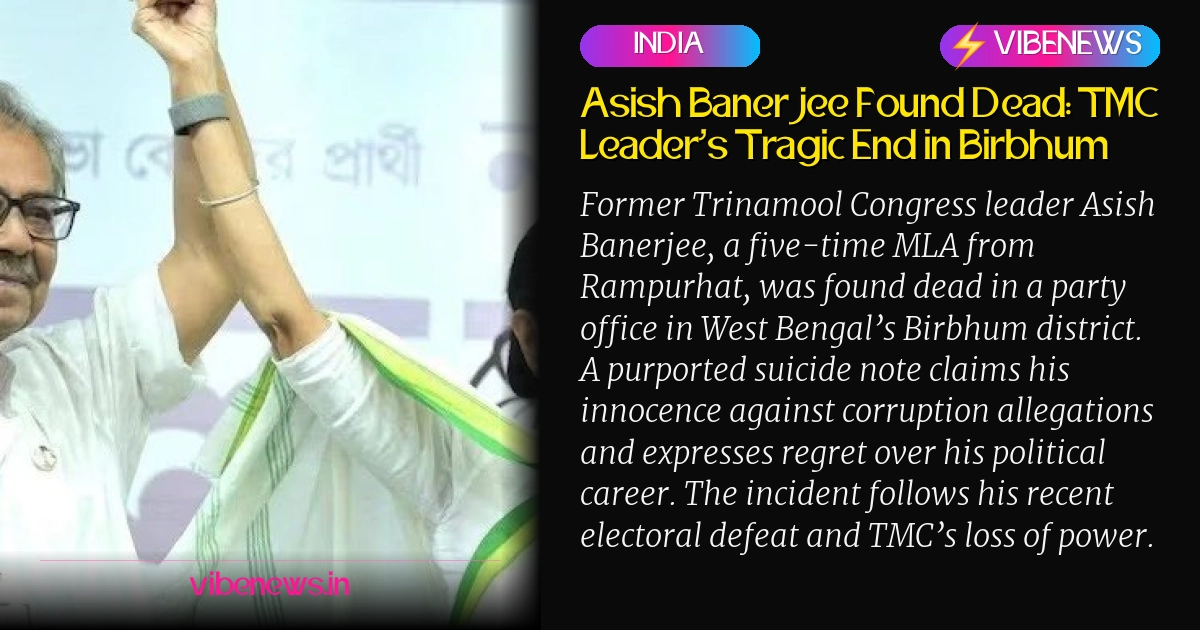

Asish Banerjee, a prominent figure in West Bengal politics and a former Deputy Speaker of the state Assembly, was discovered deceased inside a Trinamool Congress (TMC) party office in Birbhum district on Sunday morning. The veteran leader, who had represented the Rampurhat constituency for a quarter-century, was found hanging, prompting immediate police investigation into the circumstances of his untimely demise.
The discovery was made at a TMC office situated adjacent to Banerjee’s residence in Rampurhat. Authorities quickly secured the scene, and a purported suicide note, penned in Bengali, was recovered. This note, central to the ongoing inquiry, reportedly contained Banerjee’s emphatic denial of any involvement in corruption throughout his extensive political career.
In the letter, he specifically addressed alleged wrongdoings linked to the Tarapith Rampurhat Development Authority (TRDA), an entity where he had previously served as chairperson. Banerjee asserted that he held no role in critical operational aspects such as tender-related decisions, cheque issuance, plan approvals, or the granting of no-objection certificates, suggesting he was being unfairly targeted.
A Life in Politics
Asish Banerjee’s political journey was marked by significant electoral success and influence. He was a five-time Member of Legislative Assembly (MLA) from Rampurhat, consistently winning the seat from 2001 until 2026. His tenure spanned 25 consecutive years, during which he also served as a minister and later as the Deputy Speaker of the West Bengal Assembly, cementing his status as a seasoned political operative.
However, his long-standing political dominance came to an abrupt end in the recent 2026 West Bengal Assembly polls, where he lost his Rampurhat seat to Dhruba Saha of the Bharatiya Janata Party (BJP). This defeat was a personal setback and mirrored a larger political upheaval in the state, which saw the TMC lose power after 15 years of governance.
The Purported Suicide Note’s Contents
Beyond denying corruption, the purported suicide note offered a glimpse into Banerjee’s state of mind. He reportedly expressed a profound sense of being "maligned" and conveyed a regret that he had ever entered politics. This sentiment suggests a deep disillusionment with the political landscape and the personal toll it had taken on him.
Furthermore, the note allegedly revealed an internal struggle within the party. Banerjee wrote that while he often found himself unable to accept "wrongdoings" within the Trinamool Congress, he felt powerless to protest against them. This particular admission hints at potential internal conflicts or pressures that may have contributed to his distress, painting a complex picture of his final days.
The note concluded with a statement absolving others of responsibility for his death, a common element in suicide notes, yet one that doesn’t diminish the gravity of the circumstances or the questions it raises about the pressures faced by public figures.
The Shifting Political Landscape of West Bengal
Banerjee’s death unfolds against a backdrop of significant political transformation in West Bengal. The 2026 Assembly elections marked a historic shift, with the BJP successfully unseating the Trinamool Congress, which had held power for a decade and a half. This change in government has ushered in an era of heightened scrutiny for former TMC leaders and legislators.
In the months following the electoral defeat, several prominent figures associated with the erstwhile ruling party have faced corruption-related investigations and subsequent arrests. This climate of intense legal and political pressure has undoubtedly created an atmosphere of uncertainty and vulnerability for many who were once at the helm of state affairs, including individuals like Asish Banerjee.
Investigation and Local Response
The Birbhum district police have initiated a thorough investigation to ascertain the exact circumstances leading to Banerjee’s death. While the presence of a suicide note strongly suggests self-harm, investigators are meticulously examining all angles to confirm this and to understand the precise triggers that led to such an extreme step. The body has been sent for postmortem examination, the results of which are awaited to provide further clarity.
Local residents and party workers in Rampurhat expressed shock and grief over the sudden demise of a leader who had served them for so long. Many remembered his participation in local Independence Day celebrations just a day prior, where he had hoisted the Tricolour, making his sudden death even more perplexing and tragic for the community.
Editorial Context
The tragic death of Asish Banerjee transcends a mere news report; it serves as a stark reminder of the immense pressures inherent in public life, particularly within the volatile landscape of Indian politics. His purported suicide note, with its claims of innocence against corruption and expressions of disillusionment, casts a somber light on the personal toll that political scrutiny and electoral defeat can exact.
This incident is likely to resonate deeply within West Bengal’s political circles, potentially fueling further debate on the ethics of political discourse, the nature of corruption allegations, and the mental well-being of public servants. It underscores the fragility of political careers, where decades of service can be overshadowed by a single electoral loss or the shadow of unproven accusations.
Moreover, Banerjee’s reference to an inability to protest "wrongdoings" within his own party highlights the complex internal dynamics and power structures that often govern political organizations. This aspect could prompt introspection within the Trinamool Congress and other parties regarding internal dissent, accountability, and the support mechanisms available to their members.
In the long term, this event may contribute to a broader conversation about the need for greater transparency in political funding and development authorities like TRDA, as well as the importance of due process in investigations. It also brings to the forefront the human cost of political transitions and the intense public and media scrutiny that accompanies shifts in power, leaving an indelible mark on the state’s political narrative.
TL;DR
- Former Trinamool Congress leader Asish Banerjee was found dead in a party office in West Bengal’s Birbhum district.
- A purported suicide note recovered from the scene claimed his innocence against corruption allegations.
- Banerjee, a five-time MLA from Rampurhat, had recently lost his seat in the 2026 West Bengal Assembly polls.
- The note reportedly expressed disillusionment with politics and an inability to protest perceived wrongdoings within his party.
- His death occurs amidst a significant political shift in West Bengal, with TMC losing power and several former leaders facing corruption investigations.
- Police have launched an investigation into the exact circumstances surrounding his death, and his body has been sent for postmortem.