-
Nepal’s Catastrophe: A Dire Warning for the Indian Himalayas
-
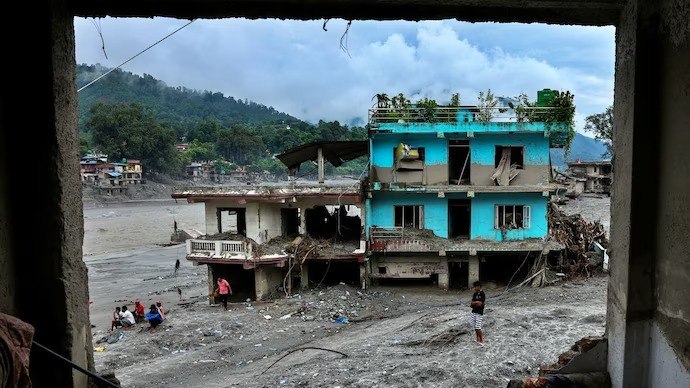
On August 26, 2026, a colossal wall of ice, rock, and debris detached near the Nepal-Tibet border, initiating a devastating chain reaction that transformed the remote Himalayan landscape. The avalanche slammed into the Bhote Koshi river system, unleashing a violent surge downstream that obliterated bridges, cut off roads, and swallowed buildings in mud and boulders. The commercial heart of Betrawati was buried, and critical power infrastructure was severely damaged.
-
https://twitter.com/Benarasiyaa/status/1828000000000000000
-
Perhaps the most unsettling discovery post-flood was the formation of a new lake at the catastrophe’s source. High in the Lhende Khola region, water began accumulating behind the debris, covering approximately 20.25 hectares, raising fears of another potential outburst in an already ravaged river system.
-
India’s Vulnerability: A Shared Mountainous Fate
-
The images from Nepal carry an uncomfortable message for India: the Himalayas transcend political boundaries. The same unstable slopes, retreating glaciers, and rapidly changing high-altitude lakes that triggered concern in Nepal extend across the Indian Himalayas, from Himachal Pradesh to Sikkim and Arunachal Pradesh. Scientists caution against predicting an exact repeat, as each mountain and river valley possesses unique geology and triggers. However, research from the Indian Himalayas reveals increasingly undeniable warning signs.
-
The concern extends beyond a single glacial lake outburst. The greater fear lies in a sequence of failures within an already fragile Himalayan landscape: a glacier collapse, an avalanche crashing into a lake, a landslide blocking a river, extreme rain destabilizing a slope, culminating in millions of tonnes of water and debris finding a path downhill. In the narrow, heavily populated valleys of the Himalayas, such a cascade could leave very little time for escape.
-
Scientific Assessment and Downstream Risk
-
Professor Dericks Praise Shukla of IIT Mandi leads a team assessing the danger in Himachal Pradesh. Their research identified roughly 2,000 lakes, comparing their extent between 2015 and 2025 and classifying them by their connection to glaciers. Lakes continuously fed by melting glaciers are particularly significant. Crucially, a growing lake does not automatically signal impending disaster. The material forming the natural barrier—whether solid bedrock, moraine dams, or loose debris—and its dimensions are critical factors in assessing vulnerability.
-
-
“Disaster risk exists only when exposed elements are present in the path of a hazard,” the analysis shared by Suhora Technologies noted.
-
-
This distinction is vital. While a lake like Samudra Tapu in Himachal Pradesh is large, expanding, and connected to the Tapu Glacier, its overall downstream risk is considered relatively lower due to the distance from settlements and a comparatively gentle river slope. Conversely, a smaller event in a densely populated valley with extensive infrastructure can escalate into a major catastrophe. Union Home Secretary Govind Mohan has reviewed the preparedness of Himalayan states and Union Territories against such risks, emphasizing concrete actions at local levels. India has already witnessed devastating cascades, including the 2021 Chamoli disaster and the 2023 South Lhonak Lake outburst in Sikkim.
-
The Path Forward: Monitoring and Modelling
-
Predicting the exact moment of a slope collapse or natural dam failure remains extraordinarily difficult. For Himachal Pradesh, Professor Shukla highlights hydrodynamic modelling as the next major scientific step. This involves estimating flood depth, lateral spread, and the travel path of a flood wave, though accurate modelling is hampered by uncertainties in estimating lake volume from satellite-derived area alone. Research on lakes like Gepang Gath in Himachal Pradesh suggests potential impacts on downstream areas, including settlements around Sissu.
-
The warning signs are not confined to Himachal Pradesh. An assessment by Suhora Technologies in Arunachal Pradesh’s Tawang district found that four of five potentially dangerous glacial lakes in the Mago Chu Basin expanded between 2016 and 2026. Sanhapo Lake, with its area increasing from 55.87 hectares in 2016 to 88.81 hectares by June 2026, stands out as a priority for detailed hazard modelling and continuous monitoring.
-
https://twitter.com/BNODesk/status/1828000000000000000
-
Professor Shukla emphasizes that the way forward is not to predict the impossible, but to build a robust system for early danger detection. This involves a two-tier approach: broad synoptic monitoring from space to identify hotspots, followed by targeted deployment of ground sensors and warning systems at critical locations. Nepal’s tragedy serves as a powerful reminder that mountain disasters can begin unseen, high above valleys where communities below may have no idea what is coming. The Indian Himalayas are sending signals, urging proactive study and preparedness before the mountains begin to move.
On August 26, 2026, an ice-rock avalanche near the Nepal-Tibet border caused a massive flash flood in the Bhote Koshi river system, destroying infrastructure.Satellite imagery revealed a new 20.25-hectare lake formed at the disaster’s source, raising fears of further outbursts.The event serves as a critical warning for the Indian Himalayas, where similar conditions like retreating glaciers and expanding lakes exist across Himachal Pradesh, Sikkim, and Arunachal Pradesh.IIT Mandi research identified nine highly critical and potentially dangerous glacial lakes in Himachal Pradesh, emphasizing that disaster risk depends on downstream exposed elements.Union Home Secretary Govind Mohan reviewed preparedness, acknowledging past Indian disasters like the 2021 Chamoli event.Scientists advocate for a two-tier monitoring approach: broad satellite scanning for hotspots followed by focused on-ground sensors and hydrodynamic modelling.