US Accusations of Tariff Evasion
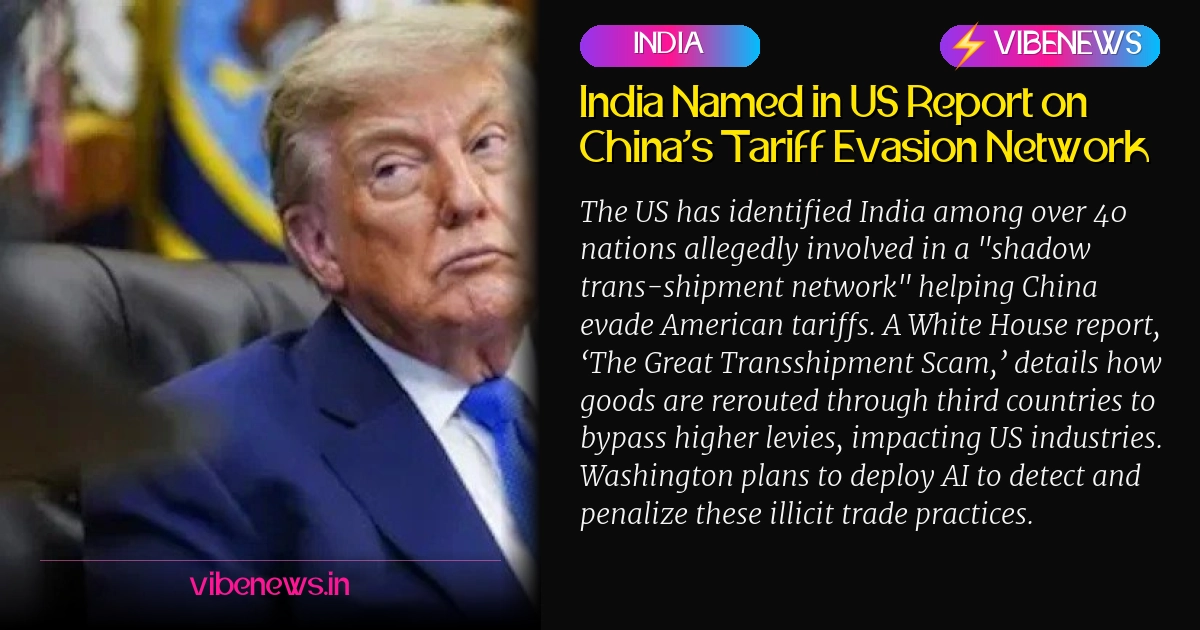
The United States, under the Donald Trump administration, identified India as one of over 40 trading partners potentially aiding China in evading American tariffs. These nations are alleged to be part of a "shadow trans-shipment network" designed to circumvent higher levies imposed by Washington on Chinese goods. The White House report, titled ‘The Great Transshipment Scam,’ highlighted a long-standing concern regarding "illegal transshipment," where products are routed through a third country with lower US tariffs to avoid the intended duties.
This comprehensive report, spearheaded by Peter Navarro, then-top trade advisor to President Trump, detailed how such practices became more prevalent following the imposition of Section 301 tariffs on China in 2018. These tariffs were a direct response to what the US deemed "unfair trade practices" by Beijing. Navarro asserted that for years, this "great transshipment scam" allowed China to "launder its exports" through numerous countries, creating a facade of different national origins for goods that were fundamentally Chinese.
The Mechanics of Rerouting
The report elaborated on the methods employed in this alleged network. China and its state-supported manufacturers would route goods through jurisdictions offering cheap labor, lax customs oversight, permissive free zones, or preferential US trade access. In these intermediary countries, goods would undergo minor processing, relabeling, repackaging, reinvoicing, or simple routing changes. These superficial alterations were sufficient to create the appearance of a new national origin, while the core Chinese content remained largely unchanged.
The document categorized the implicated economies into several groups. Some exhibited trans-shipment risk embedded within broad, legitimate trade flows. Others were found to be more deeply integrated with China-linked supply chains. A third category comprised nations with advantages like preferential US market access, making them attractive targets for opportunistic rerouting schemes.
India’s Specific Mention
India received a specific mention in the White House report, with the Pune–Gujarat–Chennai production belt identified as a region absorbing Chinese pumps and compressors. This alleged activity was cited as directly impacting industrial supply chains and manufacturing jobs in US cities such as Cincinnati, Dayton, and Columbus. The report underscored the direct economic consequence, stating that "A Chinese pump that leaves Pune as Indian is a pump not machined in Cincinnati, Dayton or Columbus."
This particular focus on India’s industrial corridors highlights the perceived sophistication of the trans-shipment operations. The regions mentioned are significant manufacturing and port hubs, suggesting a well-established infrastructure capable of handling large volumes of goods and facilitating complex logistical maneuvers. The accusation implies that India’s industrial capacity and trade routes were being leveraged to mask the true origin of products, thereby undermining US tariff policies.
The Economic Stakes and US Response
The economic scale of this alleged illicit trade is substantial. The report estimated the annual value of illegally trans-shipped goods to be anywhere from approximately USD 40 billion to USD 303 billion, a wide range reflecting different methodologies and definitions used in the assessment. Such figures underscore the significant financial impact on US industries and the potential loss of tariff revenue.
In response to these findings, the White House announced plans to combat the evasion using advanced technology. It revealed a collaboration with US Customs and Border Protection to develop an AI-enabled "detective border" system. This innovative system is designed to leverage vast amounts of information, including shipment data, routing histories, and other analytical tools, to detect and penalize trans-shipped goods more effectively. The deployment of AI signifies a new frontier in customs enforcement, aiming to outmaneuver increasingly complex evasion tactics.
Historical Context of Trade Tensions
The allegations of trans-shipment are deeply rooted in the broader context of the US-China trade war, which escalated significantly during the Trump presidency. The Section 301 tariffs, first imposed in 2018, targeted a wide array of Chinese imports with the stated goal of addressing intellectual property theft, forced technology transfers, and other perceived unfair trade practices. These tariffs fundamentally altered global supply chains, prompting many businesses to seek alternatives to direct sourcing from China.
Economists have observed a notable diversification of supply chains away from China since the onset of the trade war. While some countries, like Vietnam, genuinely benefited from this shift as companies relocated manufacturing or increased their sourcing from these nations, the report suggests that others may have inadvertently or intentionally become conduits for tariff evasion. This complex interplay of legitimate supply chain adjustments and illicit rerouting presents a significant challenge for global trade regulators.
Editorial Context: Long-Term Implications for Global Trade
The US accusation against India and other nations regarding tariff evasion carries significant long-term implications for international trade relations and the integrity of global supply chains. Firstly, it highlights the persistent challenges in enforcing trade policies in an interconnected world, where goods can be easily rerouted and re-labeled. The estimated multi-billion dollar scale of this alleged evasion underscores the economic stakes for nations attempting to protect domestic industries and enforce fair trade practices.
Secondly, the deployment of AI in customs enforcement signals a technological arms race in trade compliance. While promising greater efficiency in detection, it also raises questions about data privacy, algorithmic bias, and the potential for increased friction at borders. For countries like India, being named in such a report could prompt closer scrutiny of their trade practices and supply chain transparency, potentially influencing future trade agreements and investment flows. This development underscores the need for robust internal customs mechanisms and a clear stance on international trade norms to avoid being caught in the crossfire of major economic powers.
TL;DR
- The US accused India and over 40 other nations of facilitating China’s tariff evasion through a "shadow trans-shipment network."
- The White House report, ‘The Great Transshipment Scam,’ highlighted how goods are rerouted via third countries to avoid higher US tariffs on Chinese products.
- India’s Pune-Gujarat-Chennai industrial belt was specifically mentioned for absorbing Chinese pumps and compressors, impacting US manufacturing.
- The annual value of illegally trans-shipped goods is estimated between $40 billion and $303 billion.
- The Trump administration initiated Section 301 tariffs in 2018, leading to increased trans-shipment activities.
- The US plans to deploy an AI-enabled "detective border" system to identify and penalize such illicit trade practices.