Kerala Chief Minister Challenges Grand Mufti’s Stance on Women’s Public Role
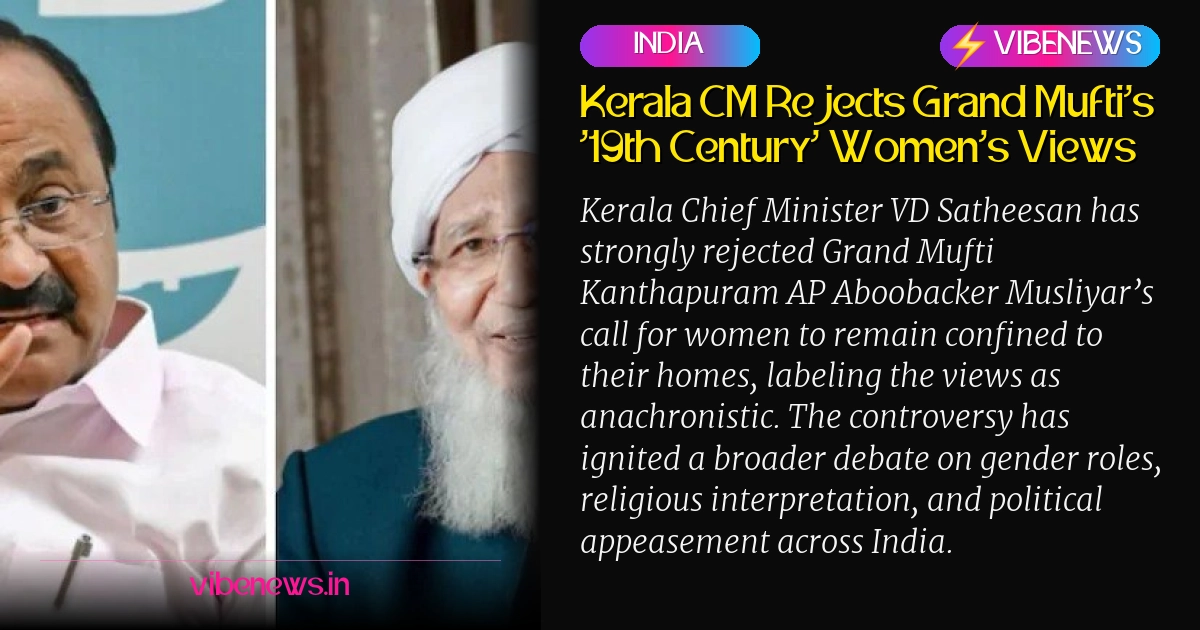
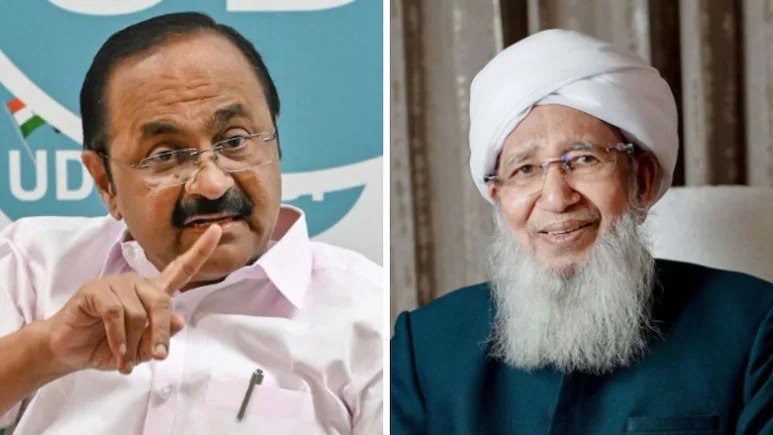
Kerala Chief Minister VD Satheesan has unequivocally rejected the recent pronouncements by Grand Mufti Kanthapuram AP Aboobacker Musliyar, who advocated for women to remain confined within their homes. Satheesan described the cleric’s views as anachronistic, belonging to the 19th century rather than the progressive ethos of contemporary society.
The Chief Minister asserted that neither his government nor his political party would endorse such a regressive stance. He firmly stated that the idea of women causing "great ruin" by entering the public sphere, or the notion that the Quran mandates women’s submissiveness, is entirely unacceptable.
The Cleric’s Traditional Interpretation
Grand Mufti Kanthapuram AP Aboobacker Musliyar delivered his controversial remarks at a Hubbul Rasool conference in Kochi. He argued that bringing women into the public domain would inevitably lead to "great destruction," citing Islam’s prescription of purdah as a preventative measure.
To illustrate his point, Musliyar employed an analogy comparing a valuable gold necklace, carefully protected within layers of packaging, to common stone grinders left exposed on the roadside. He suggested that just as a necklace loses its beauty if left for public handling, women’s dignity is compromised in the public sphere.
The cleric further claimed that a specific Quranic verse mandates women to remain within their homes and avoid public life. He maintained that Samastha scholars have upheld this teaching for a century, believing it preserves women’s dignity and respect. Musliyar also defended his right to speak on religious matters, stating his duty to disseminate these teachings regardless of criticism.
These remarks followed a circular issued by Samastha Kerala Jam-iyyathul Ulama, co-signed by Kanthapuram, which directed local committees and mosques to ensure Islamic celebrations adhere strictly to religious limits. The circular specifically objected to young women being present among unrelated men in public spaces and stages, and to the incorporation of non-Islamic customs into celebrations, particularly amid a rise in youth club-organized Milad-e-Sharif events.
Chief Minister’s Progressive Counter-Narrative
Chief Minister Satheesan vehemently countered Musliyar’s interpretation, labeling it a fundamental misreading of Islam itself. He highlighted several prominent women from Islamic history who played significant public roles, directly challenging the notion of women’s inherent submissiveness.
Satheesan cited Prophet Muhammad’s first wife, Khadijah, as a successful businesswoman, and Aisha’s leadership role in the Battle of the Camel. He also invoked the example of Queen Bilqis, a powerful ruler mentioned in Islamic tradition. These historical figures, he argued, demonstrate that women have historically held positions of influence and authority within Islamic society.
The Chief Minister further recalled an incident from the court of Caliph Umar, a revered figure in Islamic history known for his justice. He recounted how a woman publicly questioned a decision to reduce the Mehr (a mandatory gift from groom to bride), and Caliph Umar, despite initial opposition, acknowledged her correctness. This historical account, Satheesan emphasized, proves that women were present and vocal even in royal courts, actively participating in societal discourse.
Satheesan reiterated his government’s commitment to a progressive stance, advocating for women’s full participation in all aspects of mainstream life. He stressed that the idea of women living submissively indoors is antithetical to modern values and the true spirit of empowerment.
Political Reactions and Broader Implications
The Grand Mufti’s statements and the Chief Minister’s strong rebuttal have triggered a wider political debate. BJP state president Rajeev Chandrasekhar sharply criticized the cleric, asserting that girls in Kerala would not be forced into "medieval seclusion" by religious edicts. Chandrasekhar also accused both the Congress and CPI(M) of political appeasement, suggesting their silence or muted responses were driven by electoral considerations.
He specifically called out Leader of Opposition Rahul Gandhi, questioning his sincerity on women’s empowerment. Chandrasekhar highlighted Gandhi’s recent remarks in Pune, where he attacked the Manusmriti and urged women to "smash the patriarchy," contrasting it with his perceived silence on Kanthapuram’s statements. This, the BJP leader argued, exposed a hypocrisy in Gandhi’s stance.
Within the Muslim community, Samastha functionaries defended the circular as an internal instruction for followers, emphasizing the importance of religious discipline. Sunni Yuvajana Sangam leader Musthafa Mundupara stated that scholars would continue to remind the community of religious tenets. Nasar Faizy Koodathayi suggested that individuals were free to either accept or reject Kanthapuram’s views.
The Indian Union Muslim League (IUML), a key partner in Satheesan’s cabinet, adopted a cautious approach. State general secretary PMA Salam stated that the party would neither reject nor justify the scholars’ views. He explained that religious organizations are entitled to their opinions, while the League maintains its distinct political position, highlighting the delicate balance within coalition politics.
Editorial Context: A Long-Term View on Gender and Society
This controversy extends beyond a mere clash of opinions; it represents a critical juncture in India’s ongoing discourse on gender equality, religious freedom, and the interpretation of tradition in a modern, democratic state. Kerala, often lauded for its high social development indicators and progressive outlook on women’s education and health, provides a significant backdrop for this debate.
The Chief Minister’s firm rejection underscores the state’s commitment to constitutional values that guarantee equality and prohibit discrimination based on gender. His invocation of historical Islamic figures challenges a narrow, patriarchal reading of religious texts, suggesting that tradition itself can accommodate progressive interpretations.
The political reactions, particularly from the BJP, highlight the complex interplay of religion and politics, often used to score points in the broader national narrative. The silence or nuanced positions of other parties reflect the challenges of navigating diverse religious sentiments while upholding secular and progressive principles.
Over the long term, such debates are crucial for shaping societal norms and legal frameworks. They force a re-evaluation of how religious injunctions are understood and applied in a contemporary context, especially concerning women’s agency and participation in public life. The outcome and continued discussion around these issues will significantly influence the trajectory of gender equality movements and the evolution of secular governance in India.
TL;DR
- Kerala Chief Minister VD Satheesan strongly rejected Grand Mufti Kanthapuram AP Aboobacker Musliyar’s call for women to remain confined to their homes.
- The Grand Mufti argued that women’s public presence leads to "great destruction" and cited Quranic verses and a gold necklace analogy to support his traditional interpretation.
- CM Satheesan countered by calling the views "19th-century" and a misinterpretation of Islam, citing historical Islamic women like Khadijah, Aisha, and Queen Bilqis who held public roles.
- BJP state president Rajeev Chandrasekhar criticized the cleric and accused Congress/CPI(M) of appeasement, questioning Rahul Gandhi’s silence on the matter.
- Samastha functionaries defended the circular as an internal religious instruction, while the Indian Union Muslim League maintained a neutral stance due to its political position.
- The controversy highlights a significant national debate on gender equality, religious interpretation, and women’s public participation in modern India.