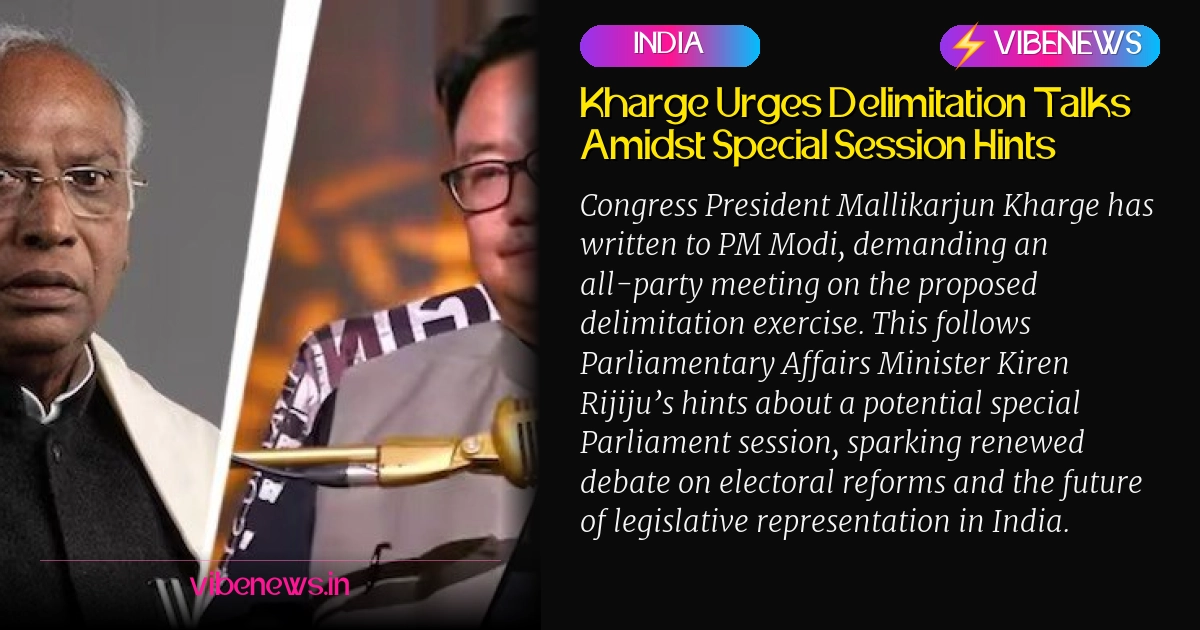
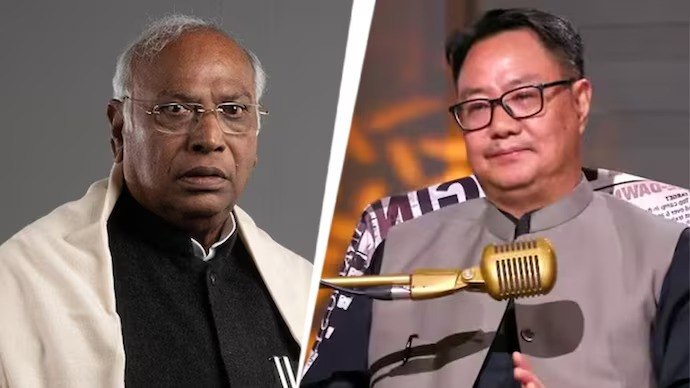
Congress President Mallikarjun Kharge has intensified his demand for an all-party meeting to discuss the government’s proposed delimitation exercise. His latest communication to Prime Minister Narendra Modi follows recent remarks by Parliamentary Affairs Minister Kiren Rijiju, who hinted at the possibility of another parliamentary sitting without explicitly confirming a special session. This development reignites a crucial national debate concerning electoral boundaries and legislative representation.
Kharge’s letter, dated August 27, 2026, reiterated a request he first made on July 16, 2026. He urged the Prime Minister to convene an inclusive meeting, emphasizing the profound significance of delimitation for the entire country. Kharge also stressed the necessity of providing political parties and state governments ample time to thoroughly examine any proposals before they are introduced in Parliament. He cautioned against any attempt to "bulldoze" legislation, referencing previous instances in April 2026.
Minister Rijiju’s Cryptic Remarks
The catalyst for Kharge’s renewed appeal was an exclusive interview given by Kiren Rijiju to India Today. During the interview, Rijiju was pressed on the likelihood of a special Parliament session or another sitting. While he refrained from a direct confirmation, the minister pointed to parliamentary precedents, noting that a session could be reconvened if it had been adjourned sine die but not formally prorogued. This subtle indication, coupled with the Monsoon Session’s un-prorogued status since August 13, has fueled widespread speculation across political circles.
Rijiju’s comments highlighted the procedural flexibility available to the government when a session is not formally prorogued by the President. He cited numerous historical occasions since 1952 where Parliament was adjourned sine die but later summoned again without a fresh prorogation. This parliamentary nuance allows for the possibility of legislative business to resume within the same session, potentially with less lead time than calling an entirely new special session.
The Delimitation Conundrum
Delimitation, the process of redrawing electoral constituency boundaries, is a constitutionally mandated exercise aimed at ensuring fair representation based on population changes. In India, the last major delimitation exercise was completed in 2008, based on the 2001 census. However, the number of Lok Sabha seats and their state-wise allocation were frozen until 2026 by the 84th Amendment Act, 2001, to encourage population control measures without penalizing states that successfully implemented them.
The impending 2026 deadline has brought the issue back into sharp focus, raising concerns, particularly among southern states, about potential reductions in their parliamentary representation due to their lower population growth rates compared to northern states. This demographic disparity forms the crux of the political sensitivity surrounding the delimitation exercise, as it could significantly alter the regional balance of power in the Lok Sabha.
Historical Context of Electoral Boundaries
India’s electoral map has undergone several delimitations since independence, with commissions established to ensure equitable representation. The process is often contentious, as it directly impacts political power and resource allocation. The current debate is particularly charged because it coincides with discussions around increasing the overall strength of the Lok Sabha, potentially to accommodate a larger population and new states, and the long-pending Women’s Reservation Bill.
The previous attempt to pass the Delimitation Bill, alongside the Women’s Reservation Bill (under the 131st Constitutional Amendment), failed to secure the required two-thirds majority in the Lok Sabha during a special session in April 2026. This legislative setback highlighted the deep divisions and lack of consensus surrounding these fundamental reforms, underscoring the need for broader political consultation.
Opposition’s Stance on Key Reforms
Kharge’s letter also outlined the Congress party’s clear position on three critical aspects. The party advocates for retaining the existing Lok Sabha strength of 543 seats for another 25 years. Furthermore, it insists on maintaining the current state-wise allocation of seats for the same duration, addressing fears of disproportionate representation shifts. Lastly, the Congress supports implementing one-third reservation for women, but specifically from the 2029 Lok Sabha elections, suggesting a phased approach rather than immediate implementation.
These points underscore the Opposition’s desire for a cautious and consultative approach to reforms that could fundamentally alter India’s political landscape. Their concerns revolve around ensuring that any changes uphold the principles of federalism and do not disadvantage states that have successfully managed population growth, while also ensuring meaningful and timely women’s representation.
Legislative Maneuvers and Precedents
The distinction between adjourning a session sine die and proroguing it is crucial in parliamentary procedure. When a session is adjourned sine die, it means "without a day" for reconvening, but the session technically remains alive until the President issues a prorogation order. If a session is not prorogued, the government retains the option to reconvene it at short notice, potentially bypassing the need for a fresh summons for a "special session."
This procedural nuance, highlighted by Minister Rijiju, allows for flexibility but also raises concerns among the Opposition about the government’s intentions and potential for swift legislative action without adequate prior consultation. The delay in proroguing the Monsoon Session has thus become a focal point of political speculation, with the Opposition questioning whether the government intends to use this window for significant legislative moves.
Editorial Context: Shaping India’s Democratic Future
The ongoing discourse around delimitation and a potential special parliamentary session transcends immediate political maneuvering; it touches upon the foundational principles of India’s federal structure and democratic representation. The decisions made regarding electoral boundaries and seat allocation will profoundly influence the balance of power between states, the effectiveness of parliamentary democracy, and the equitable distribution of political voice for decades to come.
A transparent, consultative process is paramount to ensure that these reforms strengthen, rather than strain, the nation’s diverse federal fabric. The long-term implications include potential shifts in regional political influence, the dynamics of national elections, and the very nature of legislative decision-making, making this a pivotal moment for India’s democratic evolution. Ensuring broad consensus and addressing regional concerns will be critical for the legitimacy and lasting impact of any such electoral reforms.
TL;DR
- Congress President Mallikarjun Kharge has written to Prime Minister Narendra Modi, demanding an all-party meeting on the proposed delimitation exercise.
- This demand follows Parliamentary Affairs Minister Kiren Rijiju’s recent interview, where he hinted at the possibility of another Parliament sitting.
- The Monsoon Session of Parliament was adjourned sine die on August 13 but has not been formally prorogued, fueling speculation about its reconvening.
- Kharge expressed concerns about the government attempting to "bulldoze" proposals, referencing past legislative attempts in April 2026.
- The Congress party advocates for retaining the current Lok Sabha strength of 543 seats and existing state-wise allocation for another 25 years.
- The Delimitation Bill and Women’s Reservation Bill failed to secure the required two-thirds majority in the Lok Sabha during a special session in April 2026.