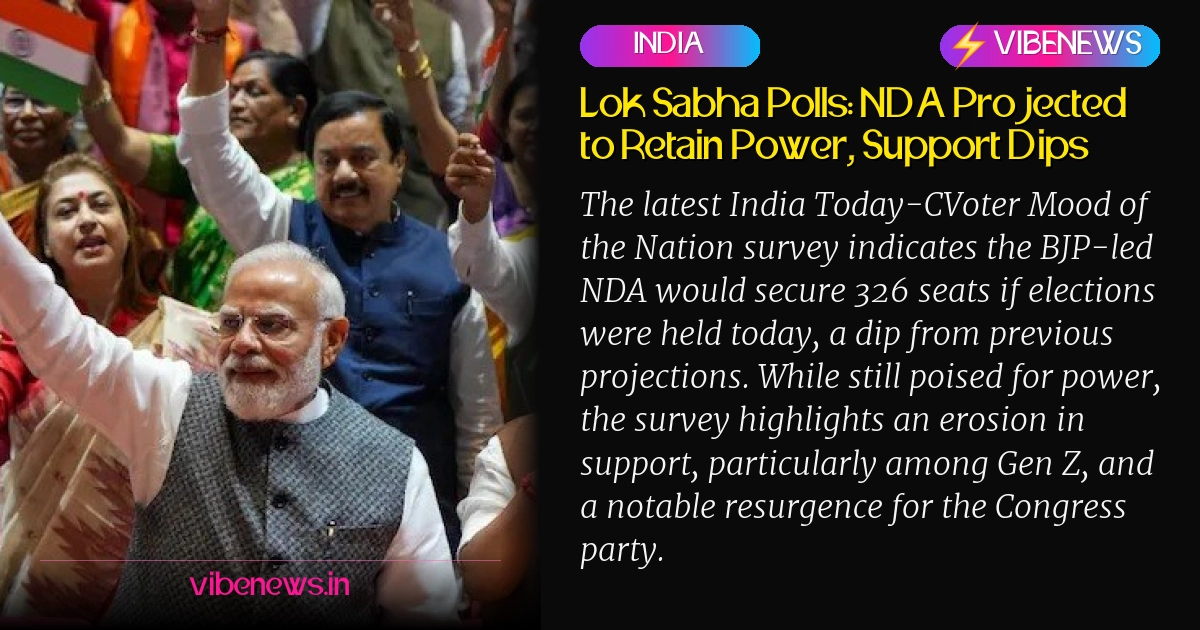
The political landscape in India continues to evolve, with the latest India Today-CVoter Mood of the Nation (MOTN) survey projecting the BJP-led National Democratic Alliance (NDA) to secure 326 seats if Lok Sabha elections were to be held today. This figure, while comfortably above the majority mark, represents a decline of 26 seats from the 352 projected in the previous MOTN survey conducted in January.
Now in its twelfth year, the bi-annual Mood of the Nation survey offers a crucial barometer of public sentiment, reflecting shifts in voter preferences and the challenges faced by major political entities. The current findings suggest that while the NDA remains the dominant force, its popularity is experiencing a modest erosion, particularly as it navigates the concerns of a younger demographic.
The Shifting Political Tides
The projected 326 seats for the NDA indicate a strong position for retaining power, yet the dip from earlier forecasts signals a dynamic political environment. This shift comes after the Prime Minister’s ambitious ‘400 paar’ slogan ahead of the 2024 general elections, where the NDA ultimately secured a mandate, albeit with the BJP falling short of a solo majority.
The survey underscores that the trust of the voters in the NDA, while showing signs of wear, largely remains intact. However, the alliance faces an increasingly complex challenge in addressing the aspirations and grievances of Gen Z as it looks towards the 2029 electoral cycle.
BJP’s Evolving Support Base
A party-wise breakdown reveals that the Bharatiya Janata Party (BJP) is projected to win 261 seats on its own, a notable decrease from the 287 seats forecast in the January survey. Despite this reduction, the BJP’s individual tally still comfortably surpasses the 272-seat simple majority required to form a government, and it is also higher than the 240 seats the party won in the 2024 polls.
This modest erosion in support for the BJP is largely attributed to the growing discontent among Gen Z voters. Recent months have seen widespread student protests, particularly at Delhi’s Jantar Mantar in July, sparked by exam paper leaks and perceived irregularities within the education system. These sustained demonstrations culminated in the resignation of Education Minister Dharmendra Pradhan, a rare instance of a cabinet minister stepping down in the current administration.
Opposition’s Gradual Ascent
Conversely, the Congress-led INDIA bloc has seen a marginal increase in its projected seat count, moving from 182 seats in the January survey to 185 in the latest edition. While this represents a slight gain, it is a significant drop from the 234 seats the alliance secured in the 2024 elections, which marked the closest the opposition had come to challenging the NDA since 2014.
The overall stagnation of the INDIA bloc’s numbers suggests that while individual constituents may be gaining ground, the alliance as a whole is yet to consolidate a substantial challenge to the NDA’s dominance. The path to a more formidable opposition front remains complex, requiring greater synergy and a unified narrative.
Congress’s Strategic Revival
The Congress party, however, presents a more promising picture within the opposition ranks. The latest poll predicts 106 seats for the party, a sharp rise from the 80 seats forecast in the January edition and also an improvement over the 97 seats projected in August 2025. This upward trend suggests a strategic shift in the party’s approach.
This resurgence is linked to Rahul Gandhi’s adoption of a new playbook, focusing on raising hot-button issues that resonate with the public. The Congress has notably increased its visibility by championing causes ranging from women’s reservation to condemning the police crackdown on student protesters on July 20, thereby attempting to corner the BJP on critical governance and social issues.
Understanding the Vote Share Dynamics
In terms of vote share, the NDA is projected to see a marginal dip to 45.1%, down from 47% in the January MOTN forecast. This is the lowest since the August 2025 survey, which predicted a 46.7% vote share, though it remains higher than the 44% the NDA garnered in the 2024 polls.
For the INDIA bloc, the latest survey predicts a 39.1% vote share, a negligible increase from the 39% forecast in the January MOTN poll. These figures highlight a relatively stable, albeit slightly shifting, distribution of electoral support between the two major political formations.
Methodology Behind the Projections
The August 2026 edition of the Mood of the Nation survey was meticulously conducted by CVoter, commissioned by the India Today Group. It involved a direct sample of 25,184 individuals surveyed between July 1 and August 25. Furthermore, the findings incorporated insights from an additional 91,795 interviews conducted over the preceding six months as part of CVoter’s ongoing tracking efforts, ensuring a comprehensive and robust dataset.
Editorial Context
The latest Mood of the Nation survey offers critical insights into the evolving political landscape of India, far beyond mere seat projections. The decline in the NDA’s projected tally, particularly the BJP’s individual dip, signals a potential shift in voter sentiment that warrants deeper analysis. The emergence of the ‘Gen Z factor’ as a significant challenge, driven by issues like educational integrity, suggests that traditional political narratives may be losing their grip on a crucial demographic. This demographic, increasingly vocal and digitally connected, could reshape future electoral outcomes if their concerns are not adequately addressed.
For the Congress, the notable rise in its projected seats and vote share indicates a potential strategic revival. By actively engaging with contemporary social and governance issues, the party appears to be carving out a more relevant space in the national discourse. This shift could invigorate the broader opposition, compelling the INDIA bloc to refine its collective strategy and present a more cohesive alternative. The long-term implications point towards a more competitive political environment leading up to the 2029 general elections, where both the ruling dispensation and the opposition will need to adapt their approaches to address a diverse and increasingly discerning electorate.
TL;DR
- NDA projected to win 326 Lok Sabha seats, a decline of 26 seats from the January 2026 Mood of the Nation survey.
- BJP’s individual tally drops to 261 seats, still above the 272-seat majority mark and higher than its 2024 performance.
- Erosion in BJP support is linked to the ‘Gen Z factor,’ specifically student protests over exam paper leaks and education system irregularities.
- Congress sees a significant rise to 106 seats, attributed to increased visibility and raising hot-button issues like women’s reservation and student protests.
- The INDIA bloc’s overall projected tally remains largely stagnant at 185 seats, a major drop from its 234 seats in 2024.
- NDA’s vote share is projected at 45.1%, a marginal dip, while the INDIA bloc’s is 39.1%.