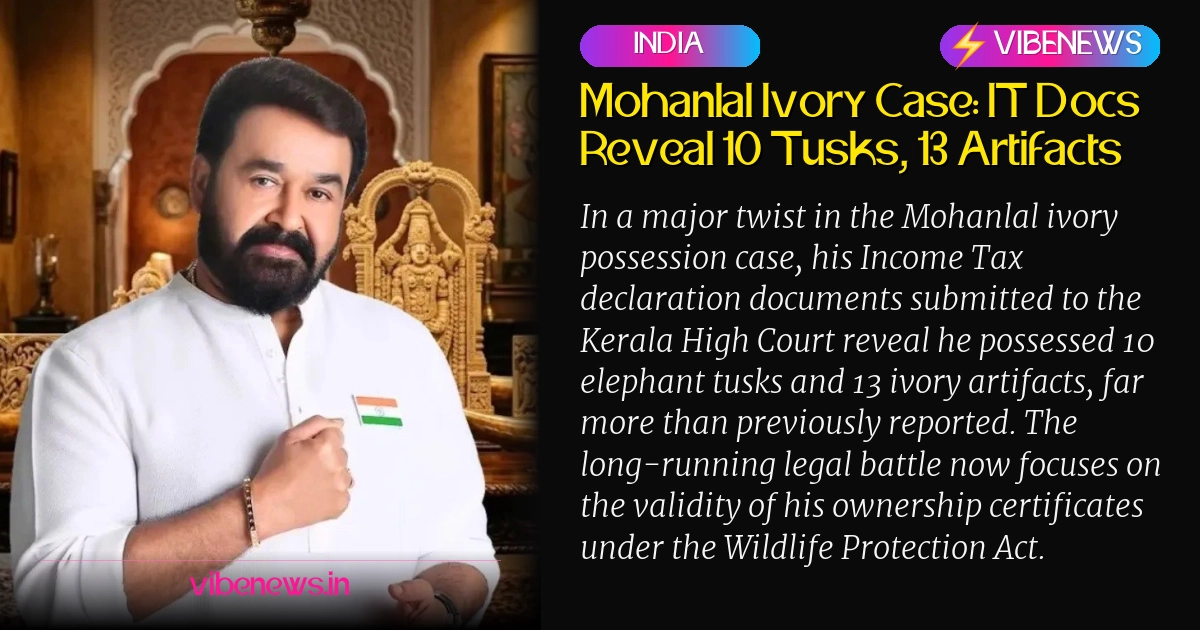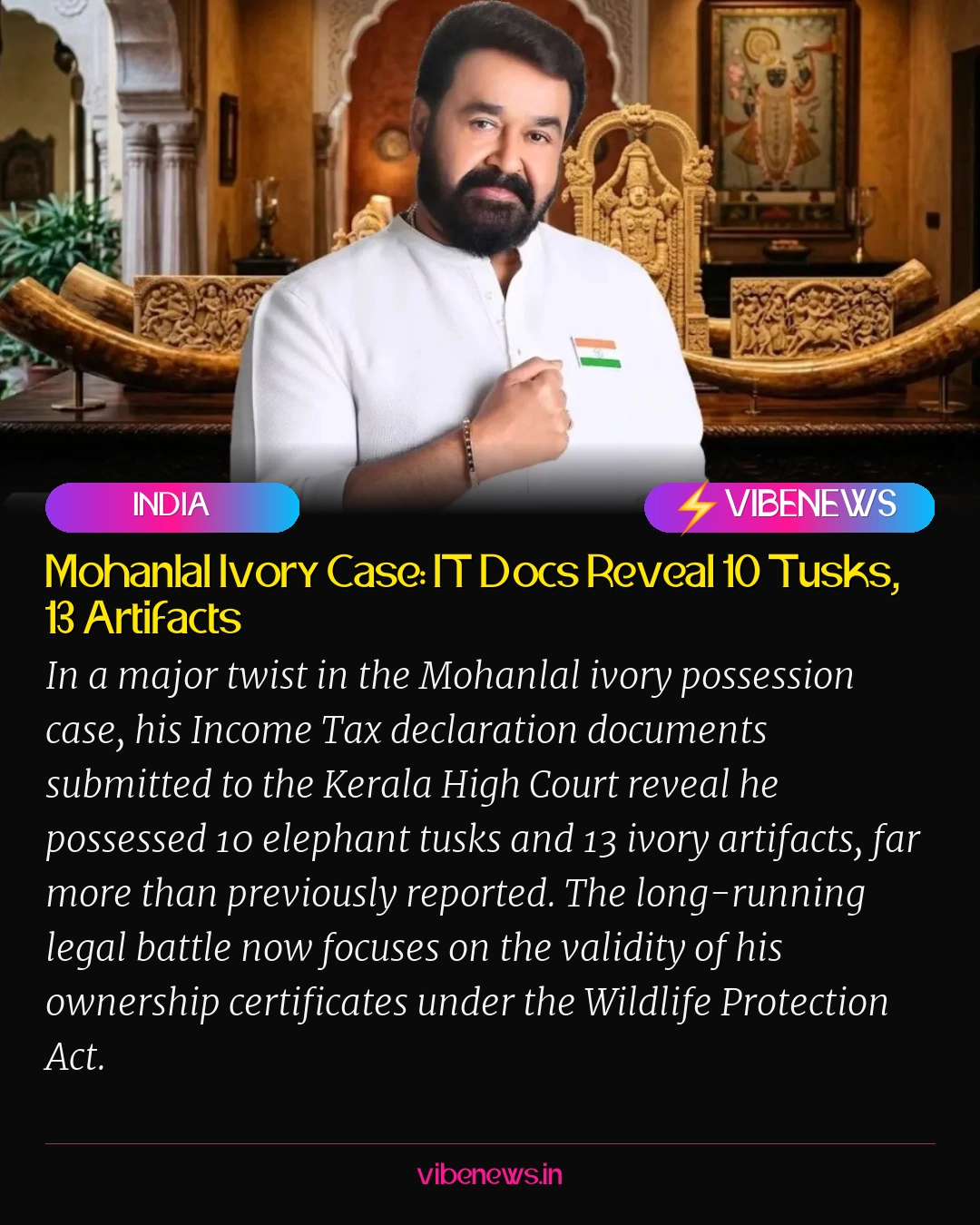

Malayalam superstar Mohanlal’s long-standing illegal ivory possession case has taken a significant turn at the Kerala High Court, with his Income Tax (IT) declaration documents revealing he possessed a total of 10 elephant tusks and 13 ivory artifacts. This new information, submitted to the court, significantly expands on previous reports which indicated only four tusks were found during 2011 raids, intensifying the legal scrutiny under the Wildlife Protection Act.
The legal proceedings are now primarily focused on whether the actor obtained the necessary official ownership certificates for these items in a timely manner, despite his legal team’s assertion that the ivory was declared under a special ‘Ivory Amnesty’ scheme introduced by the government.
New Revelations from Income Tax Documents
The recent submission of Mohanlal’s IT declaration to the Kerala High Court has brought to light the full extent of his ivory collection. According to these documents, the actor voluntarily disclosed possessing not just the four elephant tusks initially seized, but a total of 10 tusks along with 13 additional artifacts crafted from ivory.
This disclosure from his own records provides a comprehensive picture of the items in question, shifting the focus of the ongoing legal battle. The court is now tasked with evaluating the legality of possessing such a large quantity of prohibited wildlife products.
Background of the Ivory Possession Case
The case against Mohanlal dates back to June 2011, when Income Tax Department officials conducted raids on his residences and offices. During these raids, four elephant tusks were discovered at his private residence in Kochi.
Following this discovery, the Kerala Forest Department registered a case against the actor under the Wildlife Protection Act, 1972. This Act strictly prohibits the possession, trade, and sale of elephant ivory without proper authorization and ownership certificates, aiming to protect endangered wildlife species.
Mohanlal’s Defense and the ‘Ivory Amnesty’ Scheme
Mohanlal’s legal representatives have consistently argued that the actor did not engage in any illegal activities. They contend that the ivory items were declared under a special ‘Ivory Amnesty’ scheme, which allowed individuals to declare possession of such items to avoid prosecution.
This scheme was designed to bring undeclared wildlife products into the legal framework, often requiring subsequent registration and certification. The defense maintains that Mohanlal complied with the requirements of this amnesty program.
The Core Legal Dispute: Ownership Certificates vs. Declaration
Despite the declaration under the amnesty scheme, the central point of contention in the Kerala High Court is the timely acquisition of official ownership certificates. The Wildlife Protection Act mandates that even declared items must be accompanied by valid certificates proving legal acquisition and ownership.
The court is examining whether Mohanlal obtained these crucial certificates within the stipulated timeframe and whether the amnesty declaration alone suffices to legalize the possession of such a large number of elephant tusks and artifacts. This legal nuance is critical to the outcome of the case.
Implications for Wildlife Conservation in India
The ongoing legal battle involving a prominent personality like Mohanlal underscores the challenges in enforcing wildlife protection laws in India. Elephant ivory trade is a significant threat to elephant populations, and strict laws are in place to curb illegal poaching and trafficking.
The verdict in this high-profile case could set a precedent for how ‘amnesty’ declarations are weighed against the stringent requirements of the Wildlife Protection Act. It highlights the importance of clear legal frameworks and diligent enforcement to protect India’s rich biodiversity.
Next Steps in the Kerala High Court Proceedings
With the submission of the Income Tax declaration documents, the Kerala High Court is expected to continue its detailed examination of the evidence. Legal experts suggest that the court will scrutinize the dates of declaration, the specifics of the amnesty scheme, and the efforts made by Mohanlal to obtain the necessary ownership certificates.
The outcome of this case will not only impact Mohanlal but also send a strong message regarding the accountability of individuals, regardless of their stature, in adhering to wildlife conservation laws. Further hearings are anticipated as the court delves deeper into the legal complexities surrounding the possession of elephant ivory.
TL;DR
- Mohanlal’s Income Tax declaration reveals possession of 10 elephant tusks and 13 ivory artifacts, a significant increase from previously reported figures.
- These documents were submitted to the Kerala High Court in the ongoing illegal ivory possession case.
- The legal dispute centers on whether Mohanlal obtained valid ownership certificates for the ivory under the Wildlife Protection Act, despite declaring them under an ‘Ivory Amnesty’ scheme.
- The case originated from 2011 Income Tax raids on his Kochi residence, where four elephant tusks were initially discovered.
- The verdict will have implications for wildlife conservation efforts and the enforcement of the Wildlife Protection Act in India.