India’s Indigenous Navigation System Faces Service Gap
India’s homegrown satellite navigation system, NavIC, is presently operating with only three satellites capable of providing Positioning, Navigation, and Timing (PNT) services. This falls short of the minimum four satellites necessary to offer standalone positioning capabilities, a fact recently acknowledged by the government in Parliament.
Standalone positioning refers to a navigation system’s ability to determine a user’s location solely using its own satellites, without relying on external systems like GPS or Galileo. Union Minister of State for Space, Dr. Jitendra Singh, confirmed in a written reply to the Lok Sabha that following the completion of IRNSS-1F’s 10-year mission life, the operational NavIC constellation now comprises only IRNSS-1B, IRNSS-1I, and NVS-01 for PNT services.
Current Operational Status and Mitigation
While the critical standalone positioning service is temporarily unavailable, the minister clarified that NavIC’s timing service continues to function normally. This timing service is crucial for various applications, including telecommunications and power grid synchronization.
Despite the reduced constellation, the government asserts there is no immediate operational vulnerability for users. This is because NavIC is now primarily utilized within a multi-constellation Global Navigation Satellite System (GNSS) environment, integrating seamlessly with other global systems such as GPS, Galileo, and GLONASS. The Indian Armed Forces, for instance, are already employing multi-constellation GNSS, including NavIC, to meet their operational requirements, ensuring continuity and reliability.
ISRO’s Accelerated Restoration Efforts
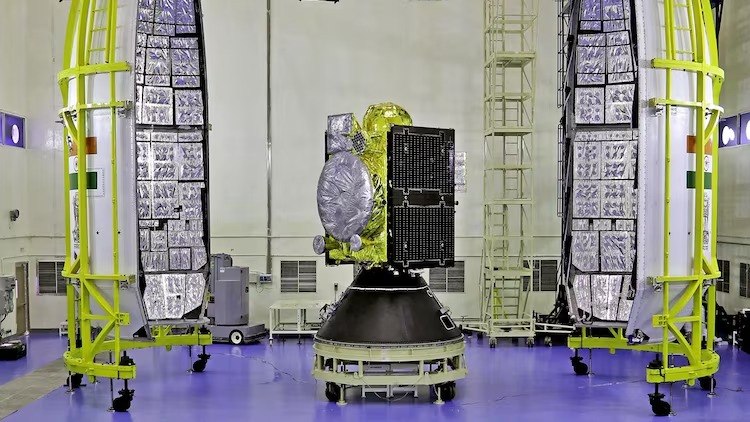
To address the current shortfall and restore the constellation’s full capabilities, the Indian Space Research Organisation (ISRO) has prioritized the launch of new satellites. Dr. Singh announced that the NVS-03 satellite is prepared for launch, with NVS-04 and NVS-05 in advanced stages of realization. These upcoming missions are critical for rebuilding the constellation and re-establishing standalone navigation services.
This push to strengthen India’s second-generation NavIC network follows some setbacks in recent years. While ISRO successfully launched NVS-01 in 2023, the subsequent NVS-02 mission encountered propulsion-related issues, preventing the satellite from reaching its designated operational orbit. The successful deployment of the new satellites is expected to enhance the overall reliability and robustness of India’s indigenous satellite navigation system, which provides precise positioning, navigation, and timing services across India and extends approximately 1,500 km beyond its borders.
Editorial Context: The Imperative of Indigenous Navigation
The current operational status of NavIC, while temporarily limiting standalone positioning, underscores India’s long-term commitment to strategic autonomy in critical space infrastructure. An indigenous navigation system like NavIC is not merely a technological achievement; it is a cornerstone of national security, economic resilience, and disaster management capabilities. Relying solely on foreign-controlled systems carries inherent risks, particularly during geopolitical tensions or natural calamities, where access or accuracy could be compromised.
The development and continuous enhancement of NavIC ensure that India has an independent and secure means of navigation for its defense forces, critical infrastructure, and civilian applications. From precision agriculture and logistics to public transport and emergency services, the applications of a fully operational NavIC are vast and transformative. The government’s proactive steps to launch new satellites demonstrate a clear understanding of this strategic imperative, aiming to solidify India’s self-reliance in a domain vital for its future growth and security. The successful restoration and expansion of the NavIC constellation will be a significant step towards cementing India’s position as a self-sufficient space power, capable of providing essential services to its citizens and contributing to global navigation infrastructure.
TL;DR
- India’s NavIC system currently has only three operational satellites providing Positioning, Navigation, and Timing (PNT) services.
- A minimum of four operational satellites are required for NavIC to provide standalone positioning services.
- NavIC’s timing services remain fully functional despite the reduced constellation.
- Users face no immediate operational vulnerability as NavIC is used in a multi-constellation GNSS environment alongside systems like GPS.
- ISRO is preparing to launch NVS-03, NVS-04, and NVS-05 satellites to restore full standalone navigation capability.
- The NVS-02 mission in 2023 faced propulsion issues, preventing it from reaching its intended orbit.