
New Leadership at the Helm
The National Testing Agency (NTA) has announced the appointment of two new directors and a joint director, a move that underscores the government’s commitment to a comprehensive overhaul of the nation’s examination system. These strategic leadership changes come as the NTA continues to face intense scrutiny following recent controversies, most notably the NEET paper leak.
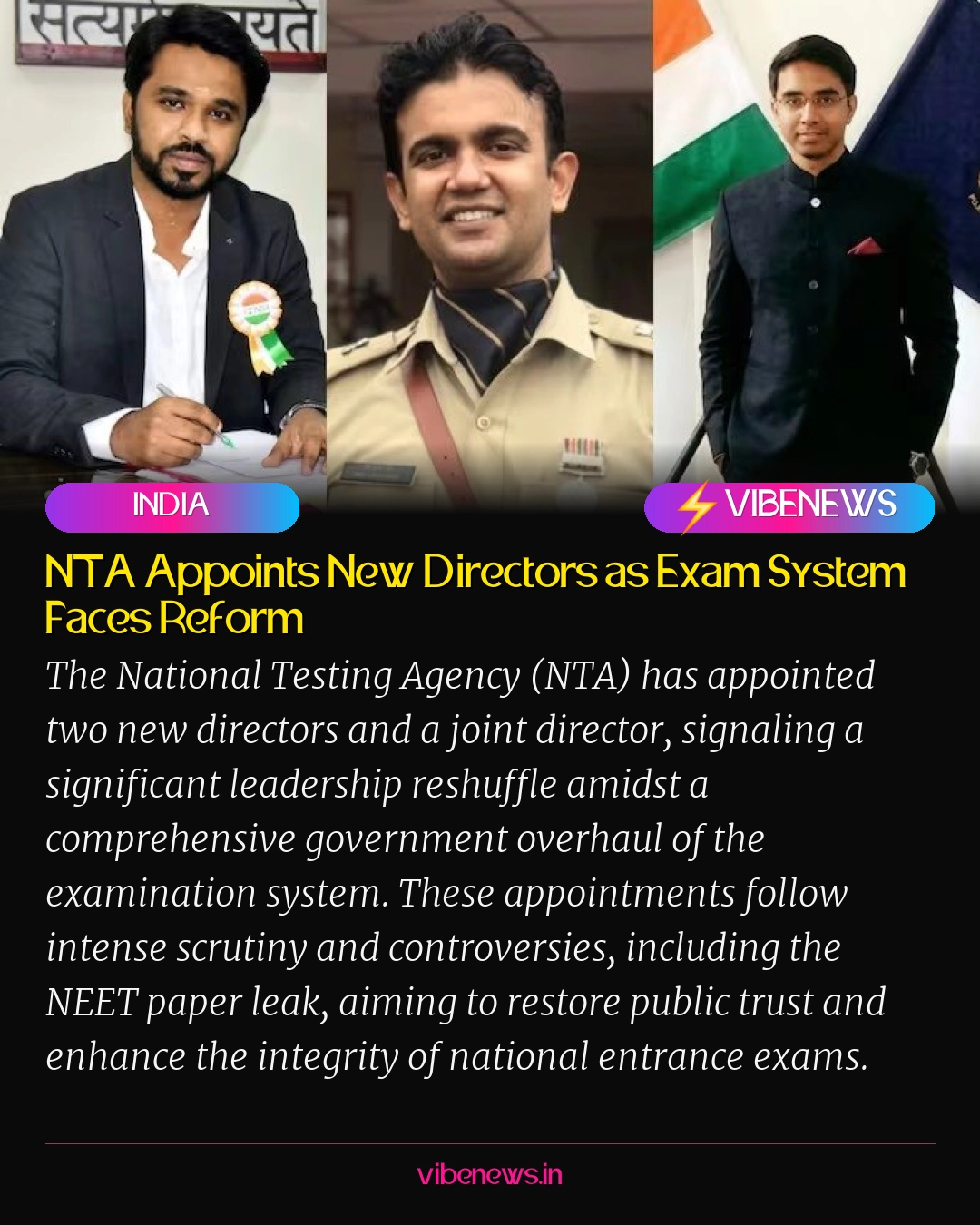
According to orders issued by the personnel ministry on August 27, Ravi Kumar Singh, an Indian Police Service (IPS) officer, and Prasanna Venkatesh V, an Indian Administrative Service (IAS) officer, have been appointed as directors. Additionally, Amit Samdariya, an Indian Revenue Service (IRS) officer, will assume the role of joint director.
Ravi Kumar Singh, a 2012-batch IPS officer from the Arunachal Pradesh-Goa-Mizoram-Union Territories cadre, brings a decade and a half of service experience. Before joining the NTA, he served as Deputy Commissioner of Police in the Economic Offences Wing of the Delhi Police, a role demanding meticulous investigation and administrative oversight.
Prasanna Venkatesh V, a 2012-batch IAS officer of the Andhra Pradesh cadre, has a distinguished record in public administration. An agriculture graduate, his previous roles include District Collector and District Magistrate of Eluru, Municipal Commissioner of Vijayawada, and Joint Collector of Kurnool. Most recently, he served as Secretary, Social Welfare Department and AP Social Welfare Residential Educational Institutions Society (APSWREIS) in Guntur.
Amit Samdariya, a 2016-batch IRS officer from the Customs and Indirect Taxes cadre, is an alumnus of IIT Delhi, where he studied mechanical engineering. He previously held the position of Joint Commissioner at the Directorate General of Goods and Services Tax Intelligence, Delhi Headquarters, before his promotion and transfer to the NTA.
The newly appointed officers have been directed to assume their positions within three weeks. The orders explicitly state that failure to comply within this timeframe could lead to their debarment from the Central Staffing Scheme, emphasizing the urgency and importance of these appointments.
The Imperative for Reform
These appointments are not isolated administrative decisions but are deeply embedded within a broader governmental initiative to restore credibility and integrity to India’s public examination system. The NTA, established in 2017 to conduct major entrance examinations, has been at the center of several controversies, with the NEET paper leak being a particularly damaging incident that eroded public trust and caused widespread anxiety among millions of students and their families.
The agency’s mandate was to bring transparency, efficiency, and standardization to the examination process, reducing the burden on other government bodies. However, a series of alleged irregularities and operational lapses have led to a significant questioning of its efficacy and security protocols. The government’s response indicates a recognition of the systemic issues that need immediate and decisive action.
Broader Systemic Changes
Beyond the leadership reshuffle, the government has outlined a comprehensive plan for overhauling the NTA’s operational framework. A key reform is the introduction of a four-tier paper checking process, designed to add multiple layers of scrutiny to question papers before they are administered. This aims to minimize errors, prevent leaks, and enhance the overall security of the examination content.
Furthermore, there is a significant move to revamp the expert panel associated with the NTA. Approximately 600 existing experts are slated for removal, to be replaced by new domain specialists. This decision reflects an effort to inject fresh perspectives, specialized knowledge, and potentially more rigorous standards into the paper-setting and evaluation processes.
In a progressive step towards greater accountability and public participation, the Centre is actively seeking public feedback on reforms to public examinations, including those conducted by the NTA. This feedback will be crucial for the Nandan Nilekani-led task force, which is mandated to frame recommendations on exam security, access, and governance, ensuring that reforms are informed by diverse perspectives and real-world challenges.
A History of Scrutiny and Aspirations
The National Testing Agency was conceived with the noble objective of streamlining the conduct of entrance examinations for higher education institutions across India. Its establishment was meant to professionalize the process, ensuring fairness and reducing the logistical burden on universities and other bodies. Over the years, the NTA has become responsible for some of the country’s most critical exams, including the National Eligibility cum Entrance Test (NEET), Joint Entrance Examination (JEE), and Common University Entrance Test (CUET), impacting millions of aspirants annually.
However, the journey has been fraught with challenges. Allegations of paper leaks, technical glitches, and administrative mismanagement have periodically surfaced, culminating in the recent high-profile controversies. These incidents have not only cast a shadow over the NTA’s operational integrity but have also deeply affected the morale and future prospects of countless students who dedicate years to preparing for these competitive examinations.
Rebuilding Public Trust
The latest appointments and the announced reforms are a clear indication of the government’s intent to address these deep-seated issues head-on. The focus is not merely on administrative changes but on fundamentally rebuilding the trust that has been eroded. For millions of students and their parents, the integrity of these examinations is paramount, representing the gateway to their academic and professional aspirations.
The success of these measures will hinge on their effective implementation and the sustained commitment to transparency and accountability. The NTA’s ability to regain its reputation as a fair and reliable examination body is critical for the future of India’s education system and the aspirations of its youth.
Editorial Context
The ongoing restructuring of the National Testing Agency represents a pivotal moment for India’s education landscape. The NTA is not just an examination body; it is a crucial gatekeeper to higher education and professional careers for millions of young Indians. The integrity of its processes directly impacts social mobility, economic opportunity, and the overall quality perception of Indian academic credentials on a global stage.
Over the long term, the success of these reforms will determine whether India can establish a robust, transparent, and equitable system for national entrance examinations. A failure to adequately address the current challenges could lead to a sustained crisis of confidence, potentially pushing students towards alternative pathways or even abroad, and undermining the credibility of domestic institutions. Conversely, a successful overhaul could set new benchmarks for exam security and governance, fostering greater trust among stakeholders and ensuring that merit truly prevails. This is a test of the government’s resolve to safeguard the future of its youth and uphold the sanctity of its educational institutions.
TL;DR
- The National Testing Agency (NTA) has appointed Ravi Kumar Singh (IPS) and Prasanna Venkatesh V (IAS) as directors, and Amit Samdariya (IRS) as joint director.
- These appointments are part of a broader government initiative to overhaul the NTA’s examination system following recent controversies, including the NEET paper leak.
- The government plans to implement a four-tier paper checking process and replace approximately 600 existing experts with new domain specialists.
- Public feedback is being sought on examination reforms, which will inform recommendations from a Nandan Nilekani-led task force on exam security and governance.
- The new officers are mandated to take charge within three weeks, underscoring the urgency of the leadership transition.
- The reforms aim to restore public trust in the NTA and ensure the integrity and fairness of national entrance examinations.