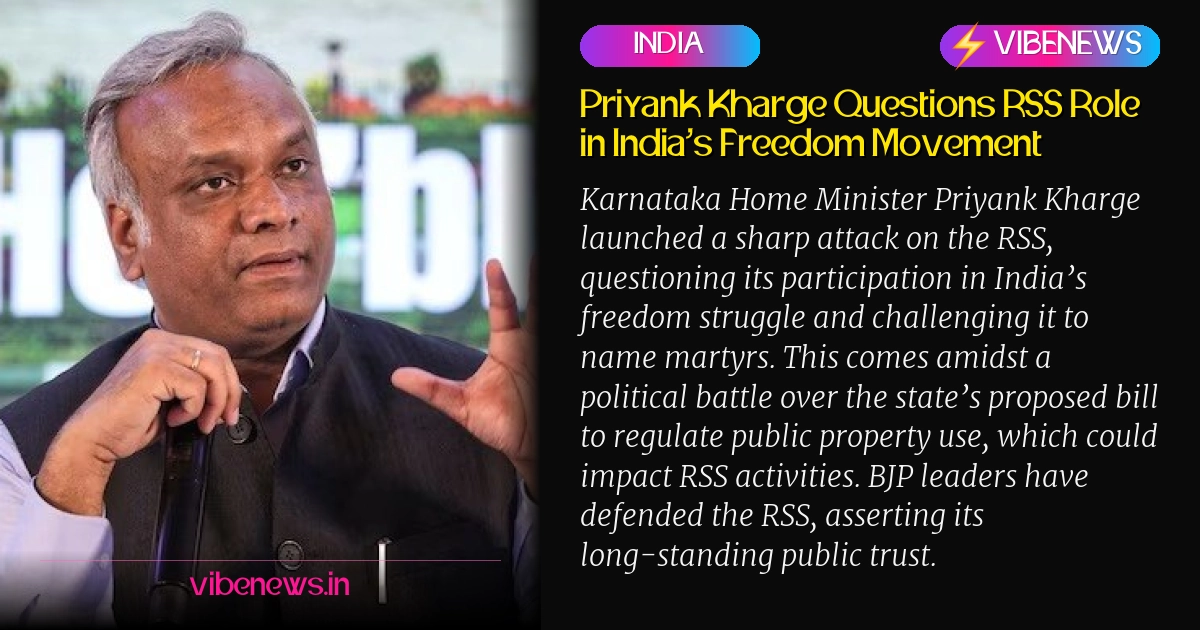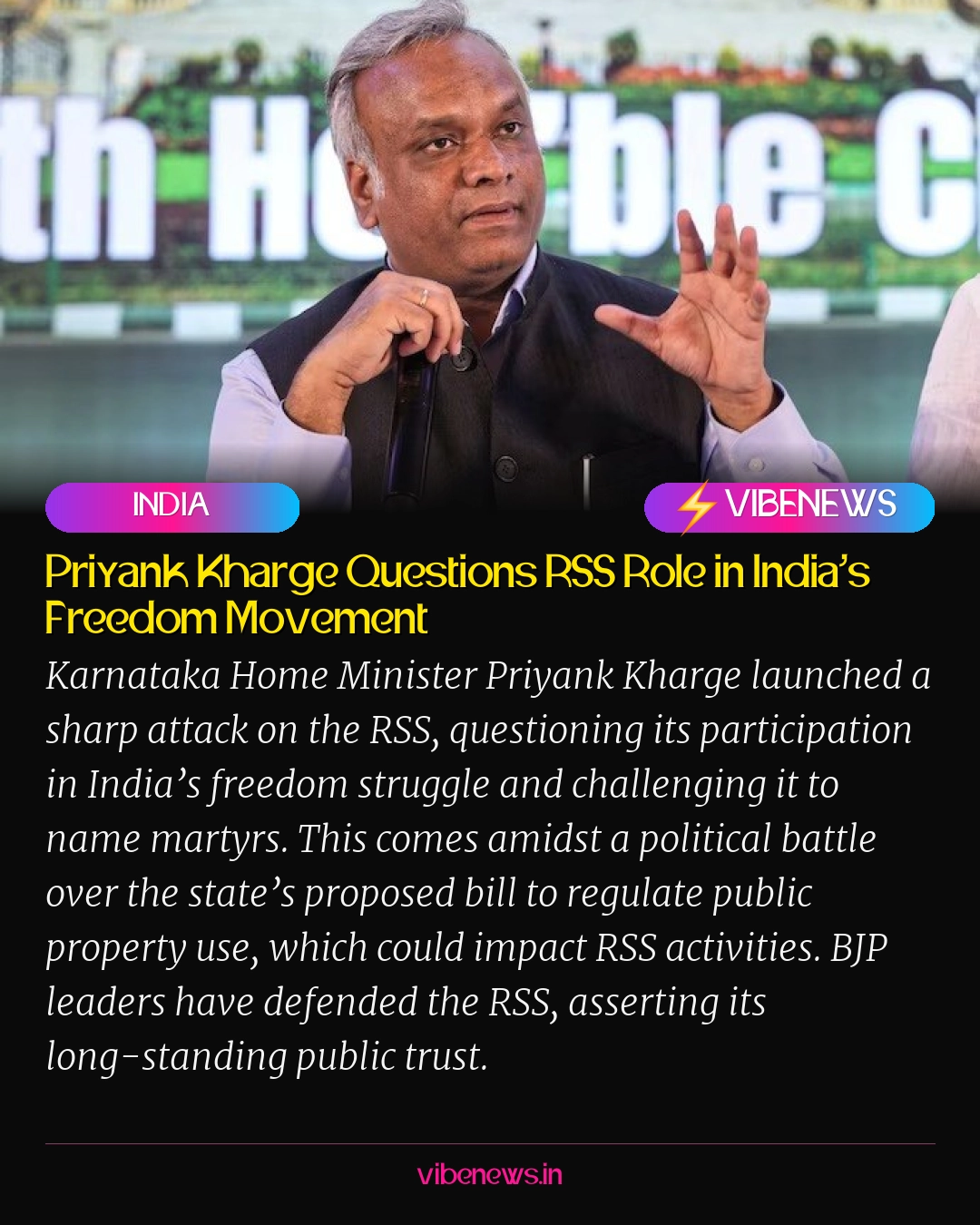
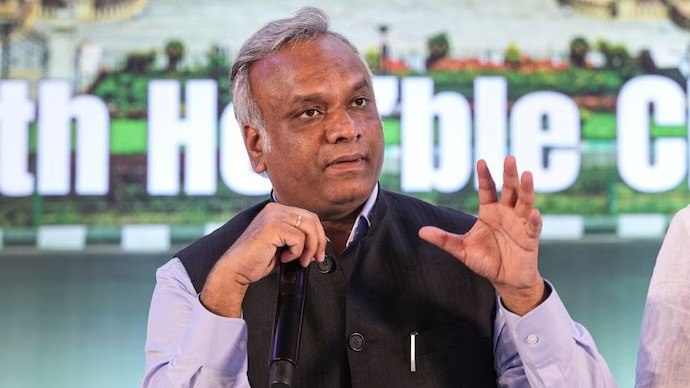
The recent Independence Day celebrations in Karnataka became a flashpoint for a significant political and ideological debate, as state Home Minister Priyank Kharge launched a pointed critique against the Rashtriya Swayamsevak Sangh (RSS). Kharge publicly questioned the organization’s contributions to India’s freedom struggle, challenging its leadership to provide a list of members who sacrificed their lives during the movement against British rule. This direct confrontation reignited long-standing historical arguments about the RSS’s role in pre-independence India.
Kharge asserted that he could readily furnish a list of 500 Congress members martyred for the nation’s independence, daring the RSS to produce even 50 such names. His remarks extended beyond the freedom struggle, accusing the RSS of exacerbating communal tensions in the aftermath of Partition. He questioned the organization’s actions in protecting citizens during the widespread riots that followed the division of India in 1947.
A key aspect of Kharge’s critique also touched upon the organizational status of the RSS. He argued that the RSS could not be "banned" precisely because it is not a formally registered entity. This statement, while seemingly a defense, was framed as a further challenge, implying a lack of formal accountability or legal standing for the organization in certain contexts.
The Legislative Intent Behind the Bill
The minister’s strong statements are not isolated but are deeply intertwined with a parallel political battle unfolding in Karnataka. The state government has proposed the Karnataka Regulation of Use of Government Premises and Public Property Bill, 2026. This legislation aims to regulate how organizations utilize public spaces and government properties, a move that has significant implications for groups like the RSS, which frequently conduct activities such as ‘shakhas’ (daily gatherings) in public grounds.
Kharge staunchly defended the proposed bill, refuting allegations from the Bharatiya Janata Party (BJP) that it was specifically designed to target the RSS. He clarified that the legislation would require any organization, regardless of its registration status, to obtain prior permission from a competent authority before holding events on public property. The minister emphasized that the bill does not name any specific organization, institution, or political party, asserting its universal applicability.
He further explained that the legislation seeks to provide statutory backing to existing directives from the Supreme Court and various High Courts concerning the regulation of public spaces. Kharge maintained that organizations would retain full freedom to conduct their activities on private premises. However, he stressed the government’s inherent responsibility to manage and regulate events, processions, and gatherings that take place on public land to ensure order and public safety.
The BJP’s Counter-Narrative
The BJP, however, views the proposed law with deep suspicion, perceiving it as a direct assault on the RSS and its long-standing operational model. Reacting to Kharge’s comments, BJP leader BL Santhosh dismissed the notion that formal registration was necessary for the RSS’s existence. Santhosh asserted that the organization has operated for decades based on the trust and support of millions of people, functioning effectively without a formal registration even during the tumultuous period of Partition.
Santhosh also offered a counter-narrative on India’s independence, arguing that freedom was not solely achieved through non-violent movements like the Salt Satyagraha or the spinning of the charkha. He contended that the sacrifices of countless revolutionaries, freedom fighters, and soldiers who risked their lives were equally, if not more, instrumental in securing India’s independence, suggesting a broader and more diverse spectrum of contributions than often highlighted.
A Deeper Look at Historical Narratives
The debate ignited by Priyank Kharge’s remarks taps into a long-standing historical contention surrounding the RSS. Founded in 1925 by K.B. Hedgewar, the RSS explicitly stated its primary objective as Hindu consolidation and cultural nationalism, rather than direct participation in the anti-colonial struggle. While individual members may have participated in various capacities, the organization, as a collective, maintained a distance from the mainstream independence movement led by the Indian National Congress. Its focus remained on character building and cultural revival, often viewing the political struggle as secondary to its broader goal of Hindu societal organization.
Critics, including many historians and political commentators, have often pointed to the RSS’s official stance during the Quit India Movement of 1942, where it largely remained aloof. This historical position has been a consistent point of contention for political opponents, who argue that the RSS did not actively contribute to the direct struggle against British rule. Conversely, RSS ideologues and supporters argue that their work in fostering national character and unity was a crucial, albeit indirect, contribution to the nation-building process that underpinned the eventual independence. They also highlight instances of their members’ involvement in social service and relief efforts, particularly during times of crisis.
Legislative Intent and Public Discourse
The Karnataka Regulation of Use of Government Premises and Public Property Bill, 2026, represents a significant legislative effort to formalize the use of public spaces. While the government frames it as a measure to ensure order and accountability, its timing and the political climate have inevitably led to interpretations of it being a targeted move. The bill’s provisions, requiring permission for public gatherings, could potentially alter the operational dynamics of many organizations, including those with deep roots in community engagement through public events.
This legislative push reflects a broader trend in Indian politics where state governments seek greater control over public assemblies, often citing reasons of law and order or efficient resource management. However, such measures frequently draw criticism from civil liberties advocates who argue they can be used to stifle dissent or restrict the activities of political and social groups. The debate in Karnataka thus transcends a mere administrative regulation, touching upon fundamental rights of assembly and expression.
Editorial Context
The ongoing verbal sparring between Kharge and the BJP, particularly concerning the RSS’s historical role, underscores a deeper ideological battle in India. It is a contest over historical narratives, the definition of patriotism, and the very identity of the nation. The Congress, often seen as the inheritor of the secular, inclusive vision of India’s founders, frequently challenges the historical credentials of organizations like the RSS, which are associated with a more Hindu-centric nationalist ideology.
This ideological clash is not new, but it gains renewed vigor in the context of state elections and legislative actions. The long-term significance of this development lies in its potential to reshape public memory and influence future generations’ understanding of India’s past. By questioning historical contributions and legislative intent, both sides are vying for control over the narrative that defines contemporary Indian politics and society. The outcome of this debate, both in public opinion and legislative implementation, will have lasting repercussions on the political landscape of Karnataka and potentially beyond.
TL;DR
- Karnataka Home Minister Priyank Kharge publicly questioned the RSS’s role in India’s freedom struggle.
- Kharge challenged the RSS to provide a list of its members martyred during the independence movement.
- The controversy is linked to the proposed Karnataka Regulation of Use of Government Premises and Public Property Bill, 2026, which could affect RSS activities in public spaces.
- Kharge defended the bill, stating it is not targeting any specific organization and aims to provide statutory backing for public space regulation.
- BJP leader BL Santhosh countered, asserting the RSS’s legitimacy without formal registration and highlighting its historical contributions and public trust.
- The debate highlights differing historical narratives and ongoing ideological clashes between the Congress and BJP in Indian politics.