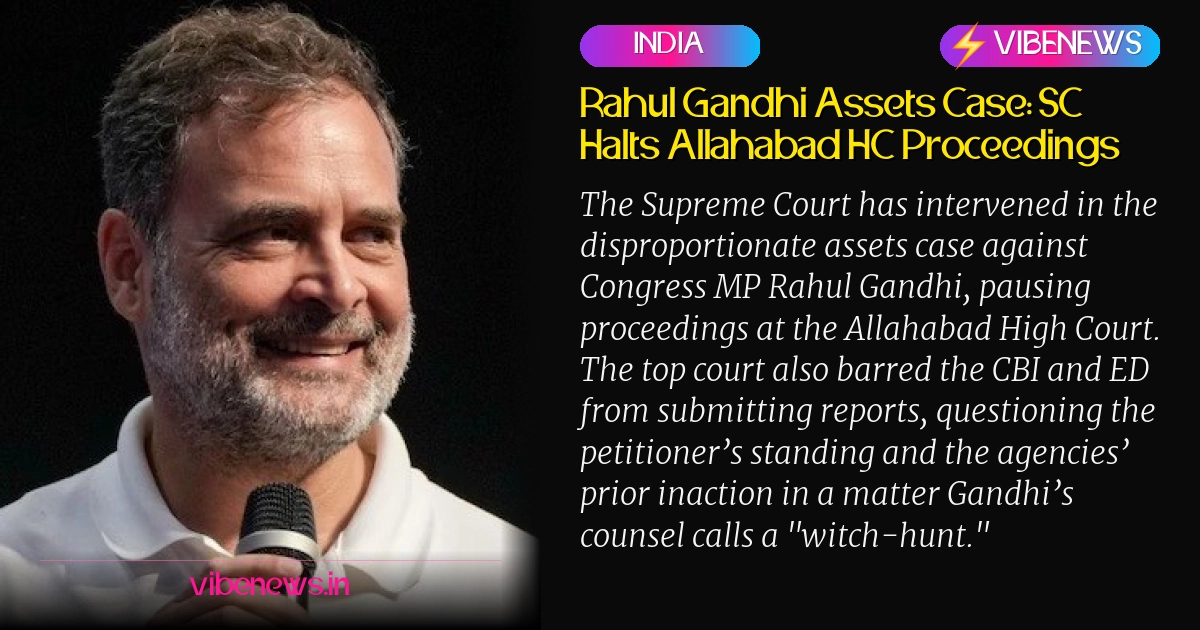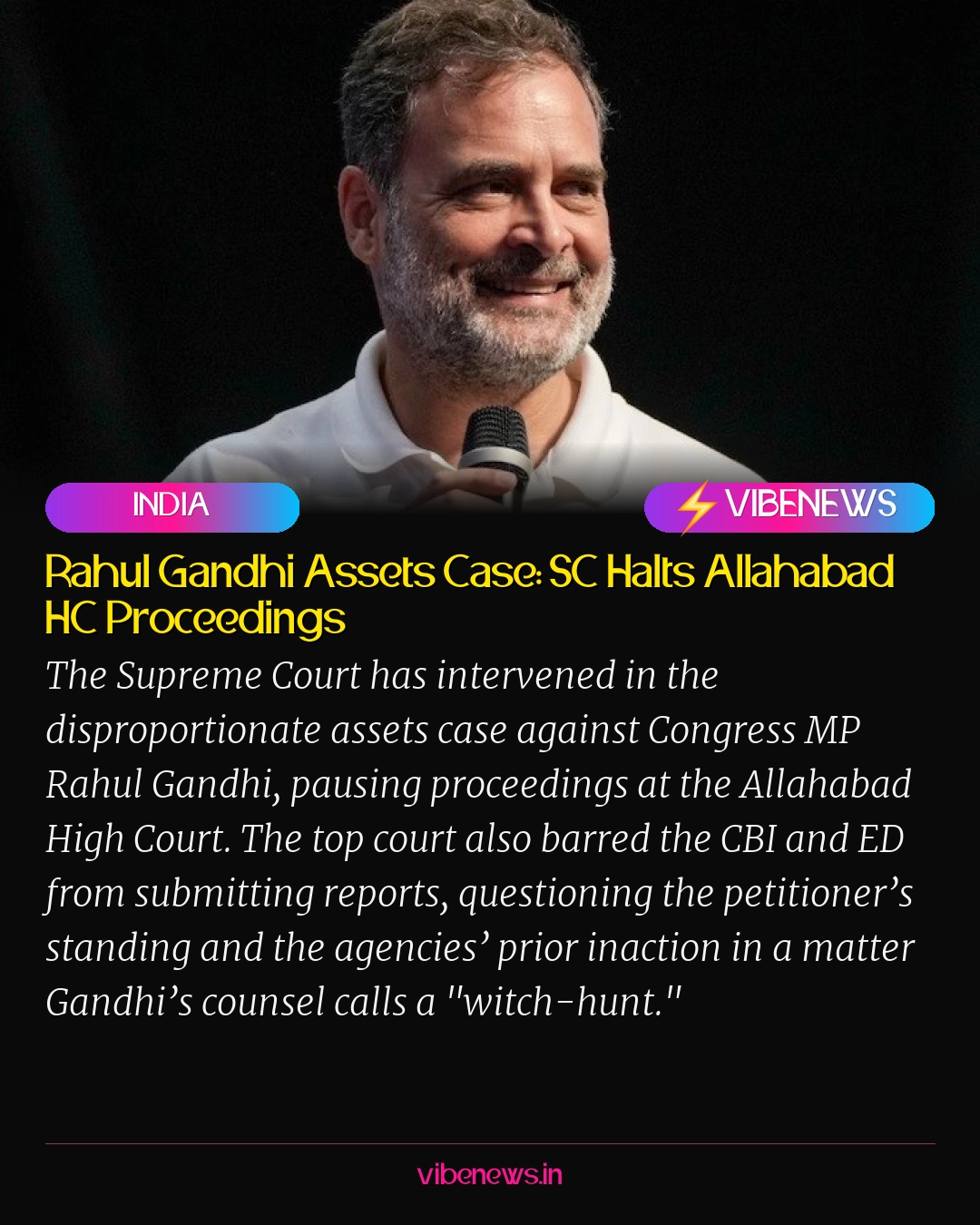

In a significant development for Congress Member of Parliament Rahul Gandhi, the Supreme Court on Monday issued a directive to the Allahabad High Court, instructing it to halt all proceedings in a case alleging that he possesses disproportionate assets. This intervention by the apex court also included a restraint order preventing the Central Bureau of Investigation (CBI) and the Enforcement Directorate (ED) from submitting any reports that might have been mandated by the High Court in connection with the matter.
A bench presided over by Chief Justice Surya Kant, alongside Justices Joymalya Bagchi and V Mohana, took this decisive action. The Supreme Court has issued notices to S Vignesh Shishir, a resident of Karnataka who initially filed the plea before the High Court, as well as to the CBI and ED. The High Court has been directed to defer its next hearing until the Supreme Court has had the opportunity to deliberate on the issue.
The Legal Challenge Unfolds
Senior advocate Kapil Sibal, representing Rahul Gandhi, mounted a robust challenge against the ongoing proceedings. He characterized them as a "witch-hunt process," asserting that such actions are not recognized by law and are deeply unfortunate. Sibal also raised serious questions regarding Shishir’s locus standi, or his legal standing, to initiate such a plea before the High Court, further alleging that the petitioner had failed to disclose his full credentials.
Sibal articulated his concerns, stating that attempts were being made repeatedly by the same petitioner. He also scrutinized the role of the CBI, pointing out that the agency had, to date, only verified the initial complaint. Even if the allegations were factually accurate, Sibal argued, the manner in which the proceedings were being pursued raised profound concerns about due process and fairness.
Judicial Scrutiny and Agency Response
Additional Solicitor General SV Raju, appearing on behalf of the central probe agencies, clarified that neither the CBI nor the ED had played an active role in the proceedings thus far. He conceded that if the complaint indeed disclosed cognizable offenses, the allegations would inherently be serious. However, the Chief Justice interjected, emphasizing the court’s primary concern: whether the fundamental principles of natural justice had been adhered to before any directions were issued to the investigative agencies.
The Chief Justice underscored that if any court intends to issue a directive, it is unequivocally expected to follow the established principles of natural justice. This observation highlights the Supreme Court’s commitment to ensuring fair play and proper legal procedure, even at preliminary stages of an investigation.
S Vignesh Shishir, who participated in the proceedings virtually, opposed Gandhi’s plea. He contended that the proceedings were still at a pre-First Information Report (FIR) stage, a phase where, he argued, the accused typically does not possess the right to be heard. This argument sets up a crucial legal debate regarding the rights of individuals during initial investigative inquiries.
Justice Bagchi, a member of the bench, posed a critical question to the law officer representing the agencies: if the allegations were indeed as serious as suggested, why had the agencies remained inactive? He pressed further, asking if the agencies required specific directions from the court to act, or if they had taken any suo motu (on their own initiative) action. This line of questioning suggests the Supreme Court’s concern over potential selective application of investigative powers or undue reliance on judicial prodding.
Roots of the Controversy
The genesis of this legal imbroglio lies in a July 20 order issued by the Lucknow bench of the Allahabad High Court. In that instance, the High Court had expressed dissatisfaction with a response provided by the CBI. Consequently, it had directed a senior officer from the agency to file a fresh affidavit, detailing the progress of its inquiry into allegations concerning Rahul Gandhi’s alleged dual citizenship. This earlier directive indicates a broader context of scrutiny surrounding Gandhi’s personal and financial affairs.
Broader Implications for Political Figures
Cases involving prominent political figures like Rahul Gandhi often transcend mere legal technicalities, evolving into significant public and political discourse. The intense scrutiny over assets and citizenship status for leaders is a recurring theme in Indian politics, reflecting a public demand for transparency and accountability. Such legal battles can significantly influence public perception and the political narrative surrounding an individual.
The judiciary’s role in these high-profile cases becomes paramount, as it navigates the delicate balance between upholding the rule of law and preventing potential misuse of legal processes for political ends. The Supreme Court’s intervention here underscores its function as a guardian of constitutional principles, ensuring that due process is observed at all levels of the legal system.
Editorial Context
This Supreme Court intervention in the Rahul Gandhi assets case carries substantial long-term implications for India’s legal and political landscape. Firstly, it reaffirms the apex court’s role in overseeing lower court directives and ensuring that principles of natural justice are not circumvented, even in cases involving high-profile individuals. The questioning of the petitioner’s locus standi and the agencies’ inaction could set a precedent for how politically motivated or unsubstantiated complaints are handled in the future.
Secondly, the case highlights the ongoing tension between investigative agencies and the judiciary, particularly concerning the independence and proactive nature of bodies like the CBI and ED. Justice Bagchi’s pointed query about suo motu action reflects a broader concern about whether these agencies act impartially or await judicial directives, especially in sensitive political matters. This development will be closely watched for its potential to influence future judicial oversight of investigative processes and the protection of individual rights against what could be perceived as vexatious litigation.
TL;DR
- The Supreme Court has paused all proceedings in the disproportionate assets case against Congress MP Rahul Gandhi at the Allahabad High Court.
- The apex court also restrained the CBI and ED from filing any reports previously directed by the High Court in this matter.
- The Supreme Court bench, led by Chief Justice Surya Kant, questioned whether principles of natural justice were followed before directions were issued to the agencies.
- Rahul Gandhi’s counsel, Kapil Sibal, strongly challenged the proceedings, labeling them a "witch-hunt process" and questioning the petitioner’s legal standing.
- Justice Joymalya Bagchi critically asked why probe agencies had not taken suo motu action if the allegations were considered serious.
- The case originated from a July 20 Allahabad High Court order that sought a fresh CBI affidavit on allegations concerning Gandhi’s alleged dual citizenship.