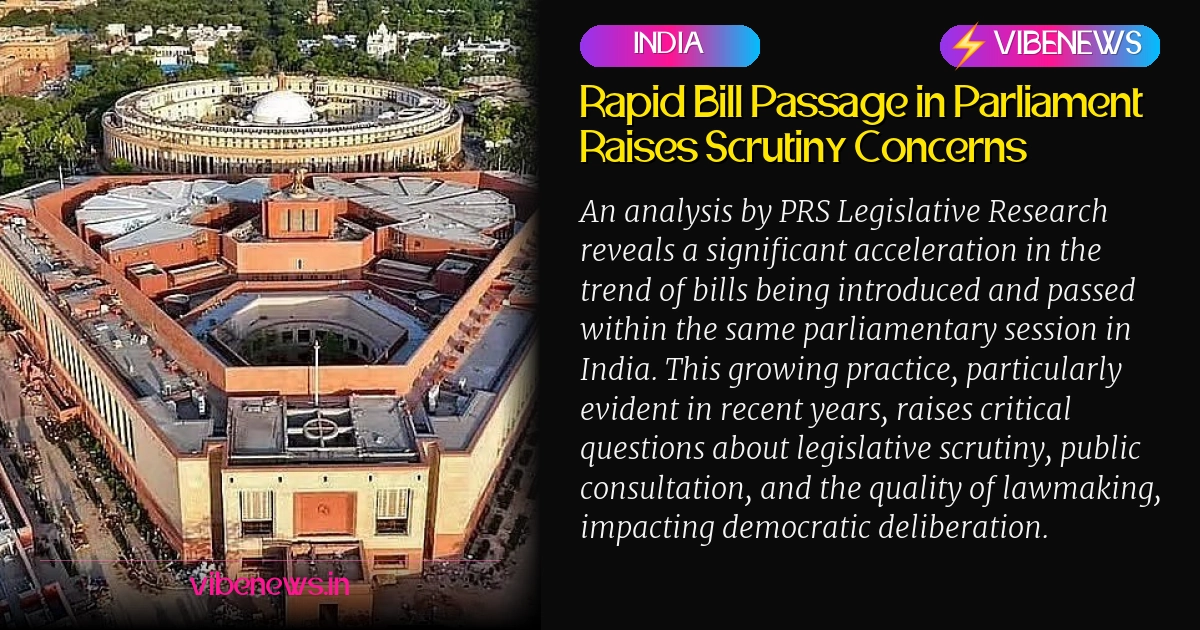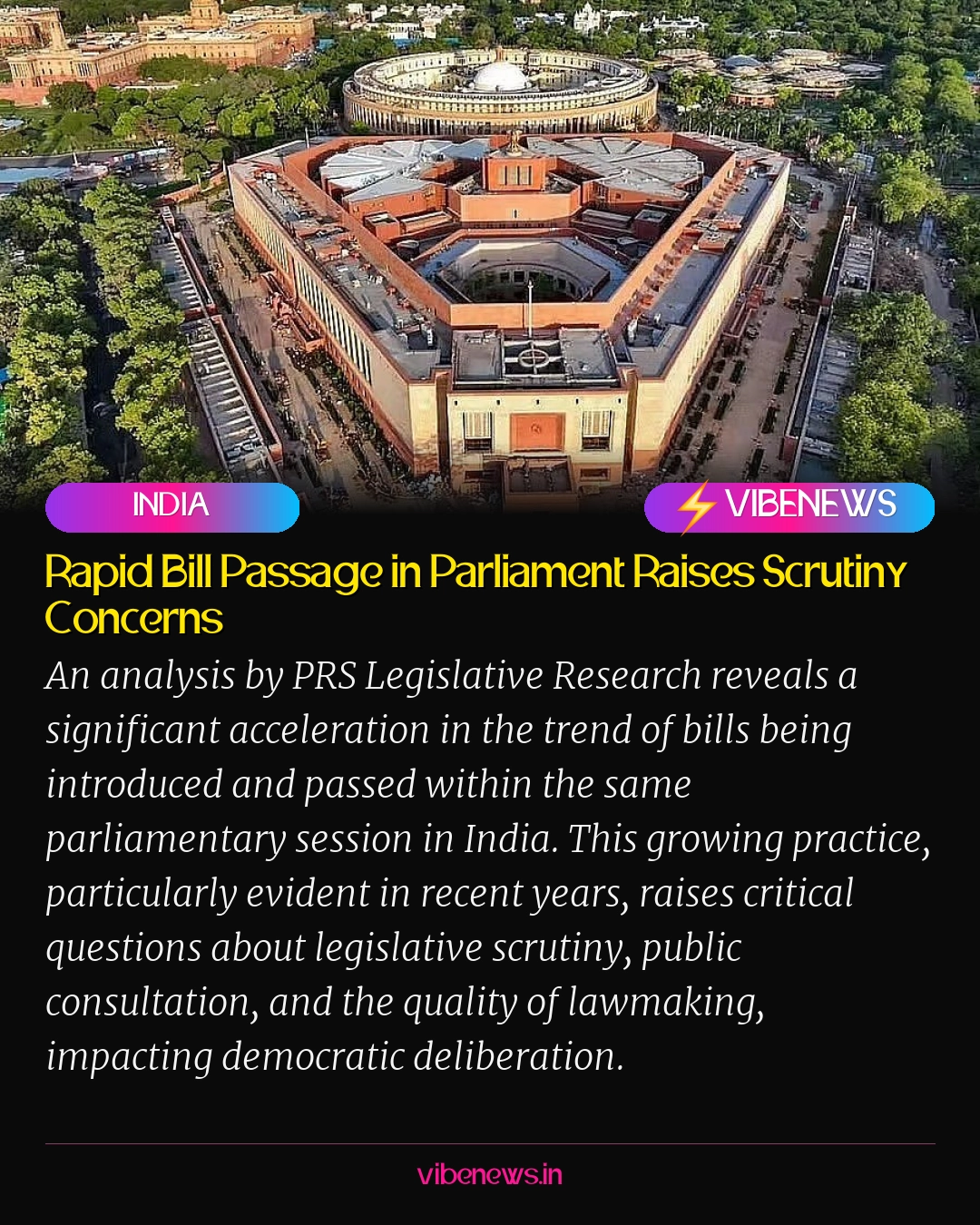
India’s parliamentary process is witnessing a notable shift, with a growing number of legislative proposals being introduced and subsequently passed within the confines of a single session. This accelerating trend, meticulously documented by PRS Legislative Research, an independent body tracking legislative activity, has ignited discussions among political analysts and civil society about the efficacy of legislative scrutiny and the robustness of democratic deliberation.
The data paints a clear picture of this expedited legislative journey. During the 16th Lok Sabha, approximately 33 percent of introduced bills completed their passage in the same session. This proportion saw a substantial increase in the 17th Lok Sabha, nearly doubling to about 62 percent. The current 18th Lok Sabha, despite a slower start, continues this trajectory, with 53 percent of the 64 bills introduced so far having been passed by both Houses in their session of introduction.
The Legislative Pace Accelerates
A closer examination of recent parliamentary sessions underscores the intensity of this trend. The Monsoon Session of 2026, for instance, saw an overwhelming 11 out of 12 introduced bills successfully navigate both Houses before the session concluded. This rapid pace contrasts sharply with the government’s initial legislative agenda, which had listed only five new bills for introduction and passage. Intriguingly, six of the 11 bills eventually passed had not even been part of the original agenda, suggesting a dynamic and often reactive legislative approach.
Similarly, the Budget Session of 2026 witnessed five of its ten introduced bills completing passage within the same timeframe. While the 18th Lok Sabha’s initial Budget Session in 2024 did not see any bills passed in the same session, and the subsequent Winter Session 2024 also left its introduced bills pending, the trend re-emerged strongly in 2025. The Budget Session of 2025 saw three out of five bills passed, followed by eight out of thirteen in the Monsoon Session, and seven out of nine in the Winter Session of the same year.
Concerns Over Scrutiny and Deliberation
The primary concern emanating from this accelerated legislative process, as highlighted by PRS Legislative Research, is the significant reduction in the time available for Members of Parliament (MPs) to thoroughly examine proposed legislation. A short gap between introduction and passage inherently limits opportunities for detailed debate, amendments, and crucial consultations with various stakeholders, including experts, civil society organizations, and the public.
The Monsoon Session of 2026 provided stark examples of this diminished scrutiny. Nine bills were reportedly cleared without any MP, other than the minister piloting them, speaking on the legislation. Furthermore, seven of the eleven bills passed during this session were cleared in five minutes or less. Such swift passage raises serious questions about the depth of parliamentary deliberation and the quality of the laws being enacted, potentially bypassing the rigorous scrutiny essential for robust legislation.
Parliamentary Functioning and Disruptions
This trend of rapid bill passage cannot be entirely divorced from the broader context of parliamentary functioning, which has often been characterized by disruptions and reduced working hours. The Monsoon Session of 2026, for instance, was marked by significant disruptions over issues like the NEET-UG paper leak, police action against protesting students, and alleged theft from the Ram temple. Consequently, Lok Sabha functioned for only 15 percent of its scheduled time, and Rajya Sabha for 33 percent.
The impact on critical parliamentary mechanisms was profound. Question Hour, a vital avenue for holding the executive accountable, functioned for a mere one percent of its scheduled time in Lok Sabha and 12 percent in Rajya Sabha. In Lok Sabha, Question Hour was held for only nine minutes during the entire session, with only two of 380 listed questions receiving oral answers. Such curtailed functioning, while not directly causing rapid bill passage, creates an environment where legislative business might be rushed to compensate for lost time, further compromising scrutiny.
The Role of Parliamentary Committees
Traditionally, parliamentary committees play a crucial role in the legislative process. They provide a forum for detailed, non-partisan examination of bills, allowing for expert input, public feedback, and often leading to significant improvements in the draft legislation. When bills are rushed through without being referred to committees, or when committees are given insufficient time, this vital layer of scrutiny is bypassed.
The input mentions that some bills, like the Indian Statistical Institute Bill, 2026, remained pending, and others, such as the Viksit Bharat Shiksha Adhishthan (VBSA) Bill, 2025, were referred to committees but their reports were not presented. The Foreign Contribution (Regulation) Amendment (FCRA) Bill, 2026, was referred to a Joint Committee amid opposition demands for its withdrawal. These instances highlight the importance of committee scrutiny, even as the overall trend points towards its reduction.
Editorial Context: Long-Term Implications for Indian Democracy
The increasing frequency of bills being introduced and passed within the same parliamentary session represents more than just an procedural shift; it carries profound long-term implications for the health of Indian democracy and the quality of its governance. Parliament, at its core, is designed to be a deliberative body, a forum where diverse perspectives are heard, debated, and reconciled before laws are enacted. When this deliberative function is curtailed, the very essence of representative democracy is challenged.
Laws passed without adequate scrutiny risk being poorly drafted, containing loopholes, or having unintended consequences that could adversely affect citizens and various sectors of society. Furthermore, the bypassing of detailed debate and public consultation can erode public trust in the legislative process, fostering a perception that laws are imposed rather than carefully crafted through democratic engagement. This trend could also diminish the role and effectiveness of the opposition, whose primary function is to scrutinize government proposals and offer alternative viewpoints. Over time, such practices could lead to a more executive-dominated legislative landscape, potentially weakening the checks and balances inherent in a parliamentary system and impacting the foundational principles of accountability and transparency.
TL;DR
- Over 50% of bills introduced in the 18th Lok Sabha have been passed in the same session, according to PRS Legislative Research.
- This trend has sharply accelerated, nearly doubling from 33% in the 16th Lok Sabha to 62% in the 17th Lok Sabha.
- The Monsoon Session of 2026 saw 11 out of 12 introduced bills passed, with six of these not on the original legislative agenda.
- PRS highlights concerns about reduced time for MP scrutiny and stakeholder consultations due to rapid passage.
- Nine bills in the Monsoon Session 2026 were cleared without any MP speaking besides the minister, and seven passed in under five minutes.
- Parliamentary disruptions have also impacted working hours, with Lok Sabha functioning for only 15% of its scheduled time in Monsoon 2026.