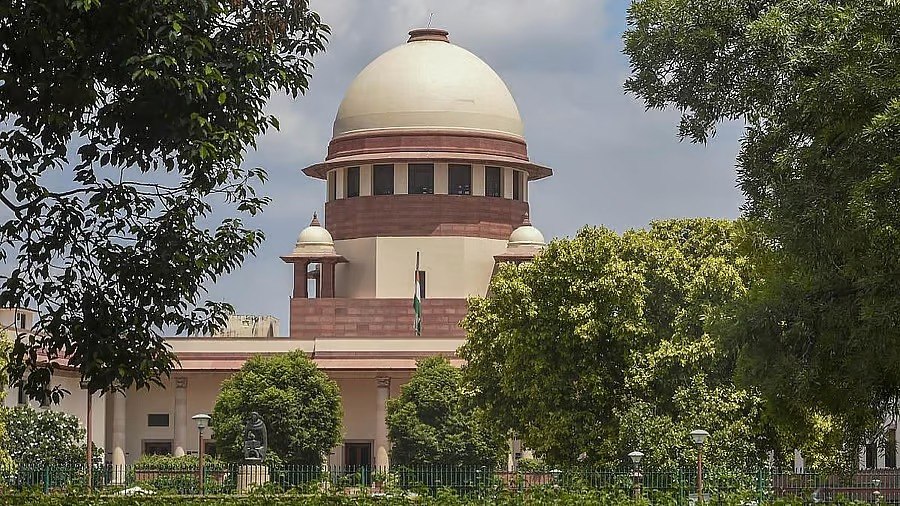
In a significant ruling that refines the interpretation of India’s stringent anti-discrimination legislation, the Supreme Court has held that caste-based abuse uttered within a private space, not accessible to public view, does not meet the statutory requirements to be considered an offense under the Scheduled Castes and the Scheduled Tribes (Prevention of Atrocities) Act, 1989. This decision, delivered by a bench of Justices Vikram Nath and Sandeep Mehta, underscores the specific conditions under which the Act’s provisions apply, particularly concerning the element of "public view."
The apex court’s pronouncement came while setting aside an Allahabad High Court order. The High Court had previously refused to quash proceedings initiated under the SC/ST Act against a school manager. The Supreme Court’s intervention clarifies a critical aspect of the Act, which aims to protect marginalized communities from caste-based atrocities.
The Case Under Scrutiny
The legal challenge originated from a complaint filed against a school manager. The complainant, a father of two students, alleged that he was assaulted and subjected to caste-based abuses by the manager and other staff members. This incident reportedly occurred on January 24, 2020, after the father visited the school to discuss an injury his son sustained during a quarrel with other students.
The First Information Report (FIR) was subsequently registered, including charges of rioting, causing hurt, wrongful confinement, and intentional insult. Crucially, it also invoked sections 3(1)(r) and 3(1)(s) of the Scheduled Castes and the Scheduled Tribes Prevention of Atrocities Act, which deal with intentional insult or intimidation with intent to humiliate a member of a Scheduled Caste or a Scheduled Tribe in any place within public view.
The Argument for Private Space
The school manager challenged the proceedings before the Allahabad High Court, arguing that the alleged incident took place inside an enclosed room within the school premises. He contended that this room, described as "room A," had no windows and was not open to the public, thus failing to meet the "within public view" criterion essential for invoking the SC/ST Act’s specific provisions.
He further highlighted that the witnesses’ statements did not confirm their presence inside the room when the alleged casteist remarks were made. Their testimonies primarily indicated that a scuffle had occurred, rather than corroborating the public utterance of caste-based slurs. The Allahabad High Court, however, had declined to quash the proceedings, leading to the appeal before the Supreme Court.
Judicial Interpretation of "Public View"
The Supreme Court meticulously examined the statutory requirement of an offense occurring "within public view." The bench emphasized that for a place to be considered "within public view," it must be open where members of the public can genuinely witness or hear the utterance made by the accused to the victim. This interpretation is pivotal to understanding the scope of the Act.
The Court explicitly stated, "If the alleged offence takes place within the four corners of the wall where members of the public are not present, then it cannot be said that it has taken place at a place within public view." This clarifies that mere presence on school premises does not automatically render an enclosed space "public" for the purposes of the Act.
Furthermore, the bench noted that the FIR did not specifically attribute any caste-based slurs to the school manager individually. The material presented by the prosecution, at its highest, indicated a quarrel and scuffle between the parties, but lacked specific evidence of caste-based utterances directly attributable to the appellant. Consequently, the top court quashed the proceedings against the school manager under the SC/ST Act, while clarifying that the case relating to other alleged offenses would proceed independently.
The Legislative Intent Behind the SC/ST Act
The Scheduled Castes and the Scheduled Tribes (Prevention of Atrocities) Act, 1989, is a landmark legislation designed to prevent atrocities against members of Scheduled Castes and Scheduled Tribes. It aims to establish special courts for the trial of such offenses and provide for the relief and rehabilitation of victims. The Act was enacted to address the historical injustices and discrimination faced by these communities, providing a legal framework to punish perpetrators and deter future acts of discrimination.
Over the years, the Act has undergone amendments to strengthen its provisions and address evolving challenges. However, its implementation has also sparked debates regarding its scope and potential for misuse. The "public view" clause, in particular, has been a subject of judicial scrutiny, as it distinguishes between private insults and those intended to publicly humiliate, which carry a greater societal impact and are specifically targeted by the Act.
Editorial Context: Refining Legal Safeguards
This Supreme Court ruling holds significant long-term implications for the application and interpretation of the SC/ST Act across India. By precisely defining "public view," the Court aims to ensure that the Act is applied judiciously, targeting genuine acts of public humiliation and discrimination while preventing its invocation in purely private disputes that may not meet the legislative intent of public atrocity.
The decision does not dilute the Act’s fundamental purpose of protecting vulnerable communities. Instead, it provides clarity on the specific circumstances under which certain provisions are applicable. This judicial refinement is crucial for maintaining the integrity of the law, ensuring that it remains a potent tool against caste-based discrimination without becoming susceptible to misapplication in cases lacking the element of public humiliation.
Legal experts suggest that such clarifications are vital for striking a balance between protecting the rights of marginalized communities and ensuring due process for the accused. It encourages a more rigorous examination of evidence, particularly concerning the context and visibility of alleged offenses, thereby strengthening the overall legal framework against caste-based atrocities in India.
TL;DR
- The Supreme Court ruled that caste-based abuse in a private space, not visible to the public, is not an offense under the SC/ST Act.
- This decision clarifies the "within public view" clause, a statutory requirement for certain offenses under the Act.
- The ruling came from a case involving a school manager accused of assaulting and abusing a father in an enclosed room.
- The Court emphasized that a place must be genuinely open for public witness or hearing for the "public view" criterion to be met.
- Proceedings against the school manager under the SC/ST Act were quashed, but other charges will proceed.
- The judgment aims to refine the Act’s application, ensuring it targets public humiliation while preventing misuse in private disputes.