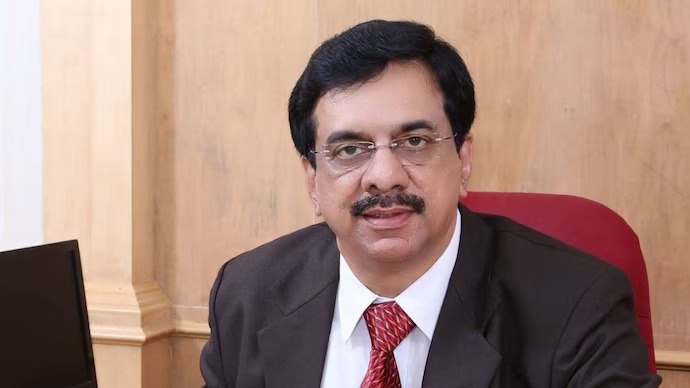
Thrissur School Owner’s Controversial Independence Day Remarks
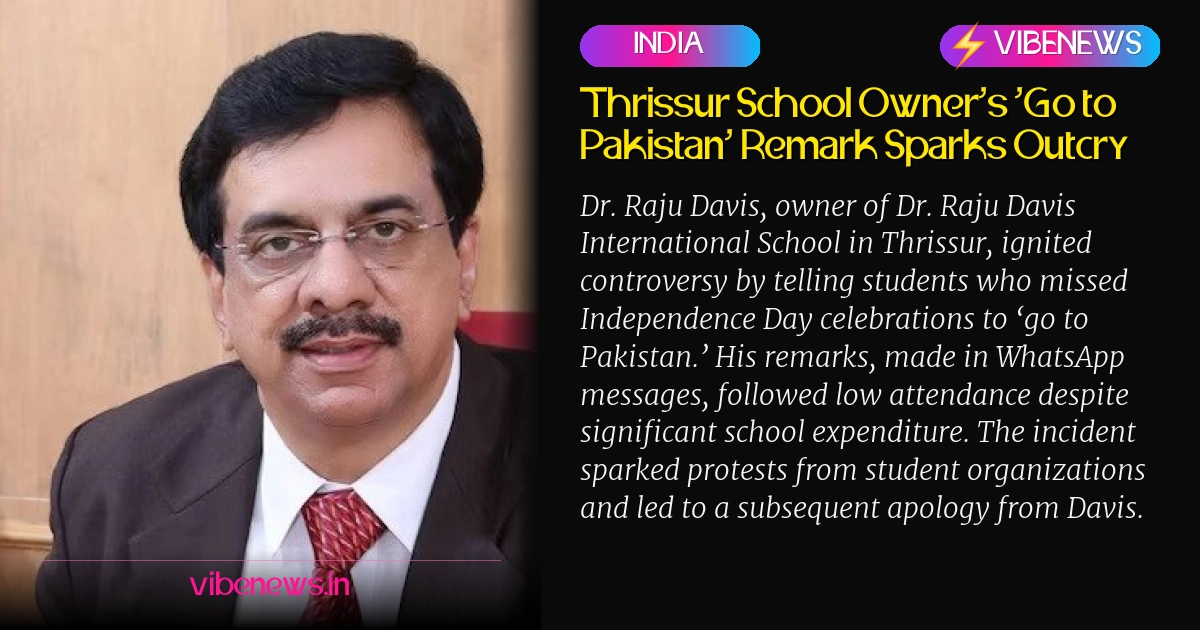
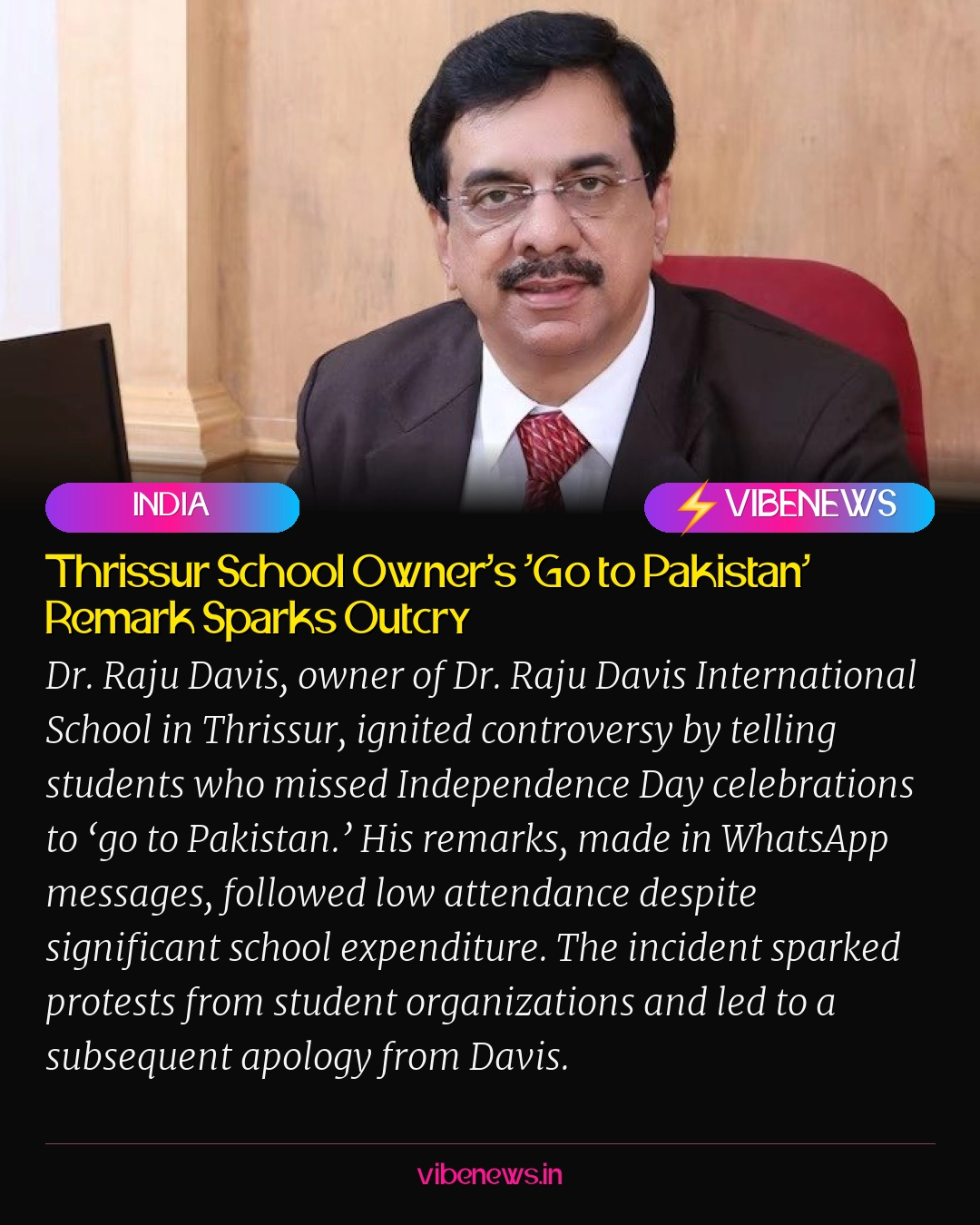
Dr. Raju Davis, owner of Dr. Raju Davis International School in Mala, Thrissur, ignited a significant controversy with remarks directed at students who missed the Independence Day celebrations. His message, shared on school WhatsApp groups, suggested that those who did not attend should "go to Pakistan" as they "don’t deserve to live here." This statement quickly drew widespread condemnation and sparked protests across Kerala.
The incident unfolded after more than half of the parents reportedly did not send their children to school for the August 15 festivities. Dr. Davis expressed his disappointment, highlighting the additional expenditure of Rs 1 lakh incurred to arrange bus services on all routes specifically for the event. He emphasized his desire for students to understand the significance and greatness of Independence Day, a sentiment he felt was undermined by the low attendance.
The Owner’s Rationale and Subsequent Clarification
In his initial message, Davis stated, "I won’t let them inside class tomorrow. They have to meet me in person and give an explanation. This is very very bad. These people must go to some other nation, Pakistan. They don’t deserve to live here." Following the immediate backlash, he issued an audio message attempting to clarify his controversial statement. He asserted that his reference to Pakistan was not religiously motivated but stemmed from its historical status as India’s "enemy nation" since 1947. He maintained that his intention was to underscore the universal responsibility of participating in national celebrations.
The remarks did not go unnoticed by student organizations in Kerala, which swiftly mobilized in protest. The Students’ Federation of India (SFI) and the Kerala Students Union (KSU), the student wing of the Indian National Congress, condemned Davis’s comments as divisive and unpatriotic. KSU activists staged a demonstration directly in front of Dr. Raju Davis’ residence, blocking roads and leading to arrests by local police. These protests underscored the deep sensitivity surrounding national identity and communal rhetoric in the state.
Public Outcry and Student Protests
Faced with mounting pressure and public condemnation, Dr. Davis later issued another audio message, offering an apology for his remarks. While the apology aimed to de-escalate the situation, the incident has already ignited a broader discussion about the appropriate language for educators, the boundaries of expressing patriotism, and the potential for such statements to foster division within a diverse student body. The swiftness of the protests and the subsequent apology highlight the immediate societal impact of such controversial pronouncements.
Independence Day: A National Tapestry
Independence Day, celebrated annually on August 15, commemorates India’s freedom from British rule in 1947. It is a day of profound national significance, marked by flag-hoisting ceremonies, cultural programs, and patriotic fervor across the country. Educational institutions traditionally play a crucial role in these celebrations, organizing events designed to instill a sense of national pride and educate younger generations about the sacrifices made by freedom fighters. The expectation for students to participate is often high, reflecting a collective desire to pass on historical memory and civic responsibility.
The Weight of Historical Context
The reference to Pakistan carries a particularly heavy historical and emotional weight in India. The partition of India in 1947, which led to the creation of Pakistan, was accompanied by immense violence and displacement, leaving deep scars on the collective consciousness of both nations. Decades of geopolitical tensions and conflicts have further entrenched a narrative where Pakistan is often invoked in discussions of national loyalty or dissent. For an educator to use this historical rivalry as a punitive measure for non-attendance at a national event, regardless of intent, is seen by many as highly problematic and potentially inflammatory.
Educational Leadership and Ethical Boundaries
The role of a school owner extends beyond administrative duties; it encompasses setting an ethical tone and fostering an inclusive environment. Educators are entrusted with shaping young minds, and their words carry significant authority and influence. Remarks that could be interpreted as questioning a student’s patriotism or suggesting emigration based on attendance at an event raise serious questions about pedagogical ethics and the promotion of a tolerant, democratic ethos within educational spaces. Such incidents often prompt a re-evaluation of how national values are communicated and reinforced in schools.
Editorial Context: A Broader Dialogue on Patriotism and Inclusivity
The controversy surrounding Dr. Raju Davis’s remarks in Thrissur transcends a mere attendance dispute; it opens a critical dialogue on the evolving nature of patriotism in contemporary India and the responsibilities of educational institutions in fostering it. In an increasingly polarized social landscape, the incident underscores the delicate balance between promoting national pride and ensuring inclusivity within diverse student populations. The use of loaded political rhetoric by an educator, even if later clarified or apologized for, can have lasting psychological impacts on students and contribute to an environment of fear or alienation.
This event highlights the imperative for school leaders to exercise extreme caution and sensitivity when addressing issues of national identity, especially in a country as diverse as India. It forces a reflection on whether patriotism should be enforced through attendance mandates and punitive language, or cultivated through understanding, dialogue, and respect for individual choices. Over the long term, such incidents can either deepen societal divides or, if handled constructively, lead to a more nuanced understanding of civic duty and national belonging that embraces pluralism rather than demanding conformity through exclusionary rhetoric. The public and student body’s strong reaction signals a growing demand for educational spaces that champion democratic values and thoughtful engagement over simplistic, potentially inflammatory pronouncements.
TL;DR
- Dr. Raju Davis, owner of Dr. Raju Davis International School in Thrissur, told students who missed Independence Day celebrations to ‘go to Pakistan.’
- The remarks were made in WhatsApp messages after over half of parents reportedly did not send their children to the August 15 event.
- Davis cited an additional Rs 1 lakh expense for bus arrangements and expressed disappointment over low attendance.
- He later clarified that his reference to Pakistan was due to its historical status as an ‘enemy nation,’ not religion.
- Student organizations SFI and KSU protested the remarks, with KSU activists being arrested during a demonstration.
- Davis subsequently issued an audio message apologizing for his controversial statements.