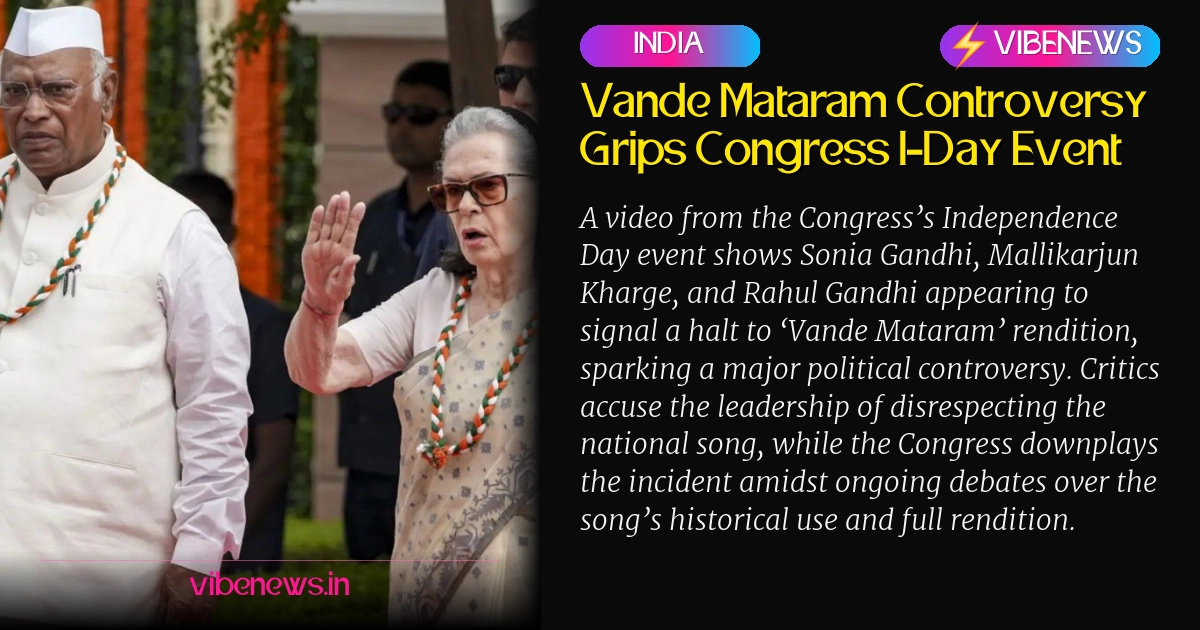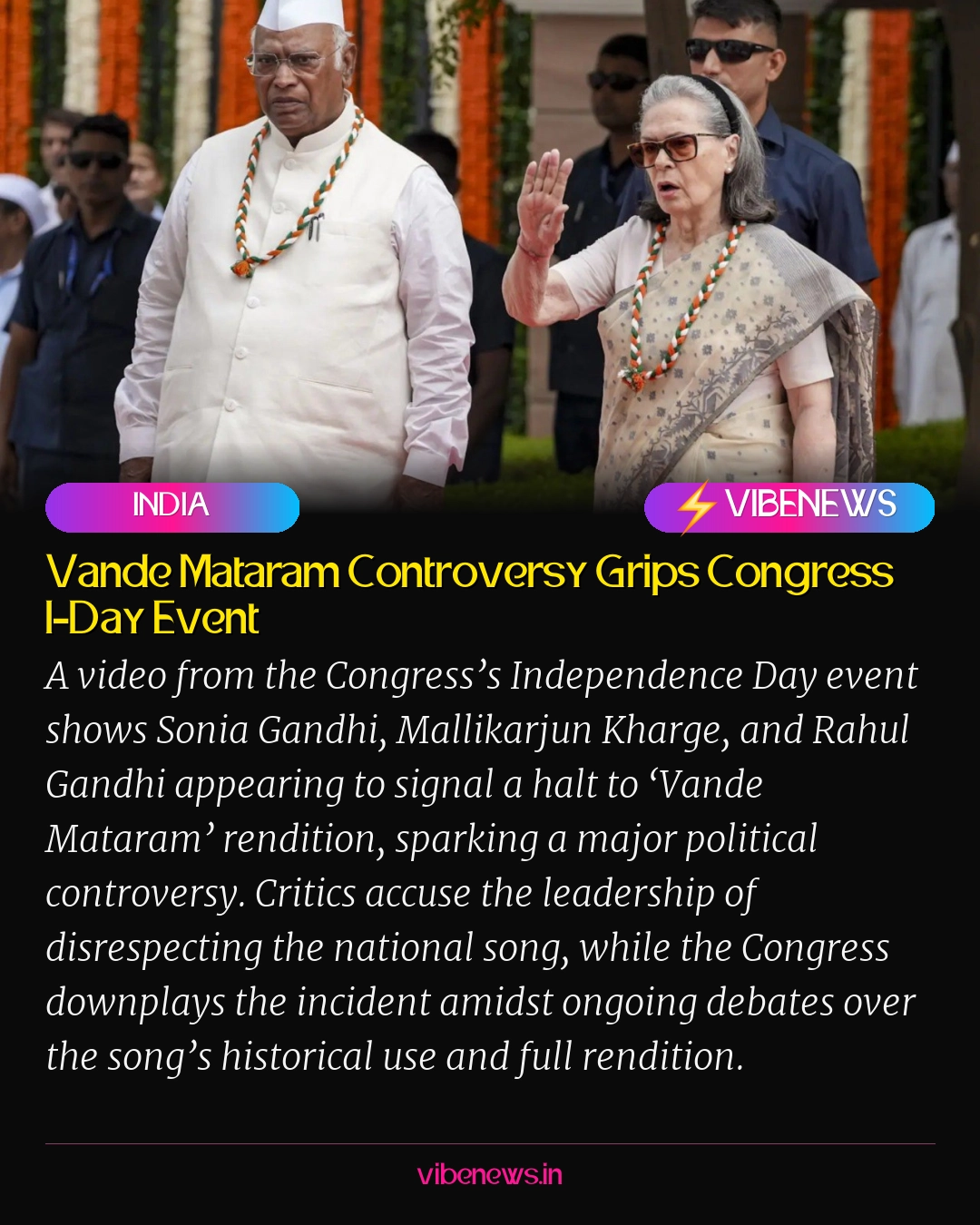
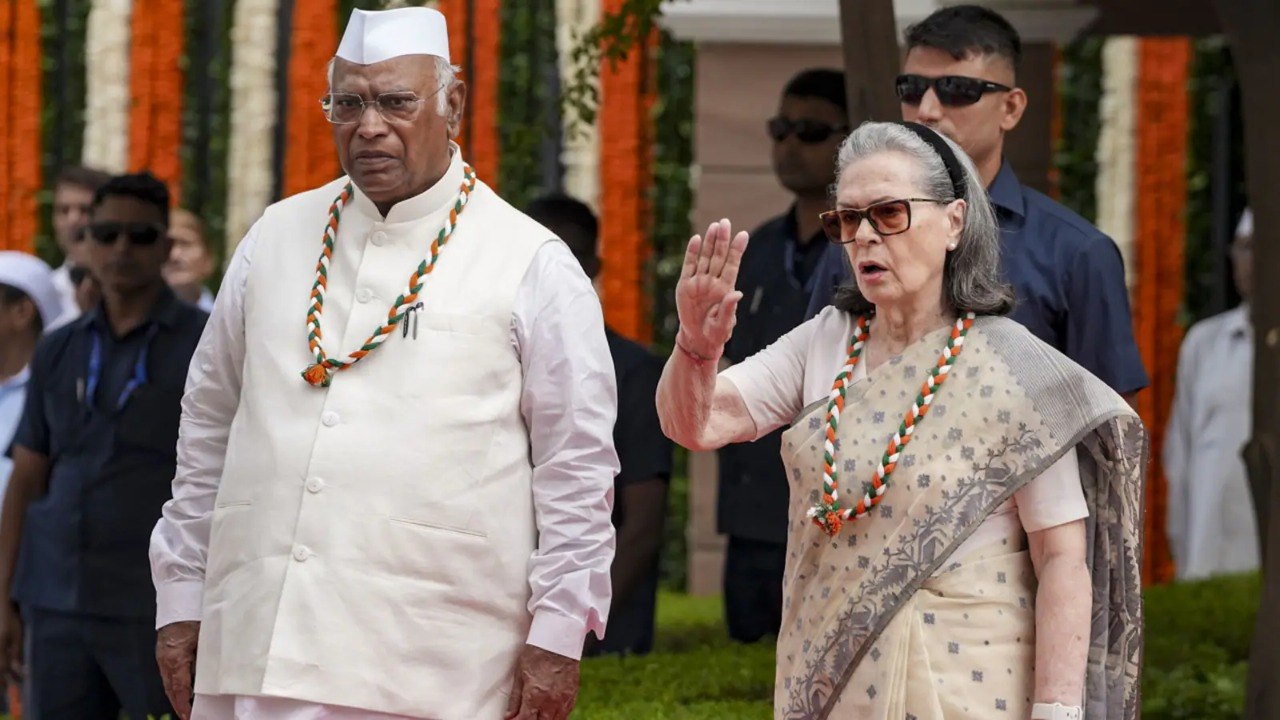
A significant political controversy has erupted following the circulation of a video from the Congress party’s Independence Day celebrations at its New Delhi headquarters. The footage appears to show Congress Parliamentary Party chairperson Sonia Gandhi and party president Mallikarjun Kharge making gestures that seemed to indicate a desire to stop the rendition of the national song, Vande Mataram.
Rahul Gandhi, a prominent party leader, was also seen making a similar gesture moments later. This visual quickly spread across social media platforms, drawing sharp criticism and fueling allegations that the Congress leadership harbored discomfort with the revered national song.
The Incident at Congress Headquarters
The video captures Sonia Gandhi, Rahul Gandhi, and Mallikarjun Kharge attending the Independence Day function alongside other party leaders and workers. As the strains of Vande Mataram filled the air, both Sonia Gandhi and Kharge are distinctly seen making hand gestures towards those around them, which observers interpreted as a signal to halt the singing or playing of the song.
Rahul Gandhi’s subsequent similar gesture further amplified the controversy. Critics swiftly seized upon the footage, accusing the Congress leadership of disrespecting a song deeply embedded in India’s freedom struggle and national identity.
Congress’s Measured Response
In the immediate aftermath, the Congress party sought to de-escalate the situation. Senior Congress leader Ashok Gehlot, when questioned by reporters about the video and the ensuing allegations, stated, "There is no controversy. Congress’ high command or Jairam Ramesh will tell you about the party’s approach."
However, a detailed explanation from the party’s top leadership regarding the gestures has yet to be provided. This lack of a clear clarification has allowed the controversy to persist, leaving room for continued speculation and political attacks.
Vande Mataram: A Legacy of Patriotism and Debate
The national song, Vande Mataram, holds a profound place in India’s history. Penned by Bankim Chandra Chatterjee in 1875 and later incorporated into his seminal novel ‘Anandamath,’ it quickly became a powerful rallying cry during India’s freedom movement against British rule.
While the first two stanzas of the song were officially adopted as the National Song, the complete version contains additional passages. These longer sections have historically been a subject of debate due to their religious imagery and references to Hindu traditions, leading to varying interpretations and acceptance across different communities.
The Intensifying Political Battle
This latest incident at the Congress headquarters unfolds amidst an already intensifying political battle surrounding Vande Mataram. Prime Minister Narendra Modi has, on multiple occasions, criticized the Congress party, alleging that it historically shortened the national song by retaining only its initial two stanzas.
During a recent parliamentary discussion, Prime Minister Modi reiterated his accusations, asserting that the Congress had "cut" Vande Mataram and questioning its handling of objections to certain portions of the song in the pre-Independence era. This historical narrative forms a crucial backdrop to the current dispute.
National Emphasis and Regional Divergence
Significantly, Vande Mataram has occupied a prominent place in this year’s Independence Day celebrations across the nation. Prime Minister Modi’s Red Fort ceremony, a focal point of national festivities, notably featured the national song before the national anthem, ‘Jana Gana Mana.’
The event also commemorated 150 years of Vande Mataram’s legacy, underscoring its importance in the national consciousness. Furthermore, both the Lok Sabha and Rajya Sabha proceedings concluded with the rendition of Vande Mataram on the final day of the Monsoon Session, highlighting a concerted effort to emphasize the song’s significance.
However, regional approaches have varied. In Kerala, the Congress-led government recently issued Independence Day instructions for schools that focused on flag hoisting and the national anthem, ‘Jana Gana Mana,’ without explicitly directing institutions to sing Vande Mataram. This move drew criticism from the BJP, illustrating the song’s continued role as a point of contention in state-level politics as well.
Editorial Context
The controversy surrounding the Vande Mataram incident at the Congress’s Independence Day event is more than just a fleeting political skirmish; it underscores deeper, long-term ideological fault lines within Indian politics. Over the years, Vande Mataram has transcended its role as a mere national song to become a potent symbol in the cultural and political discourse, often used to define patriotism and national identity.
For the Congress, an incident like this, even if unintentional, can reinforce narratives propagated by its political rivals regarding its stance on national symbols and cultural heritage. In an increasingly polarized political landscape, such visual cues can have a disproportionate impact on public perception, potentially alienating segments of the electorate who hold Vande Mataram in high regard.
Conversely, for the Bharatiya Janata Party (BJP) and its allies, this controversy provides fresh ammunition to highlight perceived inconsistencies or a lack of reverence from the opposition towards nationalistic symbols. This strategic use of cultural issues to gain political mileage is a recurring theme in Indian elections and public debate.
The ongoing debate about the full versus shortened version of Vande Mataram also reflects a broader struggle over historical narratives and their interpretation. As India continues to evolve, the way its political parties engage with and present national symbols will remain a critical indicator of their ideological positioning and their appeal to a diverse electorate. The long-term implications of such incidents lie in their potential to shape public discourse and influence electoral outcomes by tapping into deeply held sentiments about national pride and cultural identity.
TL;DR
- A video from the Congress’s Independence Day event shows Sonia Gandhi, Mallikarjun Kharge, and Rahul Gandhi appearing to signal a halt to the rendition of ‘Vande Mataram’.
- The incident quickly sparked widespread criticism and accusations of disrespect towards the national song on social media.
- Congress leaders have downplayed the controversy, with Ashok Gehlot stating there is "no controversy," but a detailed explanation from the leadership is pending.
- The row reignites a long-standing political debate about ‘Vande Mataram’s’ historical use, its full versus shortened rendition, and its religious imagery.
- Prime Minister Narendra Modi has previously criticized the Congress for allegedly shortening the song and its handling of objections in the past.
- The controversy emerges amidst a national emphasis on ‘Vande Mataram’ in this year’s Independence Day celebrations, including at the Red Fort ceremony and parliamentary sessions.