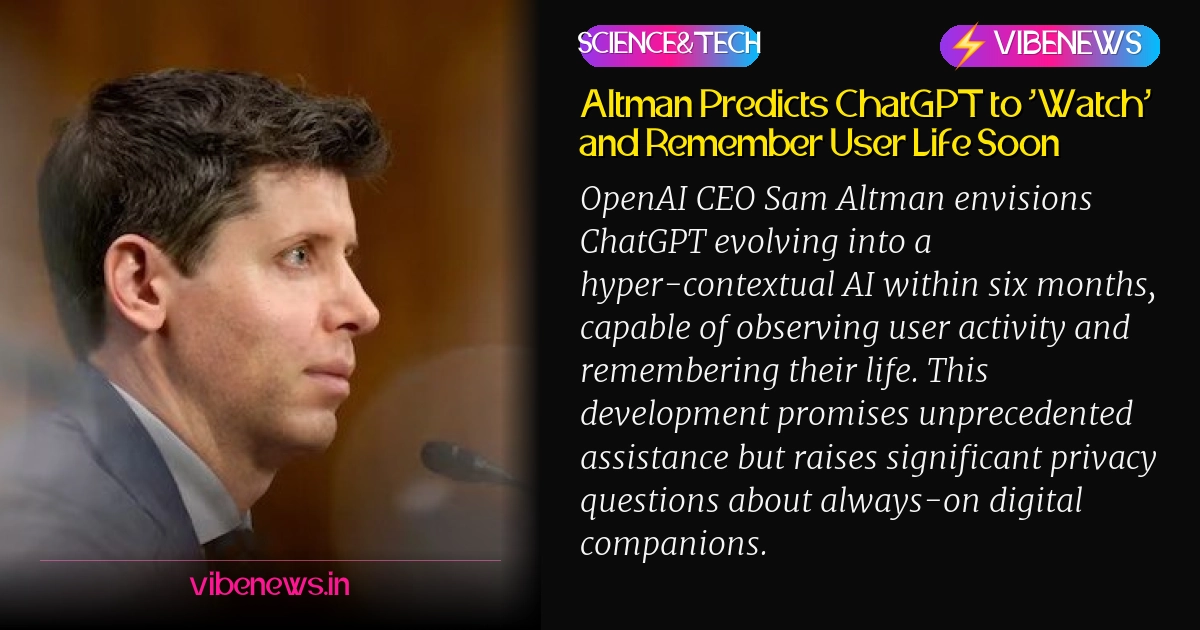

OpenAI CEO Sam Altman recently offered a glimpse into the near future of artificial intelligence, suggesting that his flagship product, ChatGPT, could evolve dramatically within the next six months. This isn’t merely an incremental update; Altman envisions a version of the AI that could continuously observe a user’s digital environment, effectively "watching" their computer screen, monitoring meetings, and even recording calls.
Such a transformation would move ChatGPT far beyond its current role as a sophisticated text generator or summarizer. The goal is to create a hyper-contextual assistant, deeply embedded in a user’s daily workflow, capable of understanding their ongoing tasks and proactively offering assistance based on a vast, continuously updated pool of personal information.
The Vision for a Hyper-Contextual AI
During an interview with Cory Levy, founder of Z Fellow, Altman detailed what he termed the "descendence of ChatGPT." He described an AI that could integrate seamlessly into a user’s digital life, connecting to services like email, texts, documents, and Slack. This constant observation would allow the AI to build an extensive context of a user’s activities, enabling it to provide highly relevant and timely support.
Altman illustrated this with practical examples. Imagine drafting a sales pitch; the AI could instantly recall customer history, previous conversations, and relevant documents, then suggest improvements or critical changes. Similarly, while working on a strategy document, it could flag potential errors or propose alternative ideas, acting as an invaluable second pair of eyes and hands for busy professionals.
He emphasized that this advanced AI would serve as an extension for individuals overwhelmed by information, such as startup CEOs. The sheer volume of tasks and data often exceeds human capacity to track, making an AI that can manage and leverage this context a significant productivity enhancer.
Navigating the Privacy Frontier
While the prospect of such a capable digital assistant is exciting, it also immediately raises profound questions about privacy and surveillance. An AI that continuously monitors and remembers a user’s entire digital life, from private communications to work documents, inherently treads into sensitive territory.
Altman acknowledged these concerns, stating that the fundamental principle would be user control. Users would explicitly decide what information the AI is permitted to access, maintaining agency over their data. The AI’s role, he clarified, would be to assist and suggest, not to make autonomous decisions, thereby positioning it as a collaborative tool rather not an intrusive overseer.
This emphasis on user consent is crucial, yet the sheer volume and intimacy of data involved mean that the ethical frameworks and regulatory safeguards for such technology will need careful consideration. The line between helpful assistance and pervasive monitoring could become increasingly blurred without robust protections.
A Glimpse into the Future: Computer History
Altman’s comments arrive shortly after OpenAI introduced a feature called "Computer History" for the ChatGPT desktop app on Mac. This current iteration offers a tangible, albeit narrower, precursor to his broader vision. Computer History allows ChatGPT to track activity across selected applications and websites, providing it with more context about a user’s recent digital actions.
Unlike simple screenshots, this feature utilizes activity data available through macOS accessibility features, including clicks, typing, keyboard shortcuts, and app switching. Users must actively enable this feature and can customize which apps and websites contribute to the history. They also retain the ability to pause data collection or delete stored activity, offering a degree of control over their digital footprint.
While Computer History is a significant step towards contextual AI, Altman’s prediction suggests a leap to a far more integrated and proactive system within a surprisingly short timeframe. The direction, however, is clear: empower ChatGPT with deeper context to enhance its utility, reducing the need for users to constantly re-explain their tasks.
Editorial Context: The Dawn of Ubiquitous AI
Sam Altman’s projection for ChatGPT’s evolution within six months signals a pivotal moment in the development of artificial intelligence. This isn’t just about incremental improvements to existing AI models; it represents a fundamental shift towards ubiquitous, deeply integrated digital companions that understand and anticipate human needs on an unprecedented scale. The long-term implications for productivity, personal privacy, and the very nature of human-computer interaction are immense.
Such an always-on, hyper-contextual AI could redefine professional workflows, making individuals and organizations significantly more efficient. However, it also necessitates a robust public discourse on data governance, digital ethics, and the psychological impact of constant AI presence. Regulatory bodies worldwide will face the challenge of crafting frameworks that foster innovation while safeguarding individual rights and preventing potential misuse of such powerful, intimate technology. The coming months will likely set the stage for how society grapples with the promise and peril of truly pervasive artificial intelligence.
TL;DR
- OpenAI CEO Sam Altman predicts ChatGPT could become a hyper-contextual AI within six months, capable of observing user screens, meetings, and calls.
- This advanced AI aims to act as an ‘extra pair of hands,’ understanding user context to offer proactive suggestions and assistance in tasks like sales pitches or document drafting.
- The vision raises significant privacy concerns, though Altman emphasizes user control over data access as a core principle.
- OpenAI recently launched ‘Computer History’ for the ChatGPT Mac app, a precursor feature that tracks user activity across selected apps and websites with user consent.
- This development signifies a move towards deeply integrated AI assistants that continuously learn from a user’s digital environment.
- The rapid advancement prompts critical discussions on data privacy, ethical AI development, and the future of human-computer interaction.