From God Particle to Cosmic Shadows
The discovery of the Higgs Boson, often referred to as the "God Particle," marked a monumental achievement in 21st-century science. Announced by CERN in 2012, this breakthrough validated a decades-old theory explaining how fundamental particles acquire mass, thereby completing the Standard Model of particle physics.
However, for CERN, the European particle physics laboratory situated in Geneva, this monumental discovery was not an endpoint. It signaled a new beginning, propelling the world’s largest particle accelerator towards its next profound scientific challenge: understanding dark matter.
Dark matter, an invisible substance, is theorized to account for a significant portion of the universe’s mass, yet it has never been directly observed. Its elusive nature presents one of the most compelling puzzles in modern astrophysics.
The Higgs Legacy and Future Investigations
CERN Director General Dr. Mark Thomson emphasized that the Higgs Boson itself remains an object of intense scientific scrutiny. He described it as a unique particle, unlike anything previously encountered in nature, possessing "bizarre, weird" properties.
Scientists are committed to delving deeper into the nature of this strange object, seeking to fully comprehend its fundamental characteristics. This ongoing investigation into the Higgs Boson is intrinsically linked to the broader quest for new physics.
The Next Generation Collider
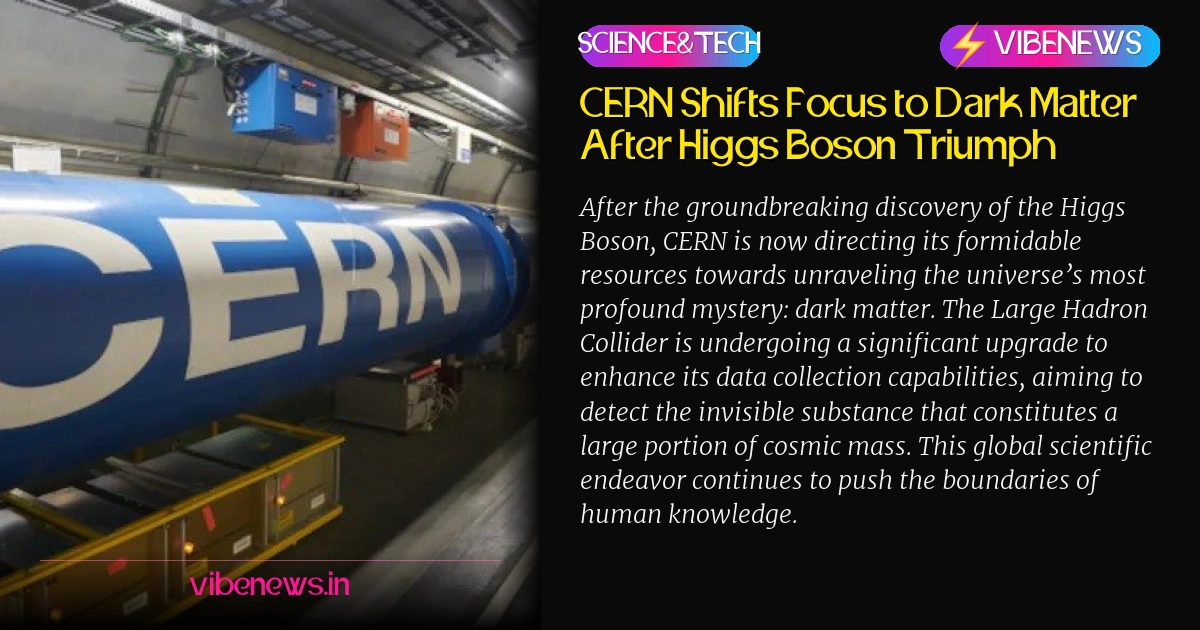
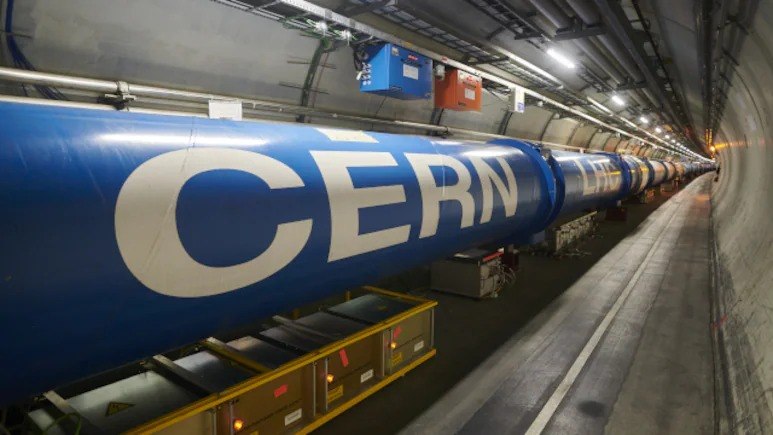
To facilitate these ambitious goals, the Large Hadron Collider (LHC) is currently undergoing a substantial upgrade. This multi-year project involves replacing approximately 1.2 kilometers of critical magnets with advanced technology and enhancing the accelerator’s detectors.
The result will be the High-Luminosity Large Hadron Collider (HL-LHC), designed to generate roughly ten times more data than its predecessor. This increase in luminosity will enable scientists to gather significantly more collision data, crucial for detailed analysis.
The detectors are being equipped with sophisticated silicon technologies, complemented by increasingly advanced computing and artificial intelligence systems. These technological advancements are vital for processing the immense quantities of data that the upgraded experiments will produce.
Unveiling the Universe’s Hidden Mass
The primary objective of the HL-LHC is clear: to collect more data, study the Higgs Boson with unprecedented precision, and search for evidence of particles and phenomena that extend beyond the Standard Model. This includes the elusive dark matter.
Visible matter, encompassing everything from stars and planets to galaxies and human beings, constitutes only about five percent of the universe. Dark matter is believed to make up approximately 27 percent, with dark energy accounting for the remainder, driving the universe’s accelerating expansion.
Dark matter does not emit or reflect light, rendering it invisible to conventional telescopes. Its presence is inferred solely through its gravitational effects on visible matter. While the LHC has previously searched for signs of dark matter without direct detection, the HL-LHC’s enhanced capabilities represent a "giant leap" in this pursuit.
Exploring Antimatter’s Mysteries
Beyond dark matter, CERN is also deeply engaged in antimatter research. Earlier this year, researchers successfully demonstrated the transport of a small quantity of trapped antimatter across the laboratory campus.
This proof-of-principle is significant for future experiments, potentially allowing scientists to conduct more precise investigations in various locations. Experiments involving antihydrogen could help determine if antimatter behaves identically to ordinary matter, with any subtle differences holding profound implications for understanding the universe’s matter-antimatter imbalance.
India’s Deep Scientific Ties
India has a long-standing and integral relationship with CERN, with Indian scientists collaborating since the 1960s, decades before India became an Associate Member State. Today, around 300 Indian scientists contribute to major CERN experiments, developing detector technologies and providing invaluable expertise.
Dr. Archana Sharma, affectionately known as India’s "Godmother at CERN," exemplifies this enduring partnership, having dedicated decades to fostering scientific collaborations and mentoring young researchers. CERN has also played a crucial role in training generations of Indian scientists, engineers, and technologists.
A striking symbol of this connection is the bronze statue of Nataraja, the dancing form of Lord Shiva, which stands at CERN. Presented by India, the statue symbolizes the cosmic dance of creation and destruction, serving as a powerful metaphor for the constant transformation of matter and energy in the universe, bridging ancient Indian philosophy with modern particle physics.
Pondering the Future of Particle Physics
CERN’s ambitions extend even beyond the upgraded LHC. The organization is developing plans for the Future Circular Collider (FCC), a proposed 91-kilometer underground ring, more than three times the circumference of the current LHC.
The initial phase of the FCC would involve colliding electrons and positrons, creating a cleaner environment for extremely precise measurements of the Higgs Boson and other fundamental particles. The long-term vision is to push the search for physics beyond the Standard Model even further, shaping particle physics for the next half-century.
The Higgs Boson provided an answer to one fundamental question about the universe, but many profound mysteries persist. Dark matter remains unidentified, dark energy is poorly understood, and the imbalance between matter and antimatter continues to puzzle physicists. The ongoing and future endeavors at CERN, with global collaboration, represent humanity’s relentless pursuit of these ultimate answers.
TL;DR
- CERN is shifting its primary focus from the Higgs Boson to the search for dark matter, one of the universe’s greatest mysteries.
- The Large Hadron Collider (LHC) is undergoing a multi-year upgrade to become the High-Luminosity LHC (HL-LHC), designed to produce ten times more data.
- The HL-LHC aims to study the Higgs Boson in unprecedented detail and search for evidence of particles beyond the Standard Model, including dark matter.
- Dark matter accounts for approximately 27% of the universe’s mass but does not emit or reflect light, making it invisible to conventional detection.
- CERN is also advancing antimatter research, having successfully demonstrated the transport of trapped antimatter, which could help explain the universe’s matter-antimatter imbalance.
- India has a significant and long-standing collaboration with CERN, contributing scientists, technology, and expertise, symbolized by the Nataraja statue on campus.