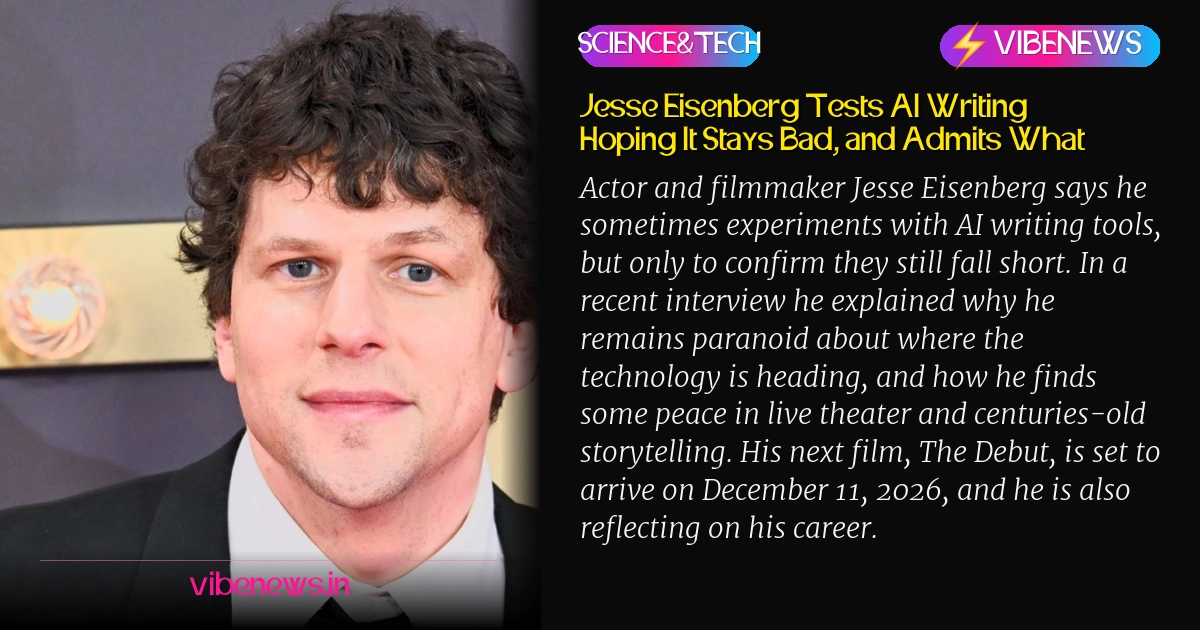
Jesse Eisenberg says he still tests artificial intelligence writing tools, but only to make sure they are bad at the job. In a recent interview, the actor, writer and director explained that he gives AI prompts to write scenes, reads the results and is relieved to find them lacking. The problem, he says, is that the relief doesn’t last long.
Eisenberg, best known for Batman v. Superman and A Real Pain, described himself as totally paranoid about the technology. When asked whether he is nervous about AI, he gave what he called a paranoid answer. He experiments with it to see whether it can write, and so far it still can’t.
"I say, ‘Write a scene like this.’ I’m just testing it to make sure it’s bad, and it’s still bad. So I’m relieved, but, like, how far away is it from being good?" That question is the heart of his concern. Eisenberg is not only worried about screenwriters losing work. He is worried about how easily the tools could be turned into something far more personal.
How far are we from a kid putting on a pair of goggles and saying, ‘I want to watch a movie about me where I rob a bank and then kiss the girl I’m in love with at school. Here are pictures of her, here are pictures of me’ and then they press play? I’m paranoid about that.
That scenario is what keeps him up. It imagines a child using a headset to generate a custom film built from their own photos, classmates and fantasies. Eisenberg didn’t offer a timeline for when that might happen. He simply asked how close we are, and he said the idea makes him uneasy.
Where the industry stands
Eisenberg is far from the only performer who has spoken out. The interview came against a backdrop of growing friction between entertainers and AI companies. Masako Nozawa, the voice actor behind Goku in Dragon Ball, blasted people who had used AI to steal her voice for their own purposes. Nicolas Cage said he will probably not work with Amazon again after he declined to sign the company’s AI waiver.
Not everyone in the business has taken the same position. George Lucas has supported AI in the past, which shows how divided opinions remain. Mario creator Shigeru Miyamoto offered a more measured stance in September, saying Nintendo would prefer to go in a different direction when the subject came up.
Those comments help explain why Eisenberg’s remarks stand out. He is not a tech executive or a labor leader. He is a working actor who writes and directs, and he is speaking from the position of someone who has to decide how much to trust the tools being pitched to his industry.
Where he finds comfort
Eisenberg is not entirely pessimistic. He pointed to two things that he believes will endure. The first is the creative spirit, which he expects will keep finding new ways to entertain people and speak about the world in ways that computers may not manage. The second is art that has survived for generations.
He used Greek plays as his example. Those works were written about 2,500 years ago, and, as he put it, they are still performed the same way they were performed then. If they have lasted that long, he argued, they will still be around. He also referenced Julianne Moore, who is about to go to a play in New York, as a sign of how much theater still matters.
"People want to be in the same room as other people, watching and listening to stories," he said. He compared it to early humans gathered around a campfire. In his view, that impulse is not going anywhere, and there will always be room for it.
The part that still worries him
Even with that optimism, Eisenberg did not pretend the money question is settled. The part that worries him most is not whether people will want stories, but whether artists will still be able to make a living from them. He admitted he is not 100 percent sure about that.
That uncertainty is the most honest line in the interview. Plenty of performers and writers face the same question, and Eisenberg doesn’t claim to have an answer. He is describing a feeling many people in creative work share: the art may survive, but the paycheck is less certain.
What comes next for Eisenberg
Eisenberg’s next movie is The Debut, which is set to arrive on December 11, 2026. The film will be his next public test of how audiences respond to his work as the debate around AI continues to unfold in Hollywood.
He has also been looking back on his career. He recently reflected on how winning a Razzie for playing Lex Luthor affected his career. In June, he talked about what it was like to turn down an opportunity to return as Mark Zuckerberg in The Social Network sequel. Those reflections give context to a performer who has been willing to speak plainly about both his successes and his doubts.
For now, Eisenberg’s approach to AI is simple. He keeps checking, he keeps finding the tools lacking, and he keeps wondering how long that will last. Whether the technology catches up to what he calls good writing is a question he cannot answer yet, and he says so openly.
TL;DR
- Jesse Eisenberg says he sometimes tests AI writing tools, but only to confirm they are still bad at it.
- He admits he is paranoid about how quickly the technology is advancing.
- His biggest fear is a child using AI to generate a personalized movie from their own photos.
- Eisenberg finds comfort in live theater and Greek plays that have lasted 2,500 years.
- He is not sure artists will still be able to make a living from their work.
- His next film, The Debut, is set to arrive on December 11, 2026.