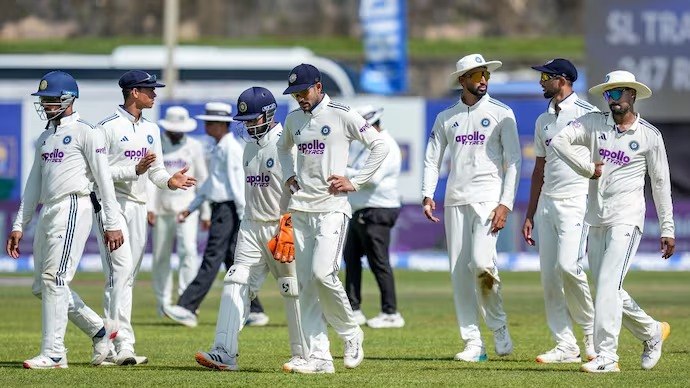
India has established a formidable position in the opening Test against Sri Lanka in Galle, securing a significant 178-run first-innings lead by bowling out the hosts for 284 on Day 3. Despite a valiant maiden Test century from Sonal Dinusha, India’s spin attack, spearheaded by Manav Suthar and Ravindra Jadeja, proved too potent for the Sri Lankan batting lineup.
The day’s play, though interrupted by rain, saw India consolidate its advantage, setting the stage for a potential push for victory on the penultimate day. The visitors will now look to build quickly on their lead and give themselves ample time to bowl Sri Lanka out a second time.
India’s Early Bowling Blitz
Resuming their first innings briefly on Monday morning, India added just four runs before Asitha Fernando dismissed Prasidh Krishna, bringing their total to 462. What followed was a dominant opening session from the Indian bowlers, who quickly put Sri Lanka under immense pressure.
Mohammed Siraj set the tone by removing Nishan Fernando with only his second delivery of the innings. However, it was left-arm spinner Manav Suthar who emerged as the defining bowler of the morning, striking with his very first delivery and consistently troubling the Sri Lankan batters with sharp turn and bounce.
Suthar soon accounted for Lahiru Udara, while Kuldeep Yadav claimed the wicket of Kamindu Mendis, courtesy of an excellent catch by Shubman Gill. Ravindra Jadeja then removed Sri Lanka captain Dhananjaya de Silva before lunch, leaving the hosts reeling at 90 for 5 and staring at a potentially damaging first-innings deficit.
Dinusha and Dickwella’s Resilient Stand
Just as India seemed poised to enforce the follow-on, Sonal Dinusha and Niroshan Dickwella mounted a spirited counter-attack. The pair forged a crucial 146-run partnership for the sixth wicket, effectively blunting India’s spin threat.
Both left-handers adopted an aggressive approach, frequently employing sweeps and slog-sweeps against the Indian spinners. This strategy forced India to spread their fielders, allowing the partnership to flourish as the ball aged and softened.
Dinusha, playing only his fourth Test, displayed remarkable composure to complete his maiden Test century, scoring 100 off 168 balls. Dickwella, meanwhile, contributed a fluent 80 off 115 deliveries, though he narrowly missed out on his own maiden Test hundred, extending his unwanted record of most Test half-centuries without a conversion.
Breaking the Resistance and Jadeja’s Historic Double
The resilient partnership was eventually broken by Prasidh Krishna, who produced a superb delivery with the 62-over-old ball to dismiss Dickwella. This breakthrough was crucial for India, as the partnership had significantly shifted the momentum of the innings.
Ravindra Jadeja, a pivotal figure in India’s Test setup, achieved a remarkable milestone during the innings. He became only the second Indian after Kapil Dev to score over 4,000 runs and take at least 350 wickets in Test cricket. His 350th wicket came when Keshara Nuwantha miscued an away-turning delivery, caught simply by Shubman Gill.
Jadeja now joins an exclusive club alongside Kapil Dev, Ian Botham, and Daniel Vettori, solidifying his status as one of the game’s premier all-rounders. He also became the fifth Indian to reach 350 Test wickets, joining Anil Kumble, Ravichandran Ashwin, Kapil Dev, and Harbhajan Singh.
The Weather’s Unpredictable Role
Despite Dinusha carrying on to reach his maiden hundred, Jadeja soon ended his fine resistance, dismissing him for 100. Manav Suthar then completed his four-wicket haul, ensuring Sri Lanka were eventually bowled out for 284, giving India a substantial 178-run first-innings lead.
However, just as India would have hoped to make further inroads into the match, the weather intervened. Increasing darkness and gathering rain clouds forced the umpires to call stumps early, with 13 overs lost on the day. This interruption means India lost valuable time, leaving a possible 176 overs remaining in the Test.
Editorial Context: The Long Game in Test Cricket
The ebb and flow of Day 3 in Galle perfectly encapsulate the strategic depth and enduring appeal of Test cricket. India’s initial dominance, followed by Sri Lanka’s spirited fightback, and then India’s reassertion of control, highlights the constant tactical adjustments required at the highest level.
For India, securing a significant first-innings lead is paramount, especially on a subcontinent pitch where spin typically dictates terms as the match progresses. The performance of young spinner Manav Suthar, alongside the seasoned Ravindra Jadeja, bodes well for India’s future spin attack and their ability to exploit turning tracks.
The weather, however, remains an unpredictable variable, potentially impacting India’s ability to force a result. The strategic decisions on Day 4, particularly regarding a declaration, will be crucial. India will need to balance scoring quickly with allowing enough time for their bowlers to take 10 wickets on a pitch that might still offer some resistance, even as it deteriorates.
TL;DR
- India secured a commanding 178-run first-innings lead against Sri Lanka in the Galle Test.
- Sri Lanka was bowled out for 284 on Day 3, responding to India’s 462.
- Sonal Dinusha scored his maiden Test century, making 100 runs off 168 balls for Sri Lanka.
- Manav Suthar was India’s leading wicket-taker with 4/76, while Ravindra Jadeja claimed 3/57.
- Ravindra Jadeja achieved a rare Test double, surpassing 4,000 runs and 350 wickets, joining an elite group including Kapil Dev.
- Rain forced an early close to Day 3, resulting in 13 overs being lost and potentially impacting India’s time to push for a victory.