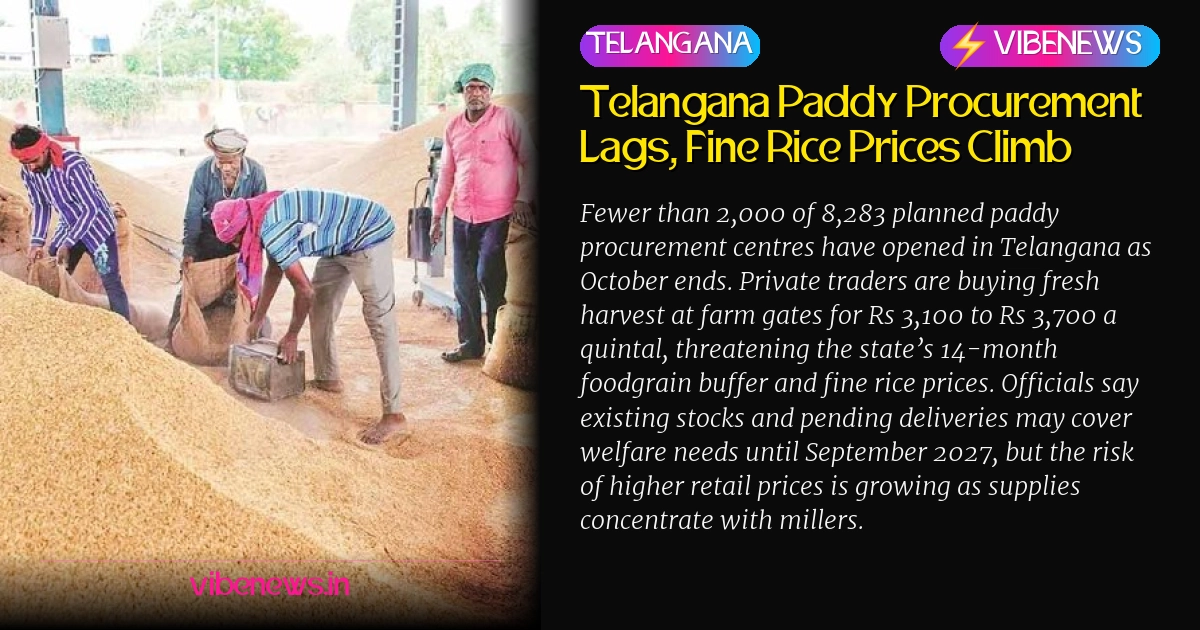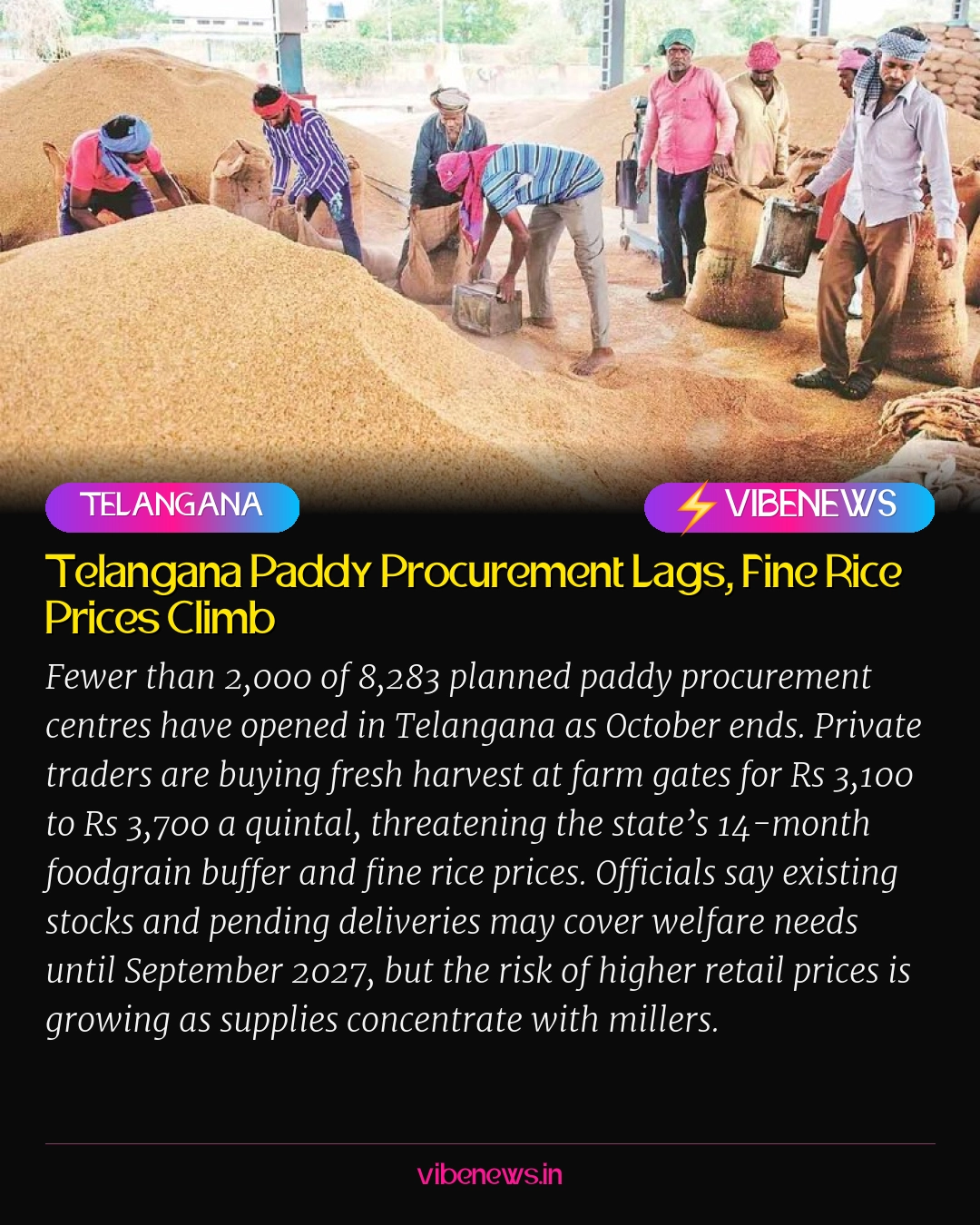
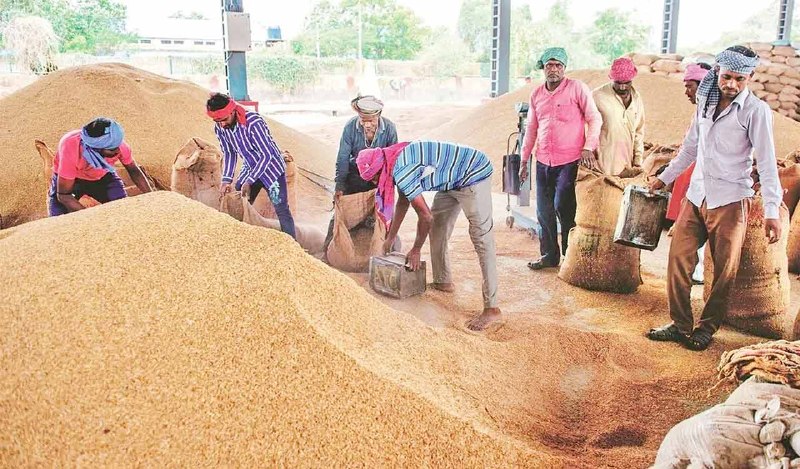
Telangana’s paddy procurement is lagging as private millers and traders buy fresh harvest straight from farmers, putting the state’s planned 14-month foodgrain buffer at risk and pushing up the price of fine rice.
Even as October nears its end, fewer than 2,000 of the 8,283 planned paddy procurement centres have opened. The state government has announced plans to procure 65 lakh tonnes this season, but the target appears difficult to achieve at the current pace.
Private buyers are moving first
Soon after harvesting began earlier this month, millers and traders from Maharashtra, Karnataka and Andhra Pradesh joined local buyers in purchasing paddy directly from farmers. They are offering Rs 3,100 to Rs 3,700 per quintal for fine varieties, and in several areas prices are running above the minimum support price.
At the Kesamudram Agricultural Market in Mahabubabad district on Monday, the Jai Sriram variety reportedly fetched a record Rs 5,016 per quintal. Fine paddy is also commanding Rs 3,100 to Rs 3,700 in districts such as Nalgonda, Karimnagar, Nizamabad and Khammam.
For farmers, the appeal is simple. Private buyers collect freshly harvested paddy at the field, sparing them the cost of drying and transporting it. Immediate payment also beats the delays that come with government procurement. Anticipating demand for fine rice amid concerns over El Niño’s impact on production, buyers are acting early, and that early movement is what is draining supply away from state channels.
Why the buffer is under pressure
Every lot that goes to a private mill is a lot the government does not buy. The diversion could concentrate supplies with private millers and traders, and that concentration carries a clear risk: if availability tightens, retail prices could rise.
The district numbers show the gap. In Nizamabad, the estimated crop is 12 lakh tonnes against a procurement target of 6.5 lakh tonnes, yet officials are unsure whether government purchases will reach four lakh tonnes. In Nalgonda, procurement is expected to reach only two to three lakh tonnes against a target of 4.5 lakh tonnes.
The buffer is built on a monthly need. Telangana requires around 2.38 lakh tonnes of fine rice every month for public distribution, social welfare educational institutions, mid-day meals and other welfare schemes. Missing procurement targets means that monthly demand has to be met from what is already in storage or still in transit.
Stocks on paper, questions on the ground
Around 9.64 lakh tonnes of rice is currently available in buffer godowns. Another 18.39 lakh tonnes is expected through pending custom-milled rice deliveries. Together, the projected 28.03 lakh tonnes is estimated to meet public distribution requirements until September 2027.
Officials put the timeline in plain terms:
"Existing stocks can meet requirements for three-four months, covering ration distribution, mid-day meals, social welfare hostels and other schemes. Supplies for another seven to eight months are pending with millers and are expected shortly."
That last line is the weak point. The projection depends on millers releasing supplies that are still in their hands. The prolonged holding of stocks by millers, combined with uncertainty over fresh procurement, could complicate supplies, particularly of fine rice varieties that households and welfare schemes rely on.
The Andhra Pradesh connection
Millers from Andhra Pradesh are among the outside buyers now competing for Telangana’s fine paddy. That places the state’s procurement shortfall inside a wider regional scramble, where the same fine varieties are drawing buyers from more than one state at once. For Telangana’s procurement machinery, that competition is the core problem: the state is trying to buy grain in a market where private money is moving faster.
Limited room to intervene
Officials indicated that the government may be unable to intervene immediately if shortages or sharp price increases hit the open market. They said the State could seek the Centre’s support in such circumstances, but no immediate market intervention is planned.
The next season adds pressure
The risk could deepen during the coming Yasangi (Rabi) season, because the Congress government has asked farmers not to cultivate paddy. The El Niño crisis already hangs over production, and buyers are pricing that uncertainty into every quintal they purchase today.
Why this reaches every household
Fine rice is not a niche product. It moves through ration shops, mid-day meal kitchens and hostels, and eventually into the grocery bills of ordinary families. When a state’s buffer falls short and private buyers hold the stock, the pressure can travel from a procurement centre in Mahabubabad to a household kitchen far beyond it. That is why a slow procurement season is a food security question, not just a farm-gate story.
Telangana now has to speed up procurement while keeping welfare supplies flowing and fine rice prices in check. Every quintal that leaves the state’s buffer pipeline for a private mill is a quintal the government must find elsewhere. Whether the gap closes before the next season arrives will decide how much of that cost lands on consumers.
TL;DR
- Telangana’s paddy procurement is lagging as private buyers take fresh harvest directly from farmers.
- Fewer than 2,000 of 8,283 planned procurement centres had opened as October neared its end.
- Private buyers are offering Rs 3,100 to Rs 3,700 per quintal for fine paddy, with some areas above MSP.
- Jai Sriram variety reportedly fetched a record Rs 5,016 per quintal at Kesamudram market on Monday.
- Nizamabad and Nalgonda are both expected to fall well short of their procurement targets.
- Officials say stocks may cover welfare needs until September 2027, but the rise in fine rice prices is a growing risk.