Recent satellite imagery has confirmed a significant escalation in China’s operational deployment of its J-20 ‘Mighty Dragon’ stealth fighter jets at airbases strategically positioned against India. This development, captured in late June and early July, showcases an unprecedented concentration of these advanced aircraft, signaling a new phase in the aerial dynamics along the disputed Himalayan frontier.
Strategic Deployments Unveiled
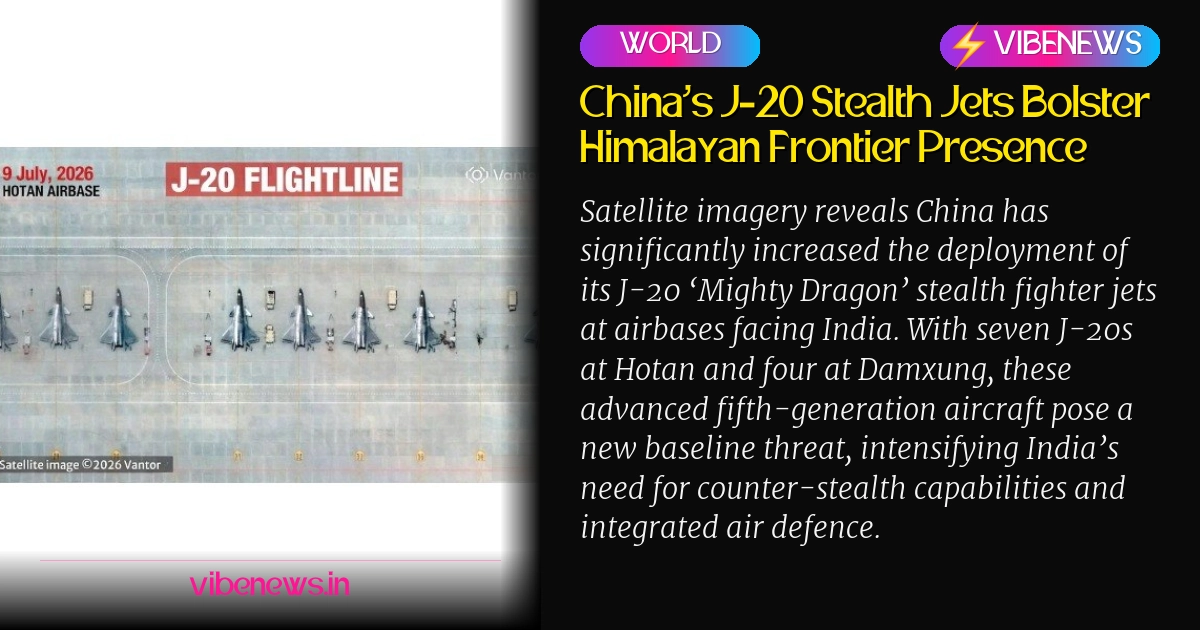
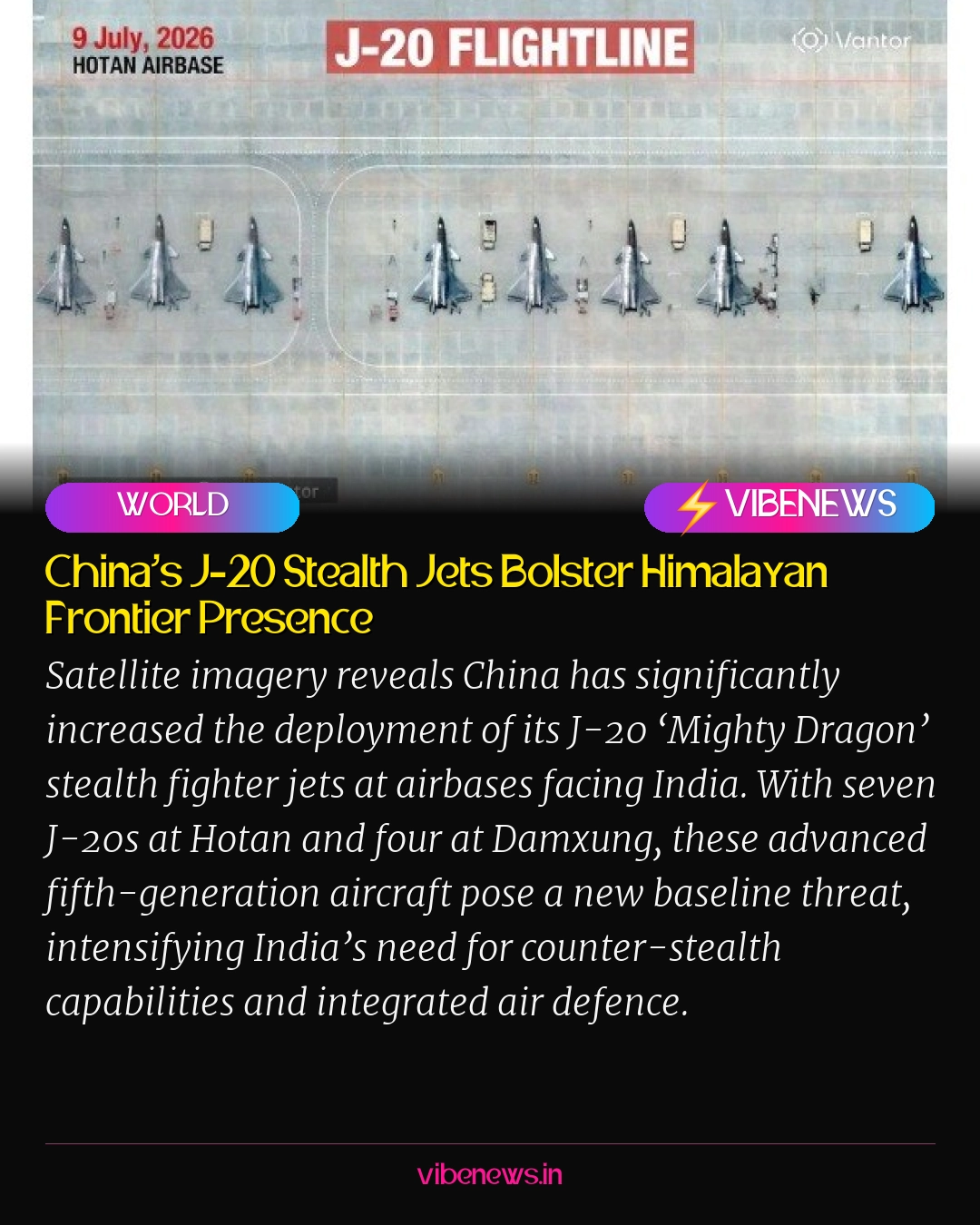
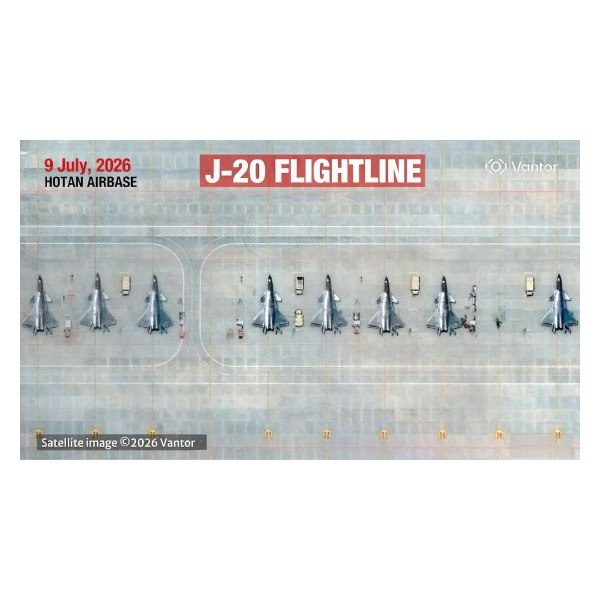
The satellite images, sourced from Vantor, reveal twelve J-20s deployed across two key airbases. On July 9, seven J-20s were observed on the tarmac at Hotan, a dual-use airbase located in the Xinjiang Uyghur Autonomous Region. This base holds critical strategic importance, lying just 389 km northeast of Leh and a mere 245 km northeast of the Indian Air Force’s (IAF) airfield at Daulat Beg Oldie in north Ladakh.
A second image documented four J-20s positioned on the flightline at Damxung airbase, situated within the Tibetan Lhasa prefecture. This base is approximately 344 km northwest of Tawang in Arunachal Pradesh. The combined deployment at these high-altitude locations represents the largest concentration of J-20s ever observed facing India.
Sameer Joshi, a former fighter pilot and co-founder of NewSpace, emphasized the shift in operational reality. He stated that these deployments confirm fifth-generation operations from high-altitude bases facing India are now routine for the People’s Liberation Army Air Force (PLAAF), rather than mere signaling. Joshi underscored the urgency for the IAF to enhance its counter-stealth sensors, integrated air defence, and standoff strike capabilities, as a low-observable threat on the northern front is now the baseline.
The J-20’s Dominance in Airspace
The significance of the J-20 deployment stems from its advanced stealth characteristics, which are designed to enable it to dominate contested airspace. With a minuscule radar signature, achieved through sophisticated stealth shaping, the J-20 possesses a considerable advantage over the IAF’s current generation of fighter jets. This includes the French-built Dassault Rafale, which, while highly capable, are non-stealth platforms.
India currently does not operate any stealth fighters. The indigenous Advanced Medium Combat Aircraft (AMCA), envisioned as the country’s first stealth jet, is projected to be at least a decade away from entering squadron service. This timeline is contingent upon the successful validation of key onboard technologies through an extensive flight-test program, highlighting a significant capability gap in the immediate future.
China’s Rapid Production Prowess
The deployment of these modern J-20 fighters comes amidst reports of a steep increase in their production numbers. A report in The War Zone indicated that J-20 numbers surged from approximately 50 aircraft in 2019 to about 200 by late 2022, with production estimates doubling in subsequent years. By late 2025, output was reportedly running at around 120 jets annually, potentially pushing the fleet to roughly 300-500 aircraft across more than a dozen PLAAF units by mid-2026.
The UK-based Royal United Services Institute (RUSI) projects an even more ambitious target, suggesting China could field around 1,000 J-20s by 2030. Air Marshal Narmdeshwar Tiwari (retired), who served as Vice Chief of the Air Staff during ‘Operation Sindoor’, lauded China’s advanced manufacturing capability. He noted that producing 125 planes per year speaks volumes about their integrated supply chain, exacting manufacturing tolerances, and top-quality human resources.
Air Marshal Tiwari emphasized that China’s J-20 program has been a national mission, envisioned with a clear roadmap and persistent support. He suggested that after the first Gulf War, China recognized the paramount importance of air power and embarked on a mission-mode approach to achieve parity, if not superiority, with global leaders in aviation technology.
A History of Escalation
This recent deployment is not an isolated incident but rather a continuation of a pattern observed over the last decade. Vibe News has consistently reported on the progressive increase in J-20 sightings at Chinese airbases of strategic significance to the IAF. The first image of a J-20 parked at the high-altitude Daocheng Yading airport in the Tibetan Autonomous Prefecture emerged in 2016, marking an early indicator of China’s intent.
More recently, a May 2024 Vibe News report documented J-20s landing at Shigatse airbase, located approximately 150 km north of the Sikkim boundary. These successive deployments underscore a deliberate and sustained effort by the PLAAF to enhance its air power projection capabilities along the entire Himalayan frontier, from Ladakh to Arunachal Pradesh.
India’s Air Defence Posture
In response to these evolving threats, the IAF currently operates 36 Rafale fighters, distributed across two squadrons based in Ambala, Haryana, and Hasimara, West Bengal. The Indian Navy has also placed an order for 26 Rafales in a $7.5 billion deal, with negotiations ongoing for an additional 114 Rafale jets for the IAF, a deal potentially valued between $36-$40 billion.
Beyond the Rafale, the IAF’s fleet includes over 260 Russian-designed Sukhoi-30MKI fighters, many of which are yet to undergo substantial upgrades. Older but still operational fighters such as the Mirage 2000 and MiG-29 also form part of India’s air defence arsenal. The need for modernization and the acquisition of advanced platforms, particularly those with stealth capabilities, has become increasingly pressing in light of China’s rapid advancements.
Editorial Context
The sustained and escalating deployment of China’s J-20 stealth fighters along the Indian border represents a profound long-term shift in the regional military balance. This is not merely a tactical move but a strategic assertion of air superiority, compelling India to re-evaluate its defence doctrines and accelerate its own technological advancements. The presence of fifth-generation stealth aircraft as a routine operational element fundamentally alters the calculus of any potential conflict, demanding a robust and integrated response from India.
Over the long term, this development will likely intensify the arms race in the Indo-Pacific, pushing India to significantly invest in indigenous stealth technology, advanced radar systems, and sophisticated air defence networks. It underscores the imperative for India to not only acquire advanced platforms but also to develop comprehensive counter-stealth strategies and enhance its electronic warfare capabilities. The strategic implications extend beyond military readiness, influencing diplomatic engagements and regional stability, as both nations navigate an increasingly complex and technologically advanced security landscape.
TL;DR
- China has deployed twelve J-20 stealth fighter jets across Hotan and Damxung airbases, significantly increasing its frontline presence against India.
- Seven J-20s were seen at Hotan (Xinjiang) and four at Damxung (Tibet), marking the largest concentration of these advanced aircraft to date.
- The J-20’s stealth capabilities give it a significant edge over India’s current non-stealth fighter fleet, including the French-built Rafale.
- Experts highlight this as a "low-observable threat," urging India to accelerate counter-stealth sensor development and integrated air defence.
- China’s J-20 fleet has grown rapidly, with production estimates suggesting 300-500 aircraft by mid-2026 and potentially 1,000 by 2030.
- India’s indigenous Advanced Medium Combat Aircraft (AMCA), its first stealth jet, is still a decade away from squadron service.