-
Himalayan Tragedy: Nepal’s Flood a Dire Omen for India
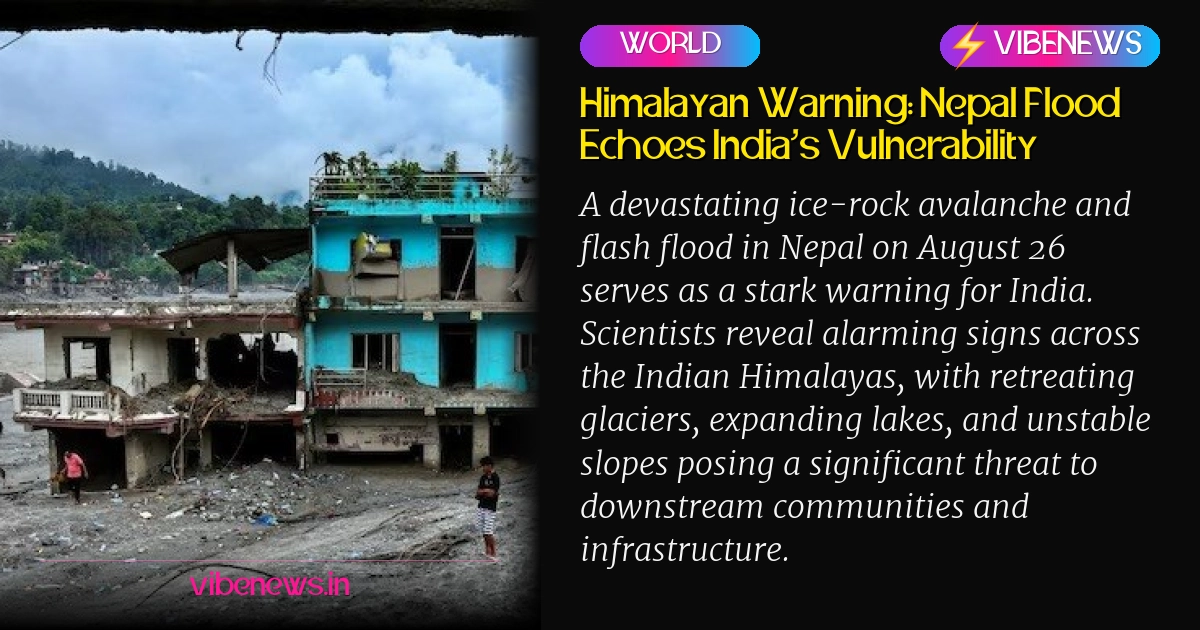
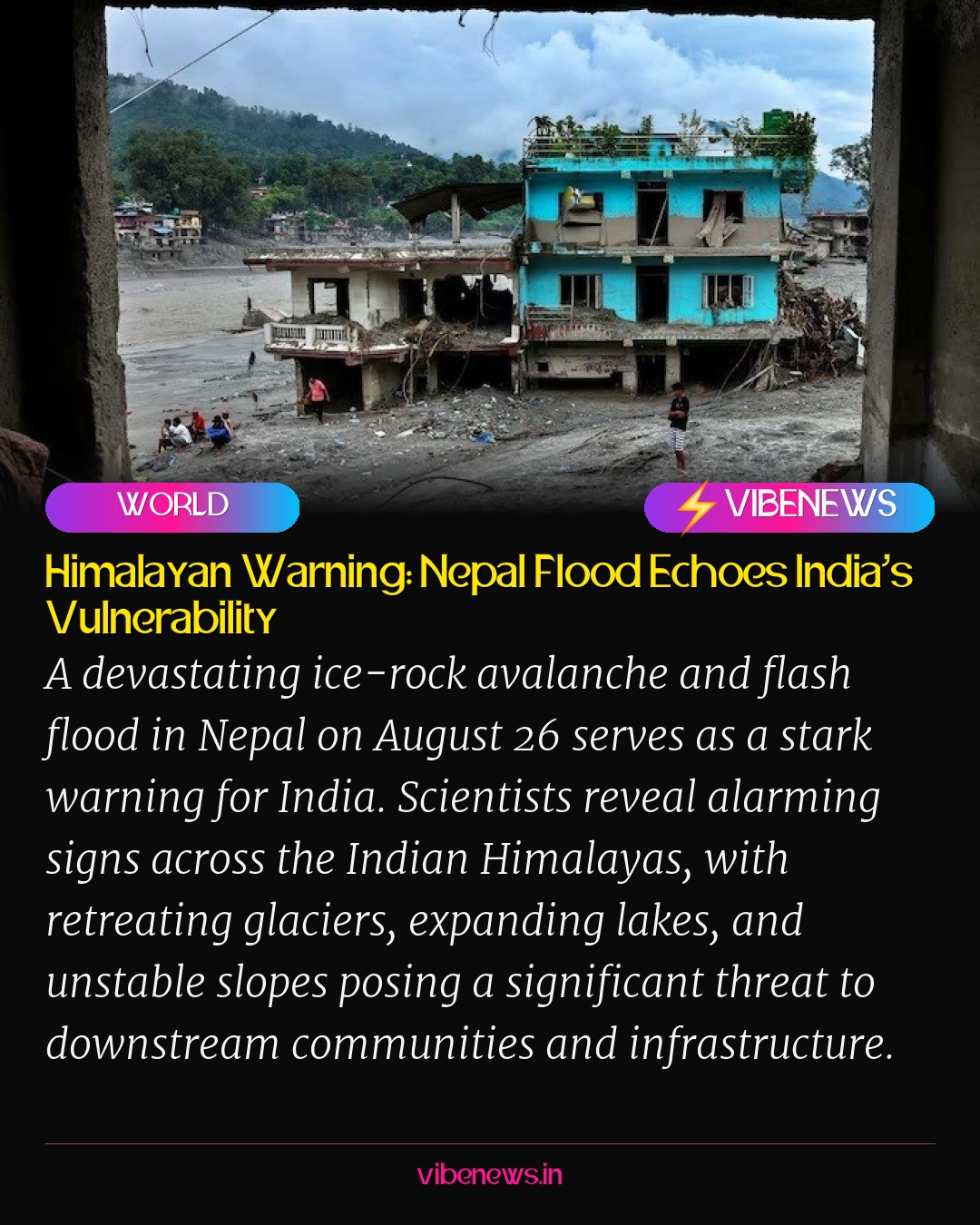
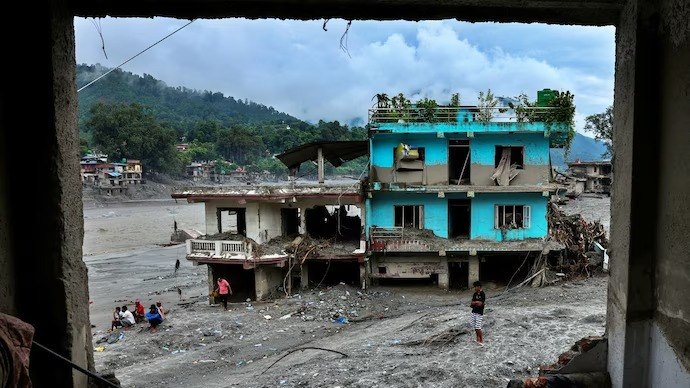
High above Nepal’s villages, on August 26, a colossal ice, rock, and debris avalanche unleashed a deadly chain reaction near the Nepal-Tibet border. It slammed into the Bhote Koshi river system, causing a violent surge that swallowed bridges, roads, and buildings, burying parts of Betrawati’s commercial heart.
Satellite imagery later revealed a newly formed lake, approximately 20.25 hectares, at the catastrophe’s source in the Lhende Khola region, raising fears of further outbursts in an already devastated river system.
For India, the tragedy carries an uncomfortable message: the Himalayas disregard political boundaries. The same unstable glaciers, slopes, and rapidly changing high-altitude lakes that triggered concern in Nepal extend across the Indian Himalayas, from Himachal Pradesh to Sikkim and Arunachal Pradesh.
While scientists caution against predicting an exact repeat of Nepal’s disaster due to varying geology and triggers, research from the Indian Himalayas reveals increasingly difficult-to-ignore warning signs. The greater fear is not just a single glacial lake bursting, but a sequence of failures: a glacier collapse, an avalanche into a lake, a landslide blocking a river, or extreme rain destabilizing a slope, unleashing millions of tonnes of water and debris into narrow, populated valleys with very little time to escape.
India’s Vulnerable Mountainous Terrain
Professor Dericks Praise Shukla of IIT Mandi highlights the urgent need to understand where the danger is concentrated. His team’s assessment of approximately 2,000 lakes in Himachal Pradesh between 2015 and 2025 classified them by their connection to glaciers and the stability of their natural barriers. The assessment found an increase in the number and total area of glacier lakes over the past decade, with around nine identified as highly critical and potentially dangerous.
Disaster risk exists only when exposed elements are present in the path of a hazard.
This crucial distinction, as noted in an analysis shared by Suhora Technologies, means a growing lake becomes a much more serious concern when vulnerable communities, roads, bridges, and hydropower projects lie downstream. For instance, Samudra Tapu lake in Himachal Pradesh, though large and expanding, poses a relatively lower downstream risk due to distant settlements and a comparatively gentle river slope.
Further warnings come from Arunachal Pradesh. An assessment by Suhora Technologies in Tawang district’s Mago Chu Basin found that four of five potentially dangerous glacial lakes expanded between 2016 and 2026. Sanhapo Lake, a high-risk classification, saw its measured area increase from 55.87 hectares in 2016 to 88.81 hectares by June 2026, making it a priority for detailed hazard modelling and continuous monitoring.
Union Home Secretary Govind Mohan has reviewed the preparedness of Himalayan states and Union Territories against the risks of Glacial Lake Outburst Floods (GLOFs) and snow avalanches. India has already witnessed devastating cascades, including the 2021 Chamoli disaster, the 2023 South Lhonak Lake outburst in Sikkim, and the Dharali deluge, repeatedly demonstrating how mountain hazards rapidly transform into downstream catastrophes.
The Imperative for Early Warning
While scientists can identify vulnerable areas, predicting the exact moment of a slope collapse or natural dam failure remains extraordinarily difficult. Professor Shukla emphasizes the need for hydrodynamic modelling to estimate flood depth, lateral spread, and how a flood wave would travel through a river valley, though accurate lake volume data remains a challenge.
The way forward, he suggests, is a two-tier approach: broad synoptic monitoring from space to identify hotspots, followed by focused on-ground monitoring and warning systems. Nepal’s tragedy serves as a powerful shakeup, reminding India that the time to study the next catastrophe is before the mountain begins to move, building a better system for seeing danger before it arrives.
On August 26, a massive ice-rock avalanche near the Nepal-Tibet border triggered a devastating flash flood in the Bhote Koshi river system, destroying infrastructure and forming a new lake.The Indian Himalayas, from Himachal Pradesh to Arunachal Pradesh, exhibit similar warning signs, including retreating glaciers, expanding lakes, and unstable slopes.Scientists caution that while an exact repeat of Nepal’s tragedy cannot be predicted, the ingredients for cascading disasters exist across the region.Research by IIT Mandi identified approximately nine highly critical and potentially dangerous glacial lakes in Himachal Pradesh, while Suhora Technologies noted the expansion of high-risk lakes like Sanhapo in Arunachal Pradesh.Disaster risk is significantly amplified when vulnerable communities, roads, bridges, and hydropower projects are located downstream of these changing mountain landscapes.Experts advocate for a two-tier monitoring approach, combining broad satellite surveillance with focused on-ground sensors, to build a better system for seeing danger before it arrives.