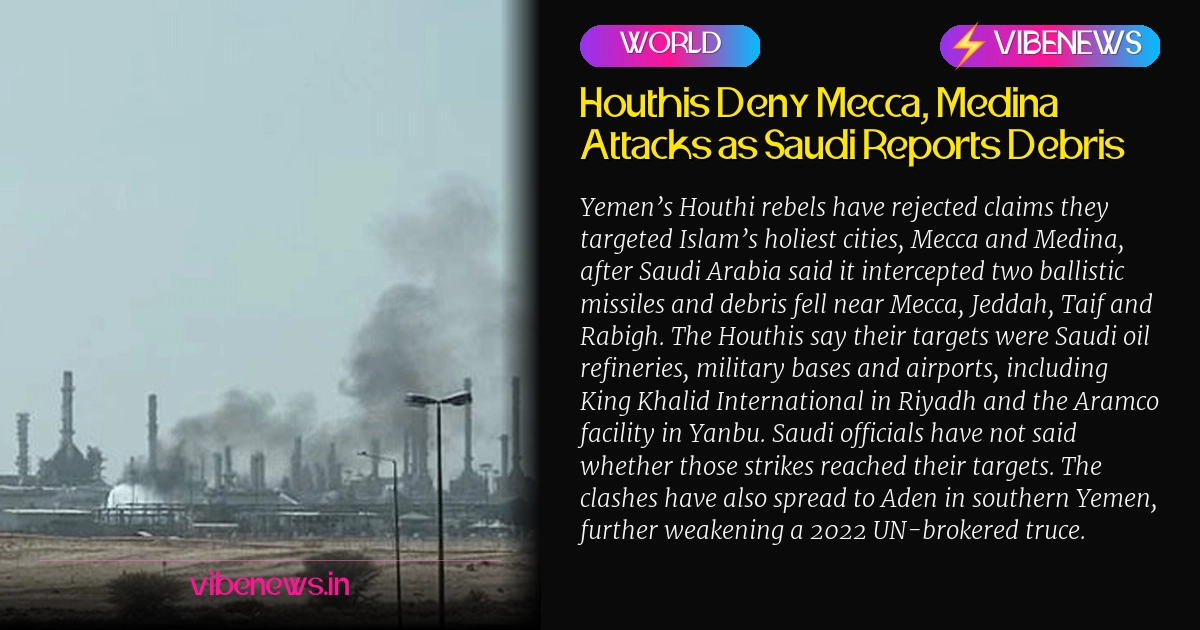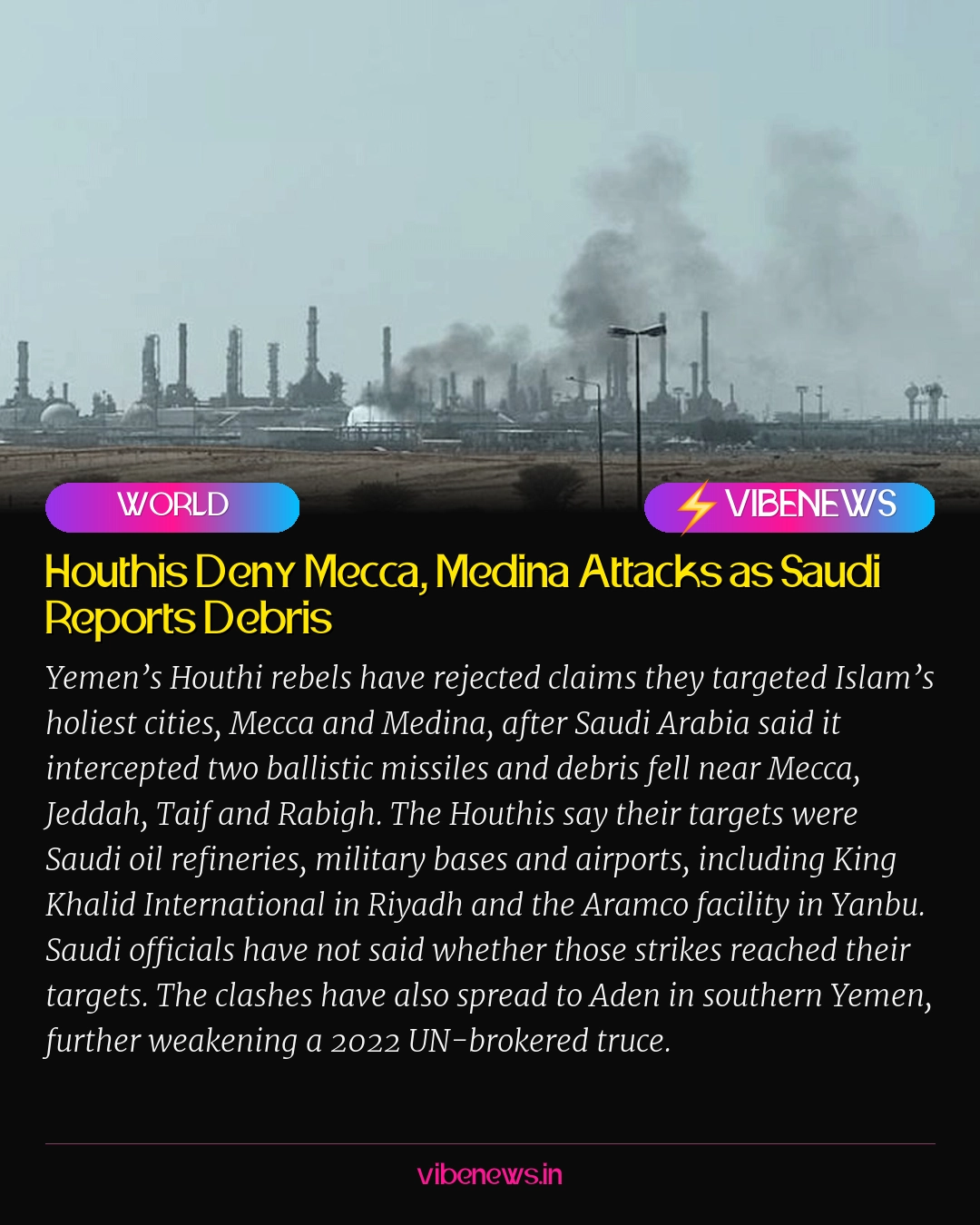
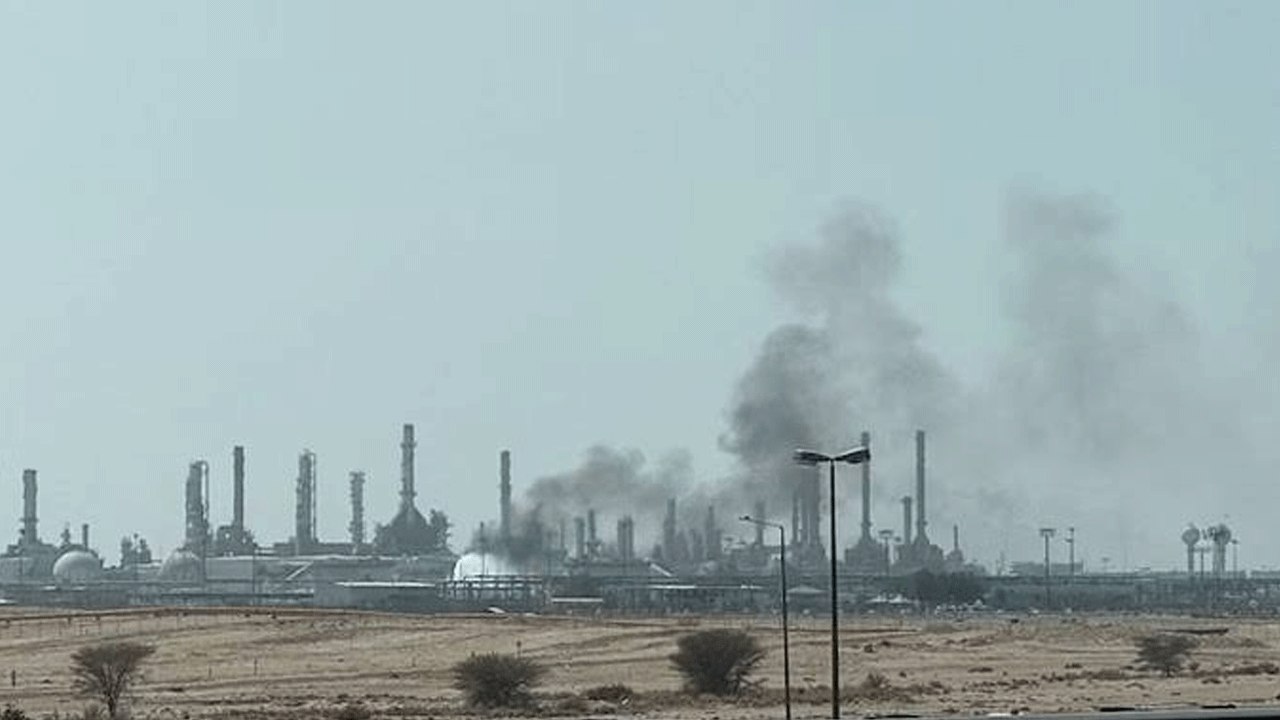
Yemen’s Houthi rebels have denied claims that they targeted Mecca and Medina, the two holiest cities in Islam, after Saudi Arabia said falling missile debris had landed in the Mecca area on Saturday.
Saudi Arabia said its forces shot down two ballistic missiles in the air. According to the Saudi Civil Defence, debris from the intercepted missiles fell near Mecca and in Jeddah, Taif and Rabigh. A Saudi-led coalition said separately that it had destroyed two missiles launched toward Yanbu and Taif.
The Houthis rejected the account. Their military spokesman, Yahya Saree, said the group had struck a much different set of targets. He claimed the attacks hit King Khalid International Airport in Riyadh, the Aramco oil facility in Yanbu, the Rabigh oil refinery and several oil pumping stations. He also said the group had targeted King Fahd International Airport in Dammam and an airport in Najran.
Saudi officials have not said whether any of those strikes reached their intended targets. That gap matters. Without confirmation from either side, the claims and counterclaims are the only accounts publicly available, and each side has an incentive to present its version as the decisive one.
A denial on the holy cities
The most sensitive part of the dispute is the holy cities. Attacks on Mecca or Medina would carry religious weight across the Muslim world, far beyond the battlefield. The Houthis have pushed back hard on that framing.
Targeting the holy cities was never our intention, and reports saying otherwise are false.
The Houthis, who are backed by Iran, insist their campaign is aimed at military and energy infrastructure inside Saudi Arabia. Whether that line holds will likely shape how governments and religious leaders respond in the coming days.
Why energy markets are watching
For global readers, the immediate concern is the type of targets involved. The Houthis say they hit oil refineries, pumping stations and an Aramco facility. Those are the sites that keep crude and refined fuel moving, and any sign that they are in the line of fire tends to draw close attention from traders, shippers and governments that depend on Gulf supply.
The reports do not show that production has been disrupted. What they do show is that the conflict has moved into Saudi territory in a way that reaches deep into the kingdom’s economic core, from Yanbu on the Red Sea coast to Rabigh and beyond. For anyone trying to judge where this war is heading, that shift is the story.
Fighting spreads south
The clashes are not confined to the Saudi border. The Houthis said they fired three ballistic missiles at the coast guard headquarters in Aden, the southern Yemeni city under the control of the internationally recognized government. They said the strike was aimed at military camps housing Saudi officers.
Aden is the seat of the government that Saudi-led coalition forces support. A strike there would mark a clear widening of the fighting, moving it from the north, where the Houthis already hold large areas, into the south.
A truce under strain
The latest exchanges have further weakened a ceasefire agreement reached in 2022 with the help of United Nations mediation. That deal was one of the few tools that had kept large-scale fighting in check for a time. Its erosion leaves diplomats with fewer options and fewer channels that both sides still trust.
The geography of the conflict is also stark. The Houthis control the capital, Sanaa, and much of northern Yemen. The Saudi-led coalition backs the internationally recognized government. Each side now has a reason to escalate or to claim the moral high ground, and the holy-city dispute gives both a powerful message to push.
What comes next
Several questions remain open. Saudi officials have not confirmed what was hit. The Houthis have not offered independent evidence for their claimed strikes on airports and refineries. And the Houthi denial on Mecca and Medina has not been matched by any public detail from the Saudi side that would settle the question of where the debris fell and what the missiles were aimed at.
What is clear is that the 2022 truce is under severe pressure, the fighting has reached Aden, and the Houthis are naming critical Saudi energy and transport sites as targets. Every new claim now carries more weight than the last, and readers should watch closely for official confirmation from Riyadh, the coalition, and the Houthi leadership.
TL;DR
- Houthis deny targeting Mecca and Medina, saying their attacks hit only Saudi oil, military and airport sites.
- Saudi Arabia says it shot down two ballistic missiles on Saturday, with debris falling near Mecca, Jeddah, Taif and Rabigh.
- The Houthis claim strikes on King Khalid airport in Riyadh, the Aramco facility in Yanbu and the Rabigh refinery.
- Saudi officials have not said whether the Houthi strikes reached their targets.
- The Houthis also claim three ballistic missiles hit a coast guard headquarters in Aden.
- The fighting has further weakened a 2022 UN-brokered truce in Yemen.