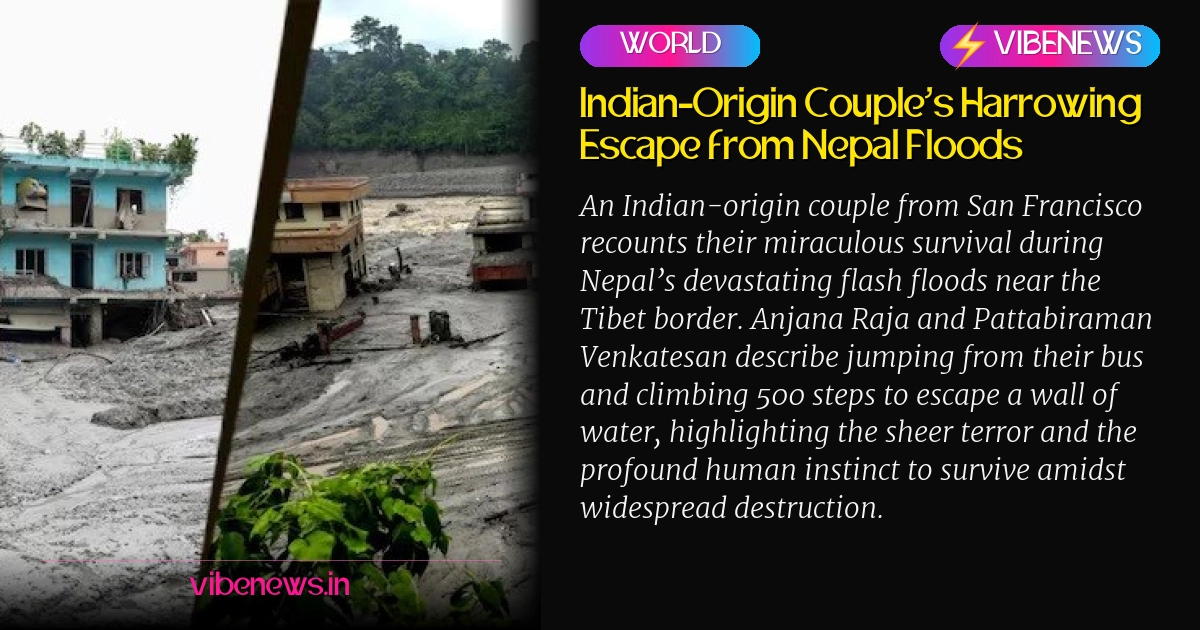
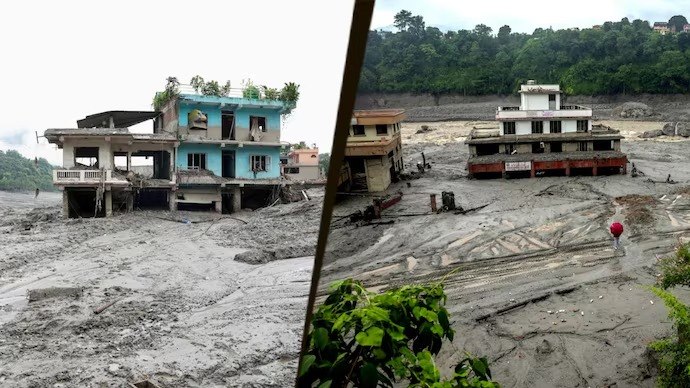
Anjana Raja and Pattabiraman Venkatesan, an Indian-origin couple residing in the San Francisco Bay Area, recently shared their terrifying ordeal during the catastrophic flash floods that ravaged Nepal’s Rasuwa district. What began as a pilgrimage to Tibet quickly transformed into a desperate fight for survival when a colossal wall of water descended upon their tour bus.
The couple, traveling through Timure, a Nepali village situated precariously close to the China border, initially struggled to comprehend the unfolding disaster. Raja described the approaching phenomenon as a 60 to 70-foot-high brown, dusty mass, while Venkatesan initially mistook it for a forest fire, highlighting the disorienting speed and scale of the natural calamity.
Their bus driver, conductor, and two helpers were the first to react, abandoning the vehicle. This immediate action served as a critical cue for Raja and Venkatesan. Driven by a primal survival instinct, Raja grabbed her partner and urged him to run, a decision that would ultimately save their lives.
They leaped from the bus and began a perilous ascent up a nearby mountain. Venkatesan recalled seeing the "monster thing coming down" just moments after they gained a mere ten feet of elevation, underscoring the narrow window they had for escape.
The Desperate Climb to Safety
The initial refuge they sought was a police base camp, which, to their horror, was swiftly engulfed and washed away by the raging floodwaters right before their eyes. This harrowing sight propelled them further upwards, scrambling for higher ground as houses crumbled and the screams of those swept away echoed around them.
The climb itself was fraught with danger. Raja described it as incredibly difficult, while Venkatesan recalled the terrain being narrow, slippery, and covered in mud, stones, and rocks. Despite the treacherous conditions, a combination of sheer adrenaline and the guidance of a local helped them reach a flat region at the mountain’s summit within what felt like mere seconds.
Throughout the arduous ascent, Raja maintained a firm grip on Venkatesan, a testament to their bond and mutual determination to survive. "I made sure I had him...I kept grabbing him. I just wanted him in my life," she recounted, emphasizing the profound human connection that often emerges in moments of extreme peril.
They spent the night huddled in a goat shed, sharing the cramped space with other local residents and tourists who had also managed to escape. The following day brought a glimmer of hope as they were eventually airlifted to safety, a rescue Venkatesan described as "nothing short of a miracle." Remarkably, every individual aboard their original tour bus also survived the ordeal.
Nepal’s Vulnerability to Himalayan Disasters
The devastating flash floods, which struck Nepal’s mountainous region along the Tibet border on August 26, have inflicted widespread destruction across the country. This incident is a stark reminder of Nepal’s extreme vulnerability to natural disasters, particularly during the monsoon season when heavy rainfall can trigger landslides and flash floods in its steep, geologically active terrain.
The Himalayan region, where Nepal is situated, is highly susceptible to such events due to its young, fragile mountains and the increasing impact of climate change. Rising global temperatures contribute to glacial melt, potentially leading to glacial lake outburst floods (GLOFs), and intensify monsoon patterns, resulting in more extreme precipitation events. These factors combine to create a perilous environment for communities living in river valleys and along mountain slopes.
Historical records show a recurring pattern of significant loss of life and infrastructure damage from similar events. The 2015 earthquake, while primarily seismic, also destabilized vast areas, making them more prone to subsequent landslides and floods. The challenges of early warning systems, rapid evacuation, and effective rescue operations in such remote and rugged landscapes remain formidable for the Nepali government and international aid organizations.
The Broader Human Toll
The scale of the recent disaster is immense, extending far beyond the miraculous escape of a few individuals. Official reports indicate that more than 600 people have tragically lost their lives, with an alarming 2,426 individuals still reported missing across Nepal. Among the missing are 517 foreign nationals, underscoring the global impact of the catastrophe on tourists and expatriates.
On the Tibetan side of the border, state-run media has confirmed five deaths and over 500 missing persons, highlighting the cross-border nature of the disaster. The US State Department has also stated that 90 American citizens remain untraceable following the floods, adding to the growing international concern and the complex challenges of search and rescue operations in the affected areas.
Editorial Context
This tragic event in Nepal serves as a critical long-term indicator of the escalating risks faced by Himalayan nations due to climate change and geographical vulnerabilities. The increasing frequency and intensity of flash floods and landslides pose significant threats to human life, infrastructure, and the region’s vital tourism industry. For Nepal, a country heavily reliant on trekking and pilgrimage tourism, such disasters can have profound economic and social repercussions, hindering development efforts and displacing communities.
The incident also underscores the urgent need for enhanced regional cooperation between Nepal, China, and India on disaster preparedness, early warning systems, and cross-border rescue efforts. Investing in resilient infrastructure, implementing sustainable land-use planning, and educating local populations on disaster mitigation strategies are paramount. The long-term stability and prosperity of the Himalayan region will depend heavily on its ability to adapt to these environmental challenges and build robust mechanisms for protecting its people and natural heritage.
TL;DR
- An Indian-origin couple from San Francisco, Anjana Raja and Pattabiraman Venkatesan, miraculously survived Nepal’s devastating flash floods near the Tibet border.
- They jumped from their tour bus in Rasuwa district and climbed approximately 500 steps to escape a 60-70 foot wall of water and debris.
- The couple, on a pilgrimage to Tibet, witnessed a police base camp and houses being swept away, highlighting the rapid and destructive nature of the flood.
- They spent the night in a goat shed with other survivors before being airlifted to safety, describing their survival as a miracle.
- The floods, which hit on August 26, have resulted in over 600 deaths and 2,426 missing persons in Nepal, including 517 foreign nationals.
- The disaster underscores Nepal’s extreme vulnerability to natural calamities in the Himalayan region, exacerbated by climate change.