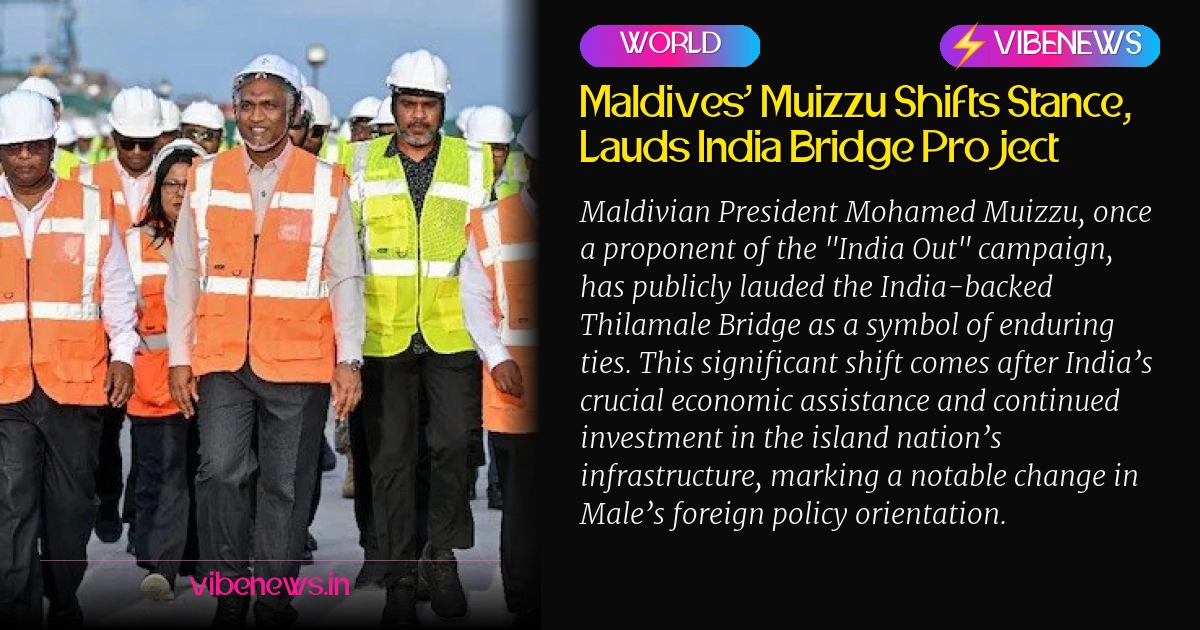
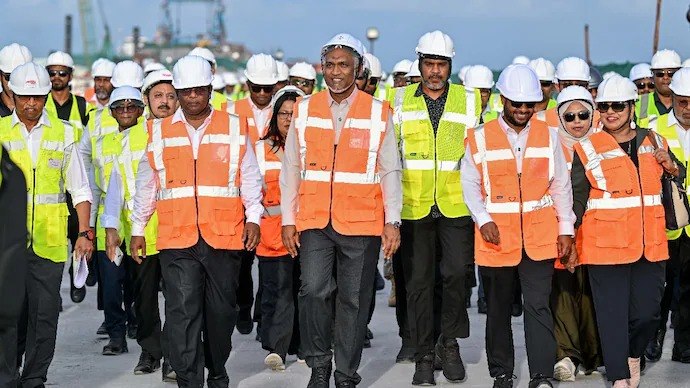
Maldivian President Mohamed Muizzu has publicly lauded the India-backed Thilamale Bridge project, describing it as a profound symbol of the enduring relationship between the Maldives and India. This commendation, made during an inspection in 2026, marks a significant pivot from his 2023 presidential campaign, which was largely predicated on an "India Out" platform advocating for the expulsion of Indian military personnel and a re-evaluation of close ties with New Delhi.
Muizzu’s initial political ascent was fueled by a nationalist sentiment that questioned India’s presence and influence in the archipelago. His campaign rhetoric often portrayed India as an overbearing regional power, promising a foreign policy shift towards other nations, notably China. Upon winning the presidency in 2023, his administration promptly initiated steps to fulfill these campaign pledges, including formal requests for the withdrawal of Indian military personnel operating aviation assets in the Maldives.
The Thilamale Bridge, officially known as the Greater Malé Connectivity Project (GMCP), stands as a monumental infrastructure endeavor. This 6.7-kilometer network of roads, bridges, and causeways is designed to seamlessly connect the capital Malé with the crucial surrounding islands of Vilimalé, Gulhifalhu, and Thilafushi. Once completed, it will establish a vital highway link between the Maldives’ international airport, its capital city, and burgeoning industrial and port areas, significantly enhancing connectivity and economic efficiency across the region.
India’s commitment to this project is substantial, providing comprehensive financial backing. The initiative is financed through a generous $400-million line of credit from India’s Export-Import Bank, complemented by a separate $100-million grant. The project was formally launched in August 2022 by then-Maldivian President Ibrahim Mohamed Solih and Indian Prime Minister Narendra Modi, with construction awarded to the Indian infrastructure giant Afcons Infrastructure Ltd.
Following his election, President Muizzu’s initial foreign policy trajectory leaned distinctly towards Beijing. His first official overseas trip as president in 2023 was to China, where he hailed the nation as one of the Maldives’ "closest allies and developmental partners." During this visit, ties between the two countries were elevated to a "comprehensive strategic cooperative partnership," culminating in the signing of 20 agreements spanning infrastructure, investment, digital and green economies, agriculture, disaster management, and China’s ambitious Belt and Road Initiative.
However, the anticipated economic dividends from these alternative partnerships, particularly with China and Gulf nations, proved slower to materialize than expected. An analysis by Maldivian journalist Ibrahim Maahil Mohamed in 2025 highlighted that economic aid from China faced hurdles due to the Maldives’ existing debt burden and ongoing restructuring requests, which constrained the nation’s capacity to secure new loans and significant financial injections.
It was against this backdrop of economic strain that India re-emerged as a crucial lifeline. New Delhi effectively provided significant economic assistance to the Maldives in 2024, helping the island nation navigate a looming debt crisis. This timely intervention underscored India’s consistent role as a reliable partner and "first responder" in times of need for its neighbors in the Indian Ocean region.
The impact of India’s support became evident during President Muizzu’s state visit to India in October 2024. During this visit, he offered assurances to New Delhi that the "Maldives will remain a true friend." He also expressed profound gratitude to the Indian government for its assistance in averting the debt crisis, acknowledging India’s unwavering support. Furthermore, India has consistently remained one of the few countries willing to invest in large-scale developmental projects within the island nation, demonstrating a long-term commitment.
Muizzu’s recent remarks during the Thilamale Bridge inspection in 2026, where he specifically thanked Prime Minister Modi, the Indian government, and High Commissioner G Balasubramanian, underscore a pragmatic shift. He acknowledged that the significant progress on the bridge was a direct result of the dedicated efforts of technical teams from both countries, signaling a renewed appreciation for bilateral cooperation.
The Legislative Shift
The "India Out" campaign, while successful in bringing Muizzu to power, faced internal complexities. While it resonated with a segment of the Maldivian populace concerned about sovereignty and perceived foreign influence, it also created diplomatic friction and economic uncertainty. The campaign’s focus on military withdrawal often overshadowed the broader spectrum of India-Maldives relations, which includes extensive trade, tourism, healthcare, and educational ties.
The Maldivian economy, heavily reliant on tourism and external aid, is particularly vulnerable to geopolitical shifts. The initial cooling of ties with India, a major source of tourists and economic support, posed potential risks to the nation’s financial stability. The pragmatic realization of these economic dependencies appears to have played a pivotal role in recalibrating the administration’s foreign policy approach.
Regional Geopolitical Implications
This policy recalibration by President Muizzu carries significant regional geopolitical implications. For India, it reaffirms its "Neighbourhood First" policy and its role as a net security provider and developmental partner in the Indian Ocean Region. The successful continuation and praise of projects like the GMCP demonstrate the tangible benefits of India’s engagement, potentially mitigating anti-India sentiments in the long run.
For China, while it remains an important partner for the Maldives, the slower pace of economic assistance and the existing debt burden highlight the limitations of its engagement model, especially for smaller nations seeking immediate financial relief. The Maldivian experience underscores the complex balancing act many small island developing states face in navigating relations with major global and regional powers.
Editorial Context: A Pragmatic Reorientation
President Muizzu’s journey from leading an "India Out" campaign to publicly praising India-backed infrastructure is more than a mere political U-turn; it represents a pragmatic reorientation driven by economic realities and strategic necessities. Over the long term, this development underscores the enduring influence of economic interdependence in shaping foreign policy, particularly for small island nations like the Maldives.
The Thilamale Bridge, beyond its physical structure, symbolizes a bridge of renewed trust and cooperation. It highlights India’s consistent and reliable role as a developmental partner, often stepping in when other avenues prove less fruitful. This shift suggests that while nationalist sentiments can sway elections, the practical demands of governance and economic stability often necessitate a more balanced and cooperative international approach. The long-term stability and prosperity of the Maldives will likely depend on its ability to maintain constructive relationships with all its partners, with India remaining a foundational pillar.
TL;DR
- Maldivian President Mohamed Muizzu has shifted his stance from an "India Out" campaign to publicly praising India-backed infrastructure projects.
- The Thilamale Bridge, part of the Greater Malé Connectivity Project (GMCP), is now hailed by Muizzu as a symbol of enduring India-Maldives ties.
- India has provided substantial financial backing for the GMCP, including a $400 million line of credit and a $100 million grant.
- Muizzu’s initial pivot towards China for economic support proved slower than anticipated due to Maldives’ existing debt burden.
- India provided crucial economic assistance to the Maldives in 2024, helping avert a debt crisis and reinforcing its role as a reliable partner.
- The policy reorientation reflects a pragmatic approach driven by economic realities and the consistent developmental support from India.