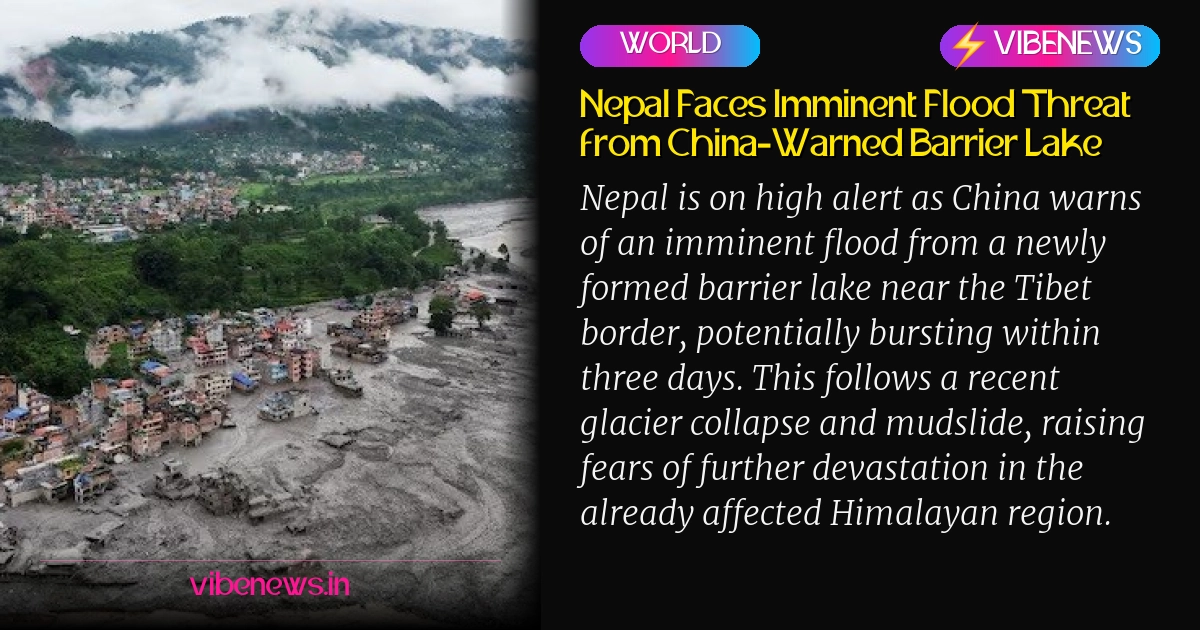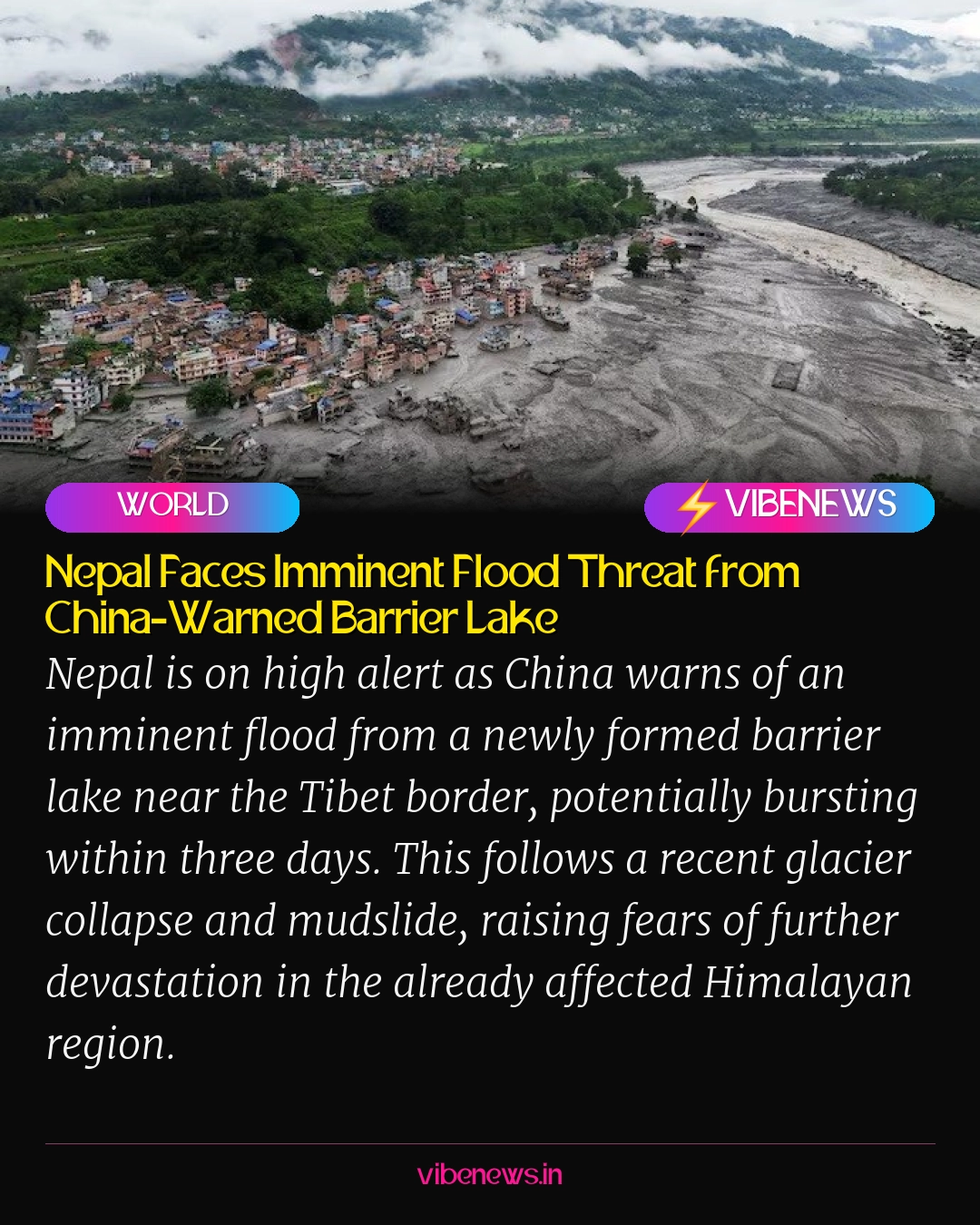
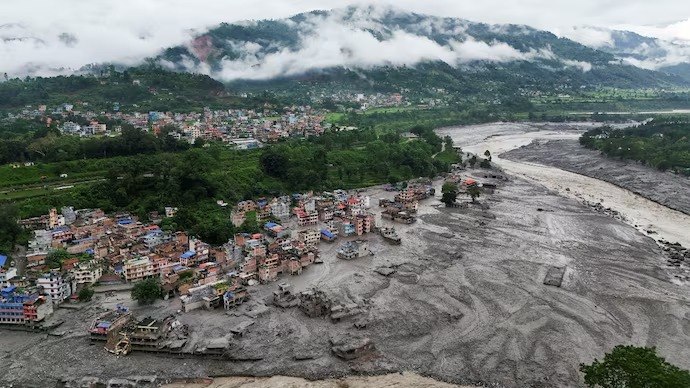
Nepal is bracing for a potential fresh wave of devastating floods, following an urgent warning from China regarding a newly formed barrier lake near their shared border. Chinese authorities have alerted Kathmandu that this upstream lake could breach within three days, unleashing a significant surge of water downstream into Nepali rivers.
This imminent threat compounds an already dire situation in the region. Just days prior, on August 26, a massive glacier collapse triggered a deadly wall of water in Nepal’s Bhotekoshi river. Simultaneously, a severe mudslide buried China’s Gyirong Port crossing, a vital trade artery between the two nations. The area is still reeling from these initial disasters, with search and rescue operations underway on the Chinese side where three deaths have been confirmed and 558 people remain missing.
The Glacier’s Fury and Initial Deluge
The initial flood in the Bhotekoshi river was not precipitation-driven, as confirmed by Nepal’s Department of Hydrology and Meteorology (DHM). Satellite imagery has revealed that a substantial chunk of glacier, likely from the north face of Langtang Lirung, broke away at an altitude of approximately 5,200 metres. This colossal ice mass then plunged about 1,200 metres into the Lhende river, a tributary of the Bhotekoshi.
The impact of the falling ice and rock created a natural dam, effectively blocking the narrow valley. This temporary barrier subsequently burst, releasing a thick, turbulent wall of water, ice, and boulders. This destructive torrent raced through several Nepali districts, including Rasuwa, Nuwakot, Dhading, Gorkha, and Chitwan, causing widespread damage and disruption.
On the same morning, a separate but possibly related mudslide struck near Gyirong Port in China’s Xizang region. China’s state broadcaster CCTV reported mud depths exceeding five feet in places, severing critical roads and communication lines. While officials have not yet formally linked the mudslide and the Bhotekoshi flood to a single source, their simultaneous occurrence underscores the region’s extreme geological instability.
A New Barrier Lake Emerges
The immediate concern now stems from a new barrier lake that has formed near the confluence of the Chhochen Khola and Purepu Tsangpo rivers. China’s Ministry of Water Resources reported that by Thursday morning, this lake already held approximately 2 million cubic metres of water and was actively overflowing. Projections indicate that an additional 3 million cubic metres could flow into the lake over the next three days, significantly escalating the risk of a catastrophic breach.
In response to this grave assessment, Chinese engineers are actively conducting flood simulations to prepare for the potential breach and mitigate its impact. On the Nepali side, authorities have issued urgent advisories to residents living along the Bhotekoshi, Trishuli, and Narayani rivers, urging them to evacuate riverbanks and remain vigilant until further notice. These rivers are critical lifelines for numerous communities, and a major flood pulse could have devastating consequences.
Echoes of Past Disasters
The recent surge of water, which crossed into Nepal around 9 am on Wednesday and peaked at Devghat in Chitwan by late afternoon, flowed at an astonishing rate of nearly 5,850 cubic metres per second. DHM data indicates that approximately 20 million cubic metres of extra water passed through Devghat, a volume several times larger than that of the infamous 1985 Dig Tsho glacial flood in the Everest region. The wave travelled almost 170 kilometres downstream in a matter of hours, demonstrating the immense power of such events.
Alarmingly, this marks the second such significant flood on this precise stretch of river in just fourteen months. A similar event occurred in July 2025, which was also attributed to a lake situated atop a glacier. This recurring pattern highlights a worrying trend of increased hydrological instability in the Himalayan region.
The Broader Climate Context
Experts from the International Centre for Integrated Mountain Development (ICIMOD) have long warned about the escalating threat of glacial lake outburst floods (GLOFs) in the Himalayas. Their data reveals a stark increase in the number of Himalayan glacial lakes, rising from approximately 1,900 in 2005 to over 2,600 currently. This proliferation of glacial lakes is directly linked to the fact that the Himalayan region is warming at a rate significantly faster than the global average.
As glaciers retreat and melt due to rising temperatures, they often leave behind depressions that fill with meltwater, forming new lakes or expanding existing ones. These lakes are frequently dammed by unstable moraines—accumulations of glacial debris—which can be highly susceptible to collapse from seismic activity, heavy rainfall, or sudden ice avalanches. The increasing frequency of these sudden, destructive floods on both sides of the Nepal-China border is a direct consequence of these environmental changes.
Editorial Context
The unfolding crisis along the Nepal-China border serves as a stark reminder of the profound and accelerating impacts of climate change on vulnerable mountain ecosystems and the communities that depend on them. The formation of new barrier lakes and the increasing frequency of glacial lake outburst floods are not isolated incidents but symptoms of a larger environmental transformation in the Himalayas. This development underscores the urgent need for enhanced regional cooperation in disaster preparedness, early warning systems, and climate change adaptation strategies.
Beyond the immediate humanitarian concerns, these events have significant long-term implications for regional trade, infrastructure development, and the livelihoods of millions. The disruption of vital trade routes like Gyirong Port impacts economic stability for both Nepal and China. Furthermore, the repeated devastation of agricultural land and settlements along river basins poses a persistent threat to food security and forces communities into cycles of displacement and rebuilding. Addressing these challenges requires sustained international attention, scientific research, and collaborative policy-making to build resilience in one of the world’s most fragile and dynamic environments.
TL;DR
- China has warned Nepal of an imminent flood from a newly formed barrier lake near the Tibet border, expected to breach within three days.
- This threat follows a recent glacier collapse on August 26, which caused a deadly flood in Nepal’s Bhotekoshi river, and a mudslide that buried China’s Gyirong Port.
- The new barrier lake, near the Chhochen Khola and Purepu Tsangpo rivers, holds 2 million cubic metres of water and could receive an additional 3 million cubic metres, posing a high breach risk.
- Nepal has issued warnings to residents along the Bhotekoshi, Trishuli, and Narayani rivers, while China is conducting flood simulations.
- The region experienced a similar major flood in July 2025, and Himalayan glacial lakes have increased significantly since 2005 due to rapid warming, making such events more common.
- The crisis highlights the urgent need for regional cooperation in disaster preparedness and climate change adaptation due to the long-term impacts on trade, infrastructure, and livelihoods.