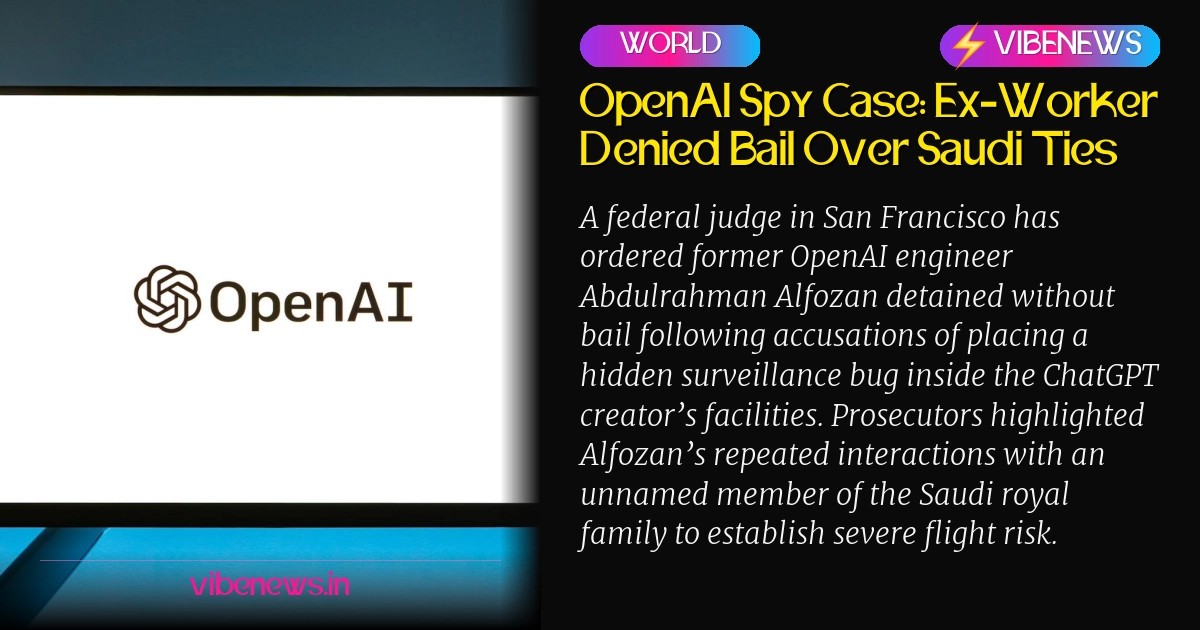
A federal court in San Francisco ordered former OpenAI employee Abdulrahman Alfozan to be held in custody without bail on Monday after determining he posed a severe flight risk in a corporate espionage case involving the artificial intelligence developer.
United States District Judge Alex Tse rejected a release petition submitted by Alfozan’s legal defense team, ruling that the Saudi national could not be freed pending trial. The judicial determination follows explosive allegations that the former tech worker infiltrated OpenAI’s corporate offices in California to plant covert audio surveillance equipment.
Federal Court Blocks Release in San Francisco
The high-stakes hearing brought international tech security anxieties directly into a California federal courtroom. Judge Tse concluded that the defendant’s foreign ties and the gravity of the underlying accusations eliminated any standard conditions for release, finding that federal authorities could not guarantee his return to face justice if he were granted bail.
"There is a risk of non-appearance that is significant," US District Judge Alex Tse ruled from a courtroom in San Francisco, denying a request by Abdulrahman Alfozan’s defense attorneys for his release.
Defense attorneys had petitioned the court to allow Alfozan to await future proceedings outside of custody. However, federal prosecutors firmly resisted any release package, warning that the engineer possessed the means, foreign backing, and motivation to flee American jurisdiction before facing trial.
Surveillance Devices and Foreign Royal Connections
According to prosecutors, Alfozan breached internal security protocols by intentionally placing a recording device inside one of OpenAI’s primary facilities in San Francisco. The ChatGPT maker has become one of the most prominent technological hubs in the world, making internal conversations regarding core proprietary architectures, algorithms, and business roadmaps extraordinarily sensitive.
The government’s opposition to bail placed heavy emphasis on Alfozan’s international contacts. Court arguments revealed that prior to his apprehension, the former engineer maintained frequent communications with an unnamed member of the Saudi royal family. Federal prosecutors successfully argued that these documented channels of contact with foreign royalty presented an intolerable risk that Alfozan would seek refuge abroad rather than confront federal accusations on American soil.
Escalating Tensions Over AI Frontier Security
The case represents an acute flashpoint for global observers monitoring espionage threats targeting pioneering artificial intelligence companies. As frontier developers push the boundaries of advanced computing, physical and internal perimeter defense has emerged as an urgent battleground. Planting unauthorized recording hardware directly within executive and development offices reveals that physical insider access remains one of the most potent vulnerabilities facing Silicon Valley.
Alfozan’s immediate detention without bond reflects the judiciary’s rigid approach when intellectual property threats intersect with foreign geopolitical interests. With the defense’s release petition decisively dismissed by Judge Tse, the former engineer remains incarcerated while federal authorities proceed with the ongoing legal action in California.
TL;DR
- Former OpenAI engineer Abdulrahman Alfozan was denied bail by US District Judge Alex Tse in San Francisco.
- Alfozan is accused of planting a covert recording device inside an OpenAI San Francisco office.
- Prosecutors established flight risk by citing Alfozan’s frequent communications with an unnamed Saudi royal family member.
- Defense attorneys sought pre-trial release, but the federal court ordered Alfozan to remain detained indefinitely.