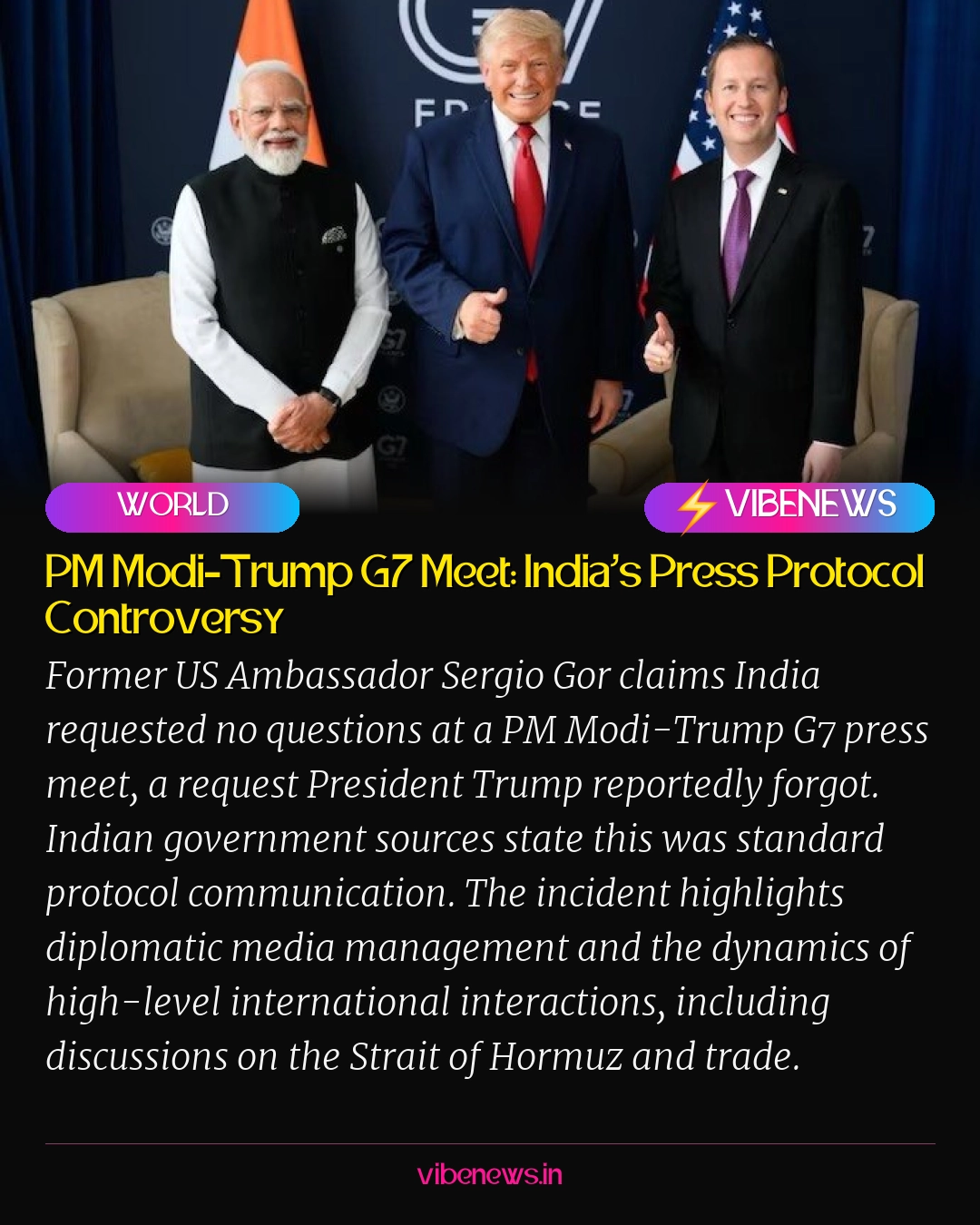
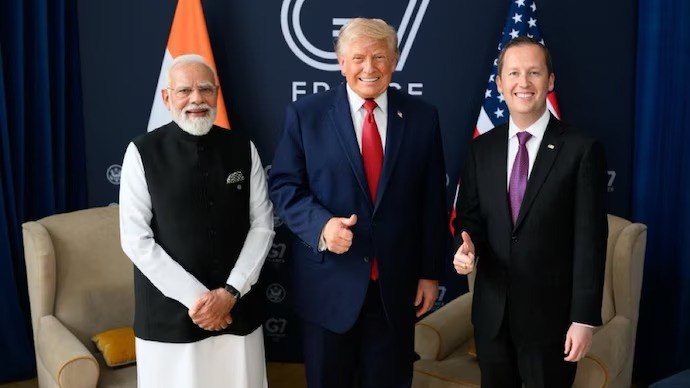
A recent claim by former US Ambassador to India, Sergio Gor, has ignited discussions regarding diplomatic protocols and media engagement during high-level international meetings. Gor stated that India had specifically requested the US to avoid questions at a joint press conference following Prime Minister Narendra Modi’s meeting with then-President Donald Trump on the sidelines of the G7 summit in France. This assertion has drawn a measured response from Indian government sources, who maintain that such communications are standard practice for VVIP visits.
Speaking at the Economic Times World Leaders Forum, Sergio Gor recounted a specific interaction prior to the Modi-Trump meeting. He claimed that President Trump had inquired about India’s preferences for the media interaction. According to Gor, the Ministry of External Affairs (MEA) had one explicit request: to allow media presence for opening remarks but to forgo a full question-and-answer session.
Gor conveyed this preference directly to Trump, who reportedly agreed, saying, "sure, no problem." However, once the leaders delivered their initial statements before approximately 50 cameras, Trump unexpectedly turned to reporters and invited questions. This spontaneous move, Gor noted, transformed the planned brief media appearance into an extensive 45-minute press conference, with "everything on the table."
New Delhi’s Protocolary Stance
In response to Gor’s claims, Indian government sources offered a different perspective, emphasizing adherence to established diplomatic norms. They clarified that discussions concerning the arrangements for leaders’ public appearances are a routine and integral part of preparing for any VVIP visit. The Indian side, they asserted, was merely communicating its standard protocol for such high-profile interactions.
This explanation suggests that India’s communication was not an unusual demand but rather a statement of its preferred operational procedure for media interactions. It highlights the often-complex negotiations that occur behind the scenes to manage public perceptions and control narratives during international diplomatic engagements.
A Broader Diplomatic Backdrop
The meeting between Prime Minister Modi and President Trump took place on June 17, 2026, in Evian-les-Bains, France, amidst the broader G7 summit. This particular interaction was significant for several reasons, occurring at a time of evolving geopolitical dynamics and bilateral negotiations between India and the United States. The leaders addressed a range of critical issues that had immediate implications for both nations.
One pressing concern raised by Prime Minister Modi was the safety of Indian mariners in the Strait of Hormuz. This issue had gained urgency following an incident days prior, where three Indian mariners were killed in an attack by the US Navy on a commercial vessel in the region. Modi underscored the paramount importance of protecting Indian seafarers operating in this volatile conflict zone, a sentiment that highlighted India’s strategic interests in maritime security.
President Trump, while acknowledging the discussion, reportedly downplayed the risks associated with seafaring, characterizing it as a “rough profession.” This exchange underscored differing perspectives on regional security challenges and the protection of civilian assets in international waters. The Strait of Hormuz, a critical chokepoint for global oil supplies, was a focal point of international tensions at the time, making discussions on its stability particularly pertinent.
Beyond security, the leaders also delved into the intricacies of India-US trade relations. Both nations were actively engaged in negotiating a bilateral trade agreement, and Trump expressed optimism, stating that the two countries were "very close" to finalizing a deal. Such an agreement held the potential to significantly reshape economic ties, impacting various sectors from agriculture to technology.
Furthermore, Trump made a notable declaration of support for India, asserting, "If anybody attacks that man, we’re gonna be there." This statement, while seemingly a strong endorsement, was qualified by a caveat regarding future leadership, adding a layer of complexity to the perceived commitment. The overall meeting served as a crucial platform for addressing immediate crises, advancing economic partnerships, and reaffirming strategic alliances.
The Dynamics of Media Access
The incident, as described by Gor, brings into sharp focus the delicate balance between diplomatic protocol and media freedom in high-stakes international diplomacy. While governments often seek to manage the narrative and control the flow of information during such events, the spontaneous nature of a press conference can introduce unpredictable elements. Leaders like Donald Trump were known for their unconventional approach to media interactions, often diverging from pre-arranged scripts.
For India, the preference for a controlled media appearance aligns with a broader trend observed in its foreign policy communication, which often prioritizes structured statements over open-ended Q&A sessions. This approach aims to ensure clarity and consistency in messaging, particularly on sensitive international issues. However, it also raises questions about transparency and the extent of media access granted to journalists covering critical diplomatic engagements.
Editorial Context
This episode, years after the G7 summit, continues to resonate as a case study in international relations and media management. It underscores the persistent tension between a government’s desire for message control and the media’s role in holding leaders accountable and informing the public. Over the long term, such incidents contribute to the ongoing global debate about press freedom, diplomatic transparency, and the evolving nature of public communication in an interconnected world.
For India, the discussion around its media protocol at international forums reflects a maturing foreign policy apparatus that is increasingly assertive on the global stage. How India navigates these expectations for transparency, while maintaining its strategic communication objectives, will be a defining aspect of its diplomatic engagement moving forward. The incident also serves as a reminder of the personal dynamics that can influence even the most formal diplomatic encounters, highlighting the human element in international statecraft.
TL;DR
- Former US Ambassador Sergio Gor claimed India requested no questions at a PM Modi-Trump G7 press conference.
- President Trump reportedly agreed to the request but then spontaneously invited questions, leading to a 45-minute Q&A session.
- Indian government sources stated they were merely communicating standard protocol for VVIP public appearances, not making an unusual demand.
- The G7 meeting in France addressed critical issues including the safety of Indian mariners in the Strait of Hormuz and ongoing India-US trade negotiations.
- The incident highlights the inherent tension between diplomatic message control and the media’s role in international forums.
- It underscores the evolving nature of foreign policy communication and the global expectations for transparency in high-level diplomacy.