
Putin Mocks G7 Economic Share at BRICS Forum in New Delhi
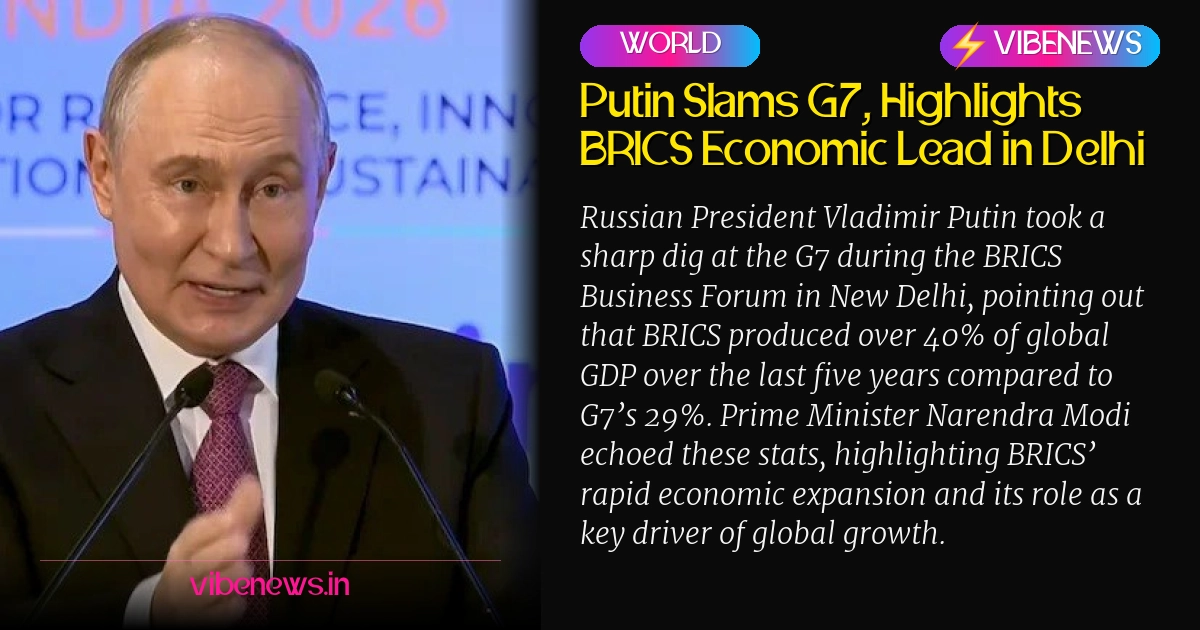
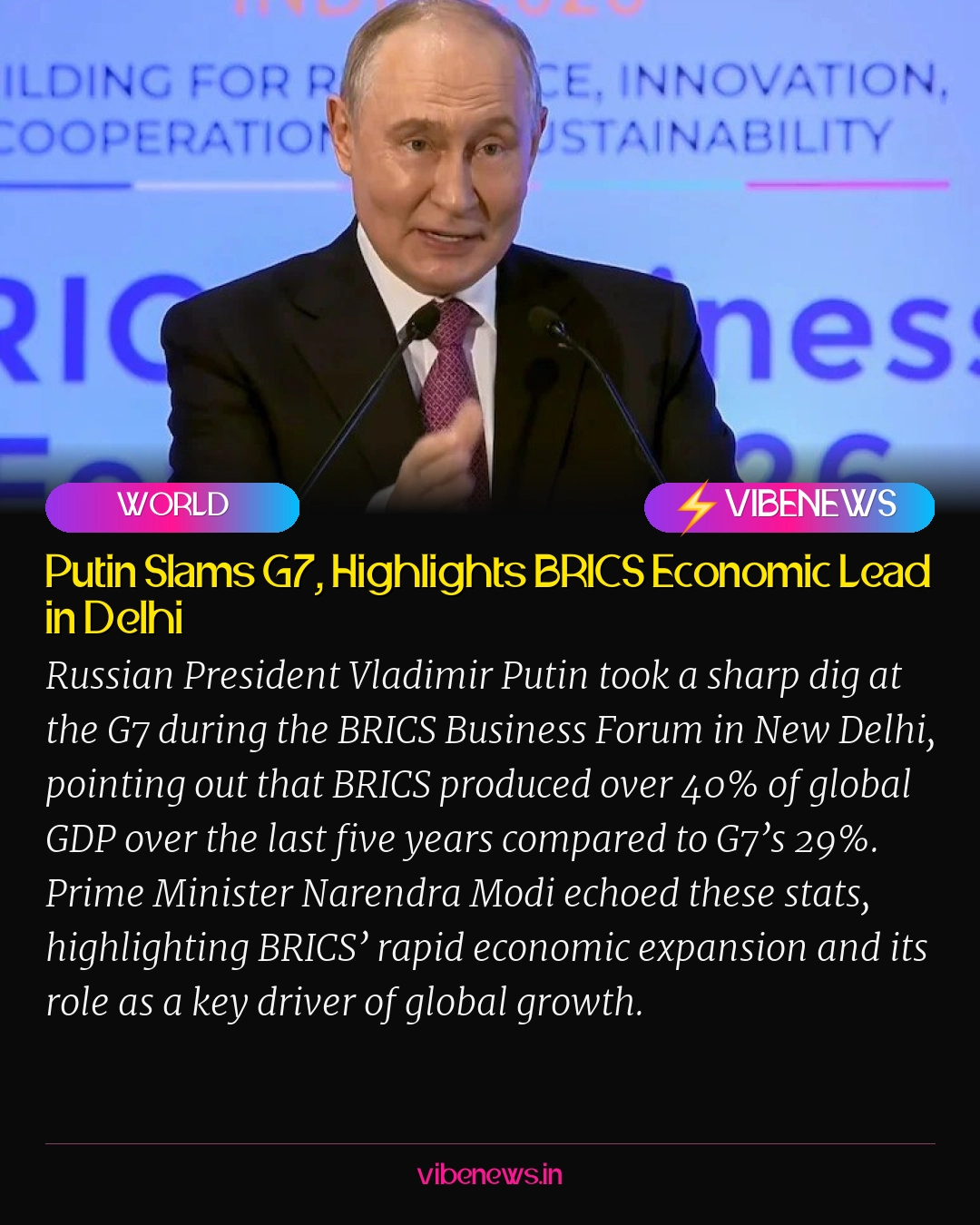
Speaking at the BRICS Business Forum held in New Delhi, Russian President Vladimir Putin delivered a direct challenge to Western economic dominance. Addressing delegates, Putin highlighted that the BRICS alliance has vastly outperformed the Group of Seven (G7) in global economic output over recent years, questioning the continued leadership status of traditional Western powers.
"Over the last five years, more than 40 per cent of the world GDP has been produced by the BRICS countries, whereas the contribution of the so-called G7, the Group of Seven -- I don’t know why they call that the Group of Seven -- stands at only 29 per cent."
Putin emphasized that the global order is experiencing deep structural shifts, with traditional economic vanguards being superseded by new engines of growth across emerging markets. He asserted that objective economic indicators from the past five years clearly demonstrate this changing dynamic.
Allegations of Western Sabotage and Economic Sanctions
During his address, the Russian leader accused Western nations of abandoning fair market competition and actively trying to undermine developing economies. He pointed to hostile measures, including the physical destruction of energy pipelines, attempts to block international transport corridors, and the seizure of maritime vessels.
Putin criticized the heavy reliance on unilateral economic measures, disclosing that over 30,000 sanctions have been imposed against Russia—more than double the total sanctions levied against all other countries in the world combined. He condemned the threat of secondary sanctions targeted at nations seeking to protect their own sovereign economic interests rather than bowing to external pressure. Despite these hurdles, Putin stated that Russia reinforced its national sovereignty by relying on internal scientific, educational, and industrial capabilities while expanding cooperation with predictable global partners.
PM Modi Backs BRICS Growth Trajectory
Taking the stage at the forum’s concluding session, Indian Prime Minister Narendra Modi reinforced the economic figures cited by Putin, offering a comprehensive look at the bloc’s expanding footprint. Modi noted that BRICS nations now represent 50 per cent of the world’s population, 40 per cent of global GDP, and more than 25 per cent of international trade.
Modi highlighted that while the broader global GDP expanded nearly two-and-a-half-fold in recent years, the combined economic output of BRICS nations surged almost four-and-a-half-fold. This demonstrates that BRICS has grown at nearly twice the rate of the rest of the global economy. He described the gathering in India as the largest BRICS Business Forum to date, emphasizing its role as a hub for innovation ranging from grassroots projects to frontier technologies.
Earlier at the event, Commerce Minister Piyush Goyal stated that India’s chairship aimed at creating balanced trade, expanding trade in services, and ensuring that economic cooperation directly benefits farmers, women, young entrepreneurs, and micro, small, and medium enterprises (MSMEs).
Bilateral Engagement and High-Level Peace Talks
On the sidelines of the 18th BRICS Summit in New Delhi, Prime Minister Modi and President Putin conducted extensive bilateral discussions. This marked their second face-to-face meeting this year, following their talks at the 26th SCO Summit in Bishkek on August 31.
According to an official statement from the Indian Ministry of External Affairs, the two leaders reviewed bilateral cooperation spanning political, economic, defense, energy, space, skill mobility, and people-to-people relations. They also addressed pressing global conflicts, particularly in West Asia and the Black Sea region, emphasizing the risks posed to maritime trade and Indian seafarers. Modi reiterated India’s firm stance that dialogue and diplomacy remain the only viable paths to resolving international conflicts, reaffirming India’s readiness to support peace initiatives.
Following their bilateral meeting, Putin invited Modi to visit Russia for the upcoming 24th India-Russia Annual Summit, an invitation accepted by the Indian Prime Minister. The two leaders subsequently traveled together in Putin’s vehicle, marking their fourth shared car ride in recent years.
Understanding the Bloc’s Global Footprint
The Group of Seven (G7) remains an informal group comprising advanced economies: Canada, France, Germany, Italy, Japan, the United Kingdom, the United States, alongside the European Union. Conversely, BRICS has expanded significantly beyond its founding members—Brazil, Russia, India, China, and South Africa.
The grouping now includes 11 full member nations with the addition of Egypt, Ethiopia, Iran, Saudi Arabia, the United Arab Emirates, and Indonesia. Additionally, 10 partner nations—including Belarus, Bolivia, Cuba, Kazakhstan, Malaysia, Nigeria, Thailand, Uganda, Uzbekistan, and Vietnam—further broaden the economic alliance’s reach across the Global South.
TL;DR
- Vladimir Putin stated BRICS generated over 40 percent of global GDP in five years compared to G7’s 29 percent.
- Prime Minister Narendra Modi noted BRICS represents half the world’s population and a quarter of global trade.
- Putin accused Western nations of sabotaging economic rivals through over 30,000 unilateral sanctions on Russia.
- India and Russia reviewed strategic ties across trade, defense, space, and energy sectors during bilateral discussions.
- PM Modi accepted an invitation from President Putin to visit Russia for the 24th India-Russia Annual Summit.