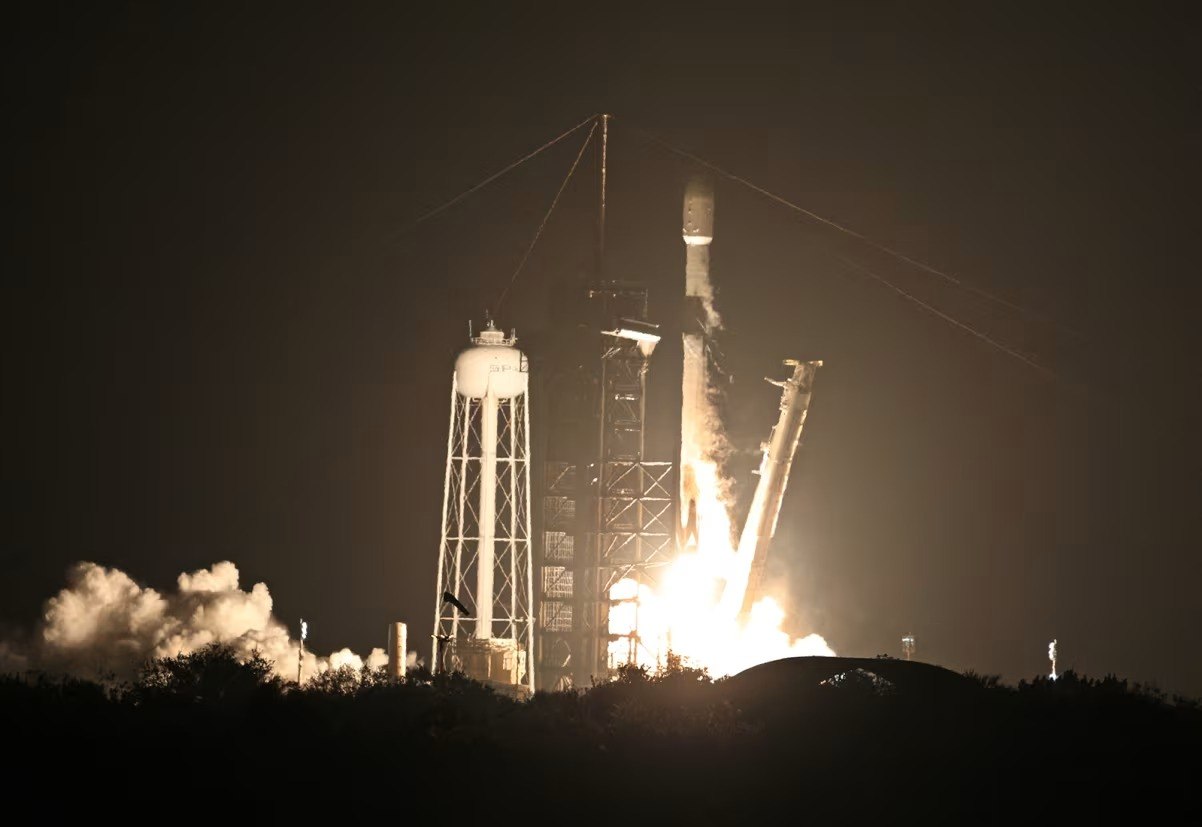
An unexpected celestial event unfolded as a discarded upper stage of a SpaceX Falcon 9 rocket, hurtling at over 5,000 miles per hour, was projected to collide with the moon. This unplanned impact, anticipated early Wednesday morning, offered scientists a rare opportunity to observe the effects of an artificial object striking the lunar surface.
The Falcon 9 had launched on January 15, 2025, carrying two commercial lunar landers. While the booster returned to Earth, its second stage, after propelling the landers towards the moon, remained in space on a trajectory that eventually led to the collision.
The Trajectory of an Unplanned Impact
For missions destined for low-Earth orbit, SpaceX typically disposes of upper stages by allowing them to burn up in Earth’s atmosphere. However, high-energy missions require different maneuvers to ensure safety, as explained by Julianna Scheiman, director of NASA Science and Dragon Programs at SpaceX.
In this instance, a combination of solar activity and gravitational forces inadvertently placed the Falcon 9’s upper stage on a collision course with the moon. Independent astronomers, utilizing publicly available data, were instrumental in tracking the object and confirming its impact trajectory.
NASA’s Center for Near Earth Object Studies, primarily focused on Earth-bound space rocks, also corroborated the impact path. The agency reassured the public that the event posed no danger to Earth, emphasizing its scientific value for tracking and observation.
A Rare Window into Lunar Dynamics
Scientists estimated the impact would create a crater approximately 65 to 90 feet (20 to 30 meters) in diameter on the moon’s surface, near the Einstein Crater. This rare occurrence of an artificial object hitting the moon provides invaluable data for understanding lunar geology and the mechanics of crater formation.
Dr. Paul Wiegert, a professor of astronomy and physics, highlighted that such events help researchers understand the process of material ejection upon impact. This knowledge is crucial for preparing for NASA’s Artemis program, which aims to establish a sustained human presence on the lunar surface.
Understanding these processes is vital for shielding astronauts and future infrastructure from potential hazards. The rocket’s upper stage, weighing around 8,818 pounds (4,000 kilograms), was expected to launch rocky material as far as 500 miles from the impact site, posing a significant threat if astronauts or habitats were within that zone.
Observing the Moment of Impact
Despite the scientific interest, the impact was not expected to be visible to the naked eye from Earth, which is approximately 225,623 miles away. Even through telescopes, spotting the event proved challenging due to the moon’s brightness in the impact region.
Astronomers across the Americas, positioned for the best viewing opportunities, aimed ground and space-based telescopes at the moon. The Korean Pathfinder Lunar Orbiter (KPLO) attempted to capture images of the upper stage before impact, while NASA’s Lunar Reconnaissance Orbiter (LRO) planned to survey the impact site afterward.
A preprint study, authored by scientists including Darryl Seligman, was released ahead of time to enable astronomers to prepare for observing the event. The impact flash itself, occurring at an estimated 5,436 miles per hour, was expected to last only about a second.
The Growing Shadow of Space Debris
While space rocks regularly crash into the moon, impacts from artificial objects are rare, having occurred only a handful of times. This event underscores a growing concern: as lunar exploration intensifies, the accumulation of space debris in lunar orbit will become an increasingly pressing issue.
Unlike Earth, the moon lacks a protective atmosphere to burn up incoming debris. Furthermore, there is no formalized tracking system for objects beyond our planet, making it difficult to monitor potential threats to lunar missions.
The increasing number of missions to the moon, including those under the Artemis program, necessitates a proactive approach to debris management. The insights gained from this Falcon 9 impact will contribute to developing strategies to mitigate risks for future lunar inhabitants and infrastructure.
Charting a Safer Course for Lunar Exploration
The collision serves as a stark reminder of the complex challenges inherent in expanding humanity’s reach into space. Scientists and space agencies are actively exploring ways to lower the odds of such collisions and to establish safer disposal paths for high-energy missions operating within the sun-Earth-moon system.
Collaboration between entities like SpaceX and NASA is crucial in addressing these challenges. The long-term goal is to ensure that the exploration and eventual colonization of the moon can proceed sustainably, without creating a hazardous environment for future endeavors.
Editorial Context: Beyond the Crater’s Edge
The unintended lunar impact of a SpaceX rocket stage is more than just a scientific curiosity; it is a potent symbol of the evolving landscape of space exploration. This incident highlights the critical need for robust international protocols and advanced tracking systems for space debris, not just in Earth’s orbit but extending to the moon and beyond.
As nations and private entities increasingly target the moon for scientific research, resource extraction, and potential human settlement, the management of orbital and surface debris becomes paramount. The data gathered from this unplanned collision will be instrumental in shaping future mission designs, safety regulations, and international cooperation frameworks.
Ultimately, this event underscores a fundamental shift: the moon is no longer merely a distant object of study but an emerging frontier requiring careful stewardship. Ensuring its long-term accessibility and safety for future generations of explorers demands a concerted effort to understand, track, and mitigate the risks posed by human-made objects in its vicinity.
TL;DR
- A discarded SpaceX Falcon 9 upper stage, launched in January 2025, impacted the moon on August 4, 2026, due to solar activity and gravitational forces.
- The collision was unintended, resulting from the challenges of disposing of rocket stages from high-energy lunar missions.
- Scientists anticipate the impact created a crater 65-90 feet in diameter, offering a unique opportunity to study lunar geology and crater formation.
- The event highlights the growing concern over space debris in lunar orbit, as the moon lacks a protective atmosphere and formal debris tracking systems.
- Observations by ground and space-based telescopes, including NASA’s LRO and Korea’s KPLO, aim to gather data on the impact and its aftermath.
- The incident underscores the urgent need for better disposal paths and risk mitigation strategies for future human and robotic missions to the moon, such as the Artemis program.