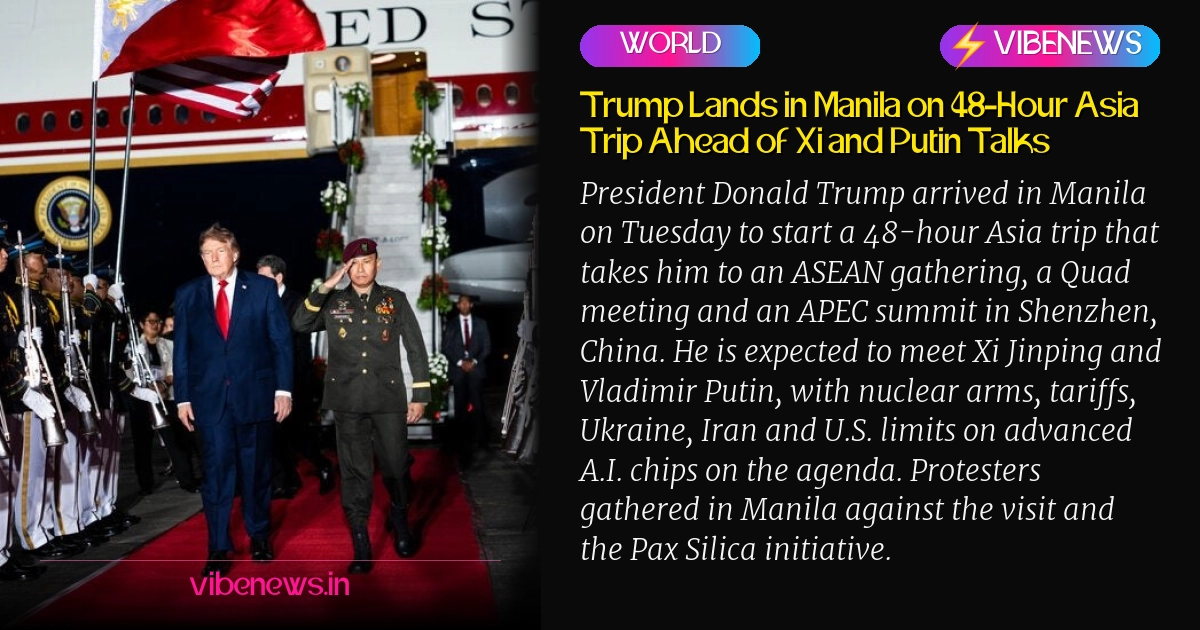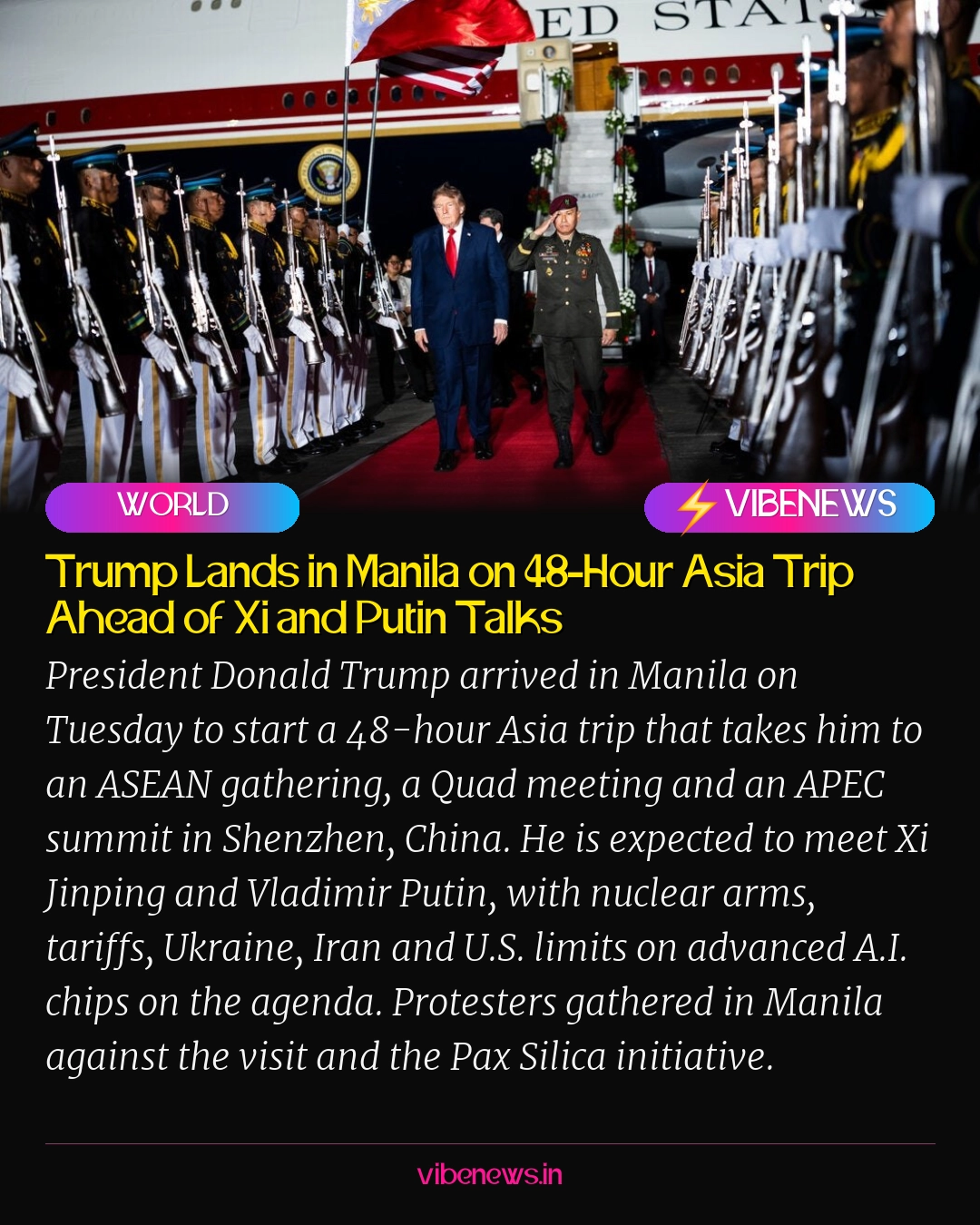
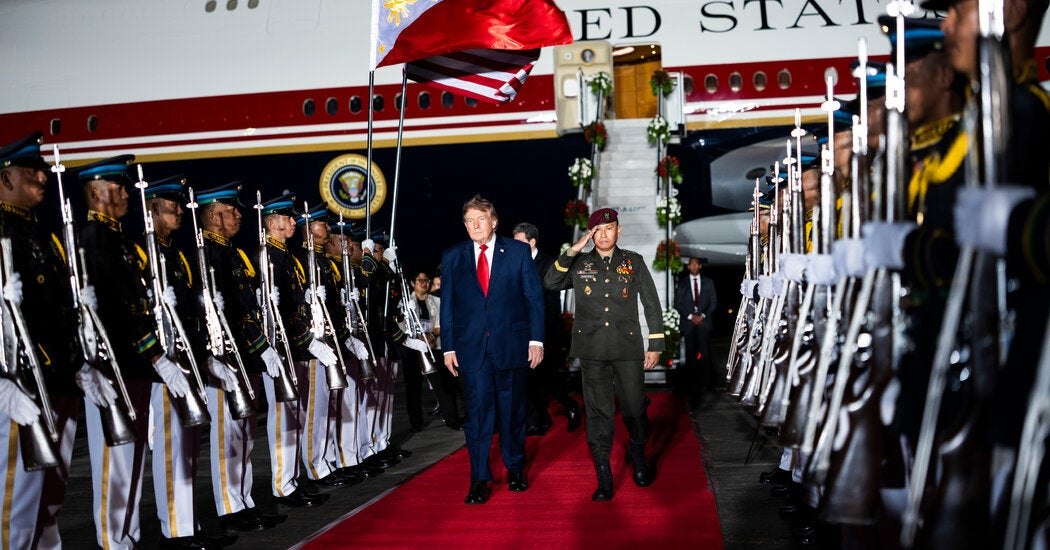
President Donald Trump landed in Manila on Tuesday to start a 48-hour Asia trip that will take him to a meeting with Chinese President Xi Jinping and Russian President Vladimir Putin. The agenda is loose, and it could stretch to tariffs, nuclear arms control, the war in Ukraine and U.S. restrictions on advanced A.I. chips.
Trump arrived at the tail end of the Association of Southeast Asian Nations summit, which is being hosted in Manila this year. He was scheduled to meet President Ferdinand R. Marcos Jr. of the Philippines and join a gathering of Southeast Asian leaders. After less than 24 hours in Manila, he will fly to the APEC economic summit in Shenzhen, where he is expected to meet both Xi and Putin.
The short itinerary fits Trump’s habits. He tends to avoid large summits where he is not the main attraction, and he enjoys sitting down with leaders of powerful nations. Xi and Putin are two authoritarian leaders he often praises in admiring terms.
A late arrival at a summit that is wrapping up
Trump reached the ASEAN gathering only on Tuesday, just as it was ending, and he is not expected to announce any major policy or diplomatic moves there. That timing is itself a message for a region that has grown uneasy about Washington. The bloc of 11 countries has increasingly come to see the United States as an unreliable partner, in large part because of Trump’s tariffs on countries across the region, including allies.
Southeast Asian leaders will be watching for any sign that the Republican defeat in the midterm elections has humbled Trump or pushed him to rethink his approach. So far, the signals are mixed. Ted Osius, a former U.S. ambassador to Vietnam, put it bluntly: “They’ve learned that the United States is not reliable, so a lot of the hedging has been away from the United States.”
Quad leaders, energy prices and a rocky relationship with India
Soon after landing, Trump met with leaders from the Quad, a grouping of the United States, India, Japan and Australia. All three partners are dealing with high energy prices triggered by the Iran war, a conflict Trump started in late February without discussing it with them first.
During remarks to the Quad leaders, Trump called Prime Minister Narendra Modi of India “a great leader and a friend of mine, highly respected by everybody all over the world.” He also described Modi as a “very tough man.” The praise came even as India and the United States work through a rocky stretch in their relationship, largely tied to trade and India’s purchases of Russian oil. Modi and Trump signed an interim framework for a trade deal in February, but talks have dragged on and frustrated both sides.
The main event in Shenzhen
The real test of the trip comes in China. Trump is expected to push for détente with Xi in Shenzhen, which is the heart of China’s robotics and artificial intelligence industries. He needs to extend a trade truce that is set to expire soon. That truce limits tariffs on Chinese goods entering the United States, and in return China has committed not to cut off exports of rare earths and magnets.
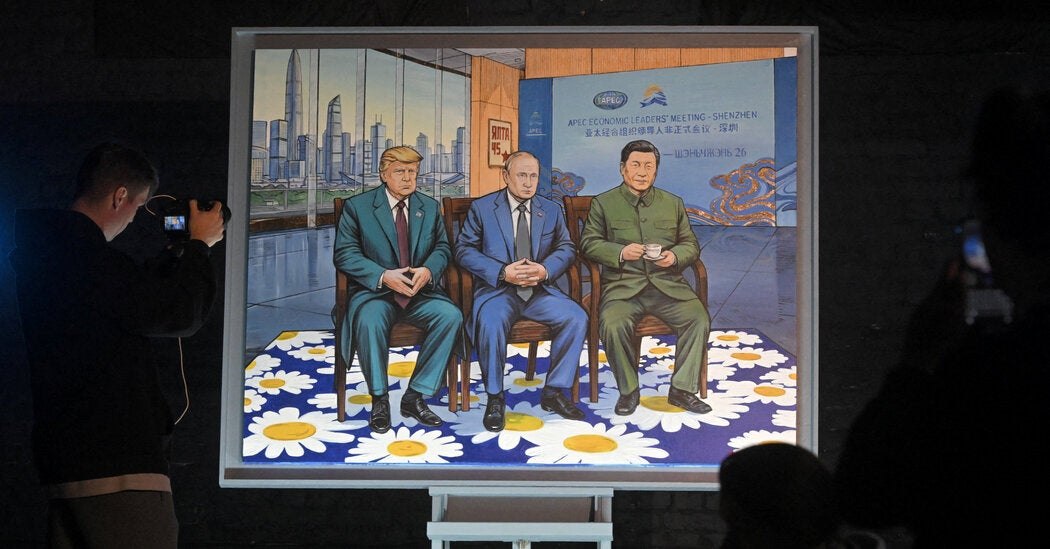
The trilateral meeting with Xi and Putin would be the first of its kind between China, Russia and the United States, and it is the highlight of the trip. Trump has already set expectations for the nuclear portion of the talks. Before leaving Washington, he said, “We are going to be talking about denuclearization, a tough subject because it is very hard for any of us to say we’ll get rid of our nukes.”
“We are going to be talking about denuclearization, a tough subject because it is very hard for any of us to say we’ll get rid of our nukes.”
Chinese officials have made clear they are not interested in nuclear talks until their arsenal is roughly the size of the American one. Trump also said, “We will talk about Iran a little,” and described the situation as being in “very good shape.” Analysts say a meeting like this is unlikely to produce progress on Iran. Russia is content to see energy prices stay high since the war began, while China wants them to fall quickly.
Putin could also meet North Korean leader Kim Jong-un if Kim travels to China for the APEC summit, Russian state news agencies reported, citing Kremlin spokesman Dmitri Peskov. Putin met on Monday with a secretary of North Korea’s ruling Workers’ Party before leaving for China. It remains unclear whether Kim will attend. Trump told reporters at his hotel that Kim would “like to come” to the APEC summit.
A chip rule that rattled markets
The U.S.-China technology fight is hovering over the visit. On Tuesday, shares of Asian technology companies fell after the Trump administration announced rules restricting overseas access to advanced A.I. chips, including those sold by Nvidia. In Hong Kong, Alibaba dropped 5 percent and Tencent fell nearly 4 percent. The Chinese A.I. firms MiniMax Group and Z.AI Co. lost 7 percent and 5 percent. In New York, tech stocks steadied after a sell-off the day before, and Nvidia shares were up about 1 percent before regular trading. The company was set to report its latest financial results later on Tuesday.
Thailand’s trade deal may not be done
Trump was expected to meet Thai Prime Minister Anutin Charnvirakul in Manila and sign what the White House has called a “trade deal.” Thailand’s Ministry of Foreign Affairs said in a statement that Bangkok expected to agree only to a “joint statement marking progress in negotiations.” The gap between those two descriptions is notable. Washington and Bangkok have been negotiating for more than a year on tariffs, food imports and labor rights.
Last year, the United States hit Thailand with a 36 percent tariff, one of the steepest rates Trump levied after returning to office. He later lowered it to 19 percent, before the U.S. Supreme Court struck down the tariffs in February. The administration then found a way to impose 12.5 percent tariffs on Thai goods. A full signing could still be far off, since Thailand’s parliament would need to pass a law. Economist Pavida Pananond of Thammasat Business School in Bangkok said, “The level of trust Thailand has in the U.S. is not at the same level as before all this economic weaponization of tariffs.”
Protests in the streets of Manila
Thousands of demonstrators gathered in downtown Manila on Tuesday, opposing Trump’s visit and Pax Silica, a U.S.-led initiative that aims to unite partners around A.I. supply chains independent of China. Most of the protesters were university students who said they were fed up with a government they believe is more focused on its relationship with Washington than on impoverished Filipinos. Cinna Sison, an 18-year-old student at the University of the Philippines, said the demonstrators wanted to show their disgust with Trump and Marcos. Nearby, 22-year-old visual artist Raja Bausing was finishing a papier-mâché model of Trump holding Marcos. “Trump was welcomed in a grand way and yet we Filipinos are maltreated,” she said.
The anger has roots in local concerns too. In May, Mayor Roseller Rodriguez of Capas learned from news reports that U.S. officials had arrived in his district to start an artificial intelligence hub tied to Pax Silica. He had not been invited, and he says he still has few answers about water, electricity and what would happen to farmers living there. “My problem is Pax Silica will be built in our community,” he said. Pax Silica, which 26 signatories have joined, is being cast by Trump administration officials as a 21st-century successor to Pax Americana.
Marcos, his father’s legacy and a state visit
Trump’s stop in Manila is part of a state visit to the Philippines, where he will be received with a 21-gun salute. Trump has praised Marcos’s family legacy. Marcos is the son of the dictator Ferdinand E. Marcos, who ruled the Philippines for 20 years, imposed martial law and was ousted in 1986 by a nonviolent uprising. The younger Marcos spent years rehabilitating his family’s image and won election in 2022. He is hosting Trump at Malacañang Palace, which was also his childhood home. Marcos has said little publicly about the meeting. His administration has hinted that the two countries are working on a military aid agreement.
Trump is expected to hold a bilateral meeting with Marcos on Wednesday before flying on to China. Whether he will meet Marcos’s mother, Imelda, 97, remains unclear. Trump has socialized with her in New York, and Marcos said Trump asked about her when he called to congratulate him on his 2024 election victory. “My mother is really his friend, he knows my mother very well,” Marcos said.
What comes next
The Manila stop may be brief, but its symbolism is heavy. Trump is trying to show alliance with a region Washington sees as a strategic and maritime counterweight to China, while many of the countries in that region keep deep trade ties with Beijing. ASEAN, formed in 1967 and representing nearly 700 million people, is trying to balance between the two powers. Whether Trump’s quick visit changes that calculation will become clearer in Shenzhen, where his talks with Xi and Putin could set the tone for trade, nuclear arms and the future of the Iran conflict.
https://vp.nyt.com/video/2026/11/17/183730_1_17vid-trump-manila-2356_wg_1080p.mp4
TL;DR
- Trump arrived in Manila on Tuesday to begin a 48-hour Asia trip covering ASEAN, the Quad and APEC.
- He is expected to meet Xi Jinping and Vladimir Putin in Shenzhen, China, after less than 24 hours in the Philippines.
- Trump’s trade truce with China expires soon, and he needs to extend it while there.
- A U.S. chip restriction sent Asian tech shares lower, with Alibaba down 5 percent in Hong Kong.
- Thailand says it expects only a joint statement, not the trade deal the White House described.
- Thousands protested in Manila against Trump’s visit and the U.S.-led Pax Silica A.I. initiative.