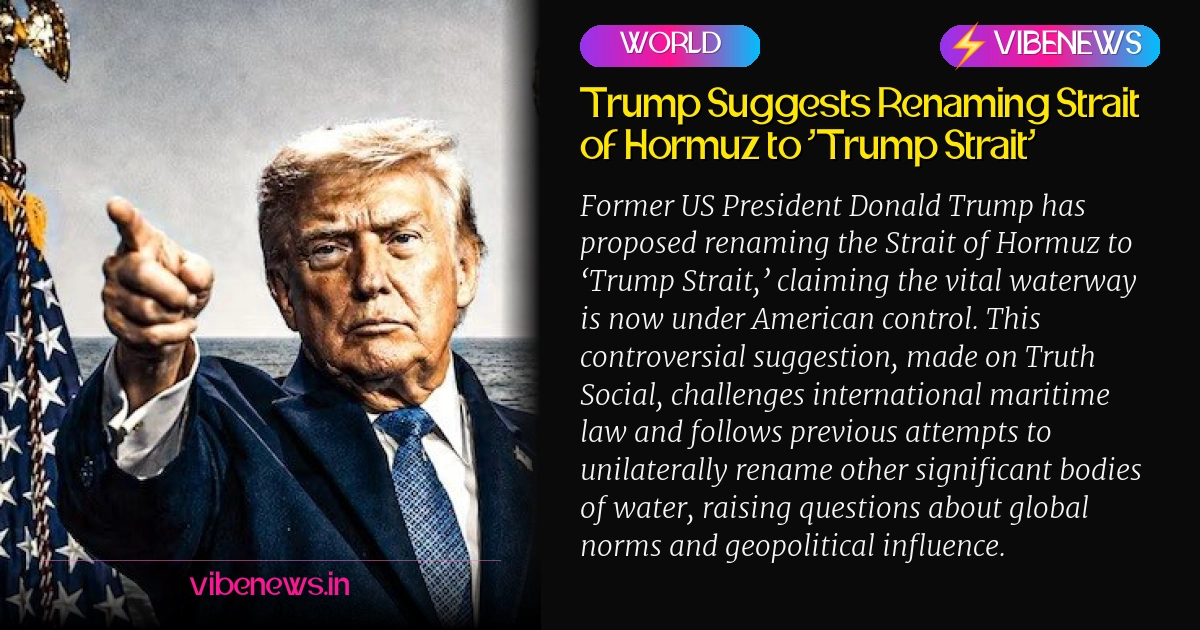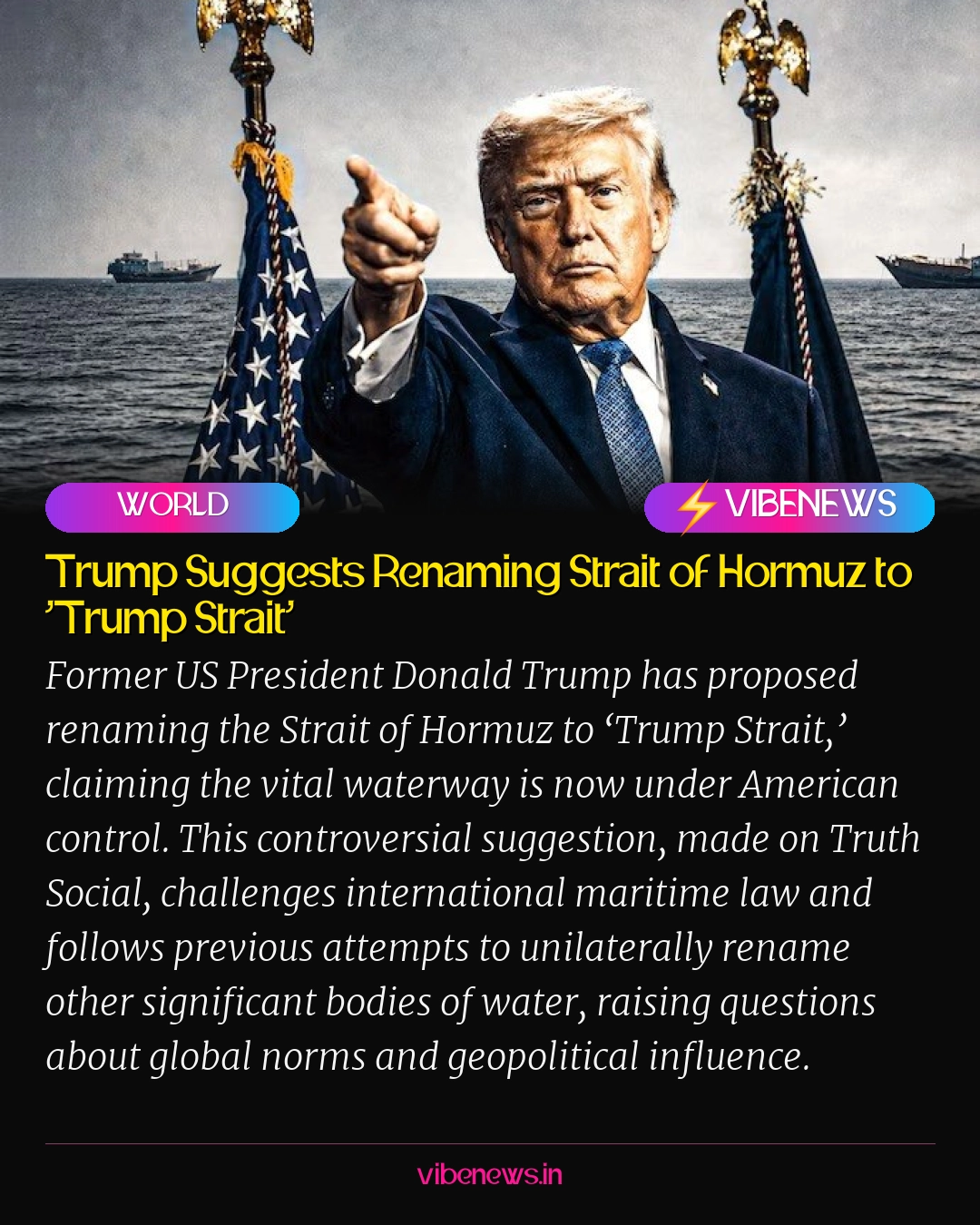
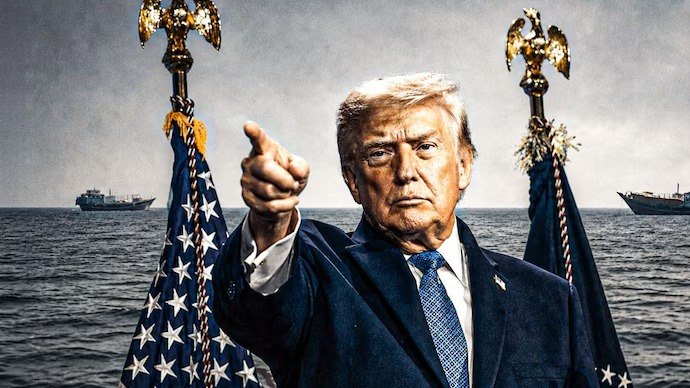
Former US President Donald Trump has once again ignited controversy with a suggestion to rename the strategically vital Strait of Hormuz after himself. This proposal, shared on his Truth Social platform, posits that the waterway is now under American control, a claim that immediately raises questions about international law and geopolitical realities.
Trump’s post stated, "Now that we have it under USA control, should we change the name Hormuz Strait to TRUMP STRAIT??? Like America itself, it would be ‘hotter’ than ever before!" This assertion comes amidst an ongoing conflict with Iran, where Trump has previously depicted the Strait as "new US territory."
The Strait’s Enduring Significance
The Strait of Hormuz, a narrow choke point connecting the Persian Gulf to the Arabian Sea and the open ocean, is arguably the world’s most critical oil transit route. Situated between Iran and Oman, it facilitates the passage of roughly 20 million barrels of crude oil and petroleum products daily, representing a significant portion of the world’s seaborne energy supplies.
Its strategic importance has historically made it a flashpoint for regional and international tensions, particularly concerning Iran’s influence and global energy security. Major oil producers like Saudi Arabia, the UAE, Kuwait, Iraq, and Qatar rely on this waterway to access international markets, making its security paramount for global economic stability.
A Contested Claim of Control
Trump’s assertion that the Strait is now under "USA control" stems from his administration’s narrative during the conflict with Iran. While the US maintains a substantial naval presence in the region to ensure freedom of navigation, the Strait remains an international waterway, not sovereign US territory.
Its status is governed by international maritime law, specifically the United Nations Convention on the Law of the Sea (UNCLOS), which grants all ships the right of transit passage through straits used for international navigation. Unilateral claims of territorial control or renaming rights over such passages are not recognized by the international community and could be seen as a violation of established norms.
The US Energy Secretary Chris Wright noted that over 17 million barrels crossed the waterway on a recent Monday, describing it as a wartime record. While the Trump administration has argued that total regional oil exports, including those bypassing the Strait via pipelines, remain robust, the question of who holds authority over the Strait’s nomenclature is distinct from its operational flow.
A Pattern of Unilateral Nomenclature
This is not an isolated incident in Trump’s political career. His administration previously sought to rename other significant bodies of water, reflecting a broader pattern of asserting national or personal branding onto geographical landmarks. In August, an executive order was signed to rename Lake Ontario as "Lake America," a move swiftly rejected by Canadian officials who share the lake.
Earlier, he also directed the US government to use "Gulf of America" instead of the long-established Gulf of Mexico. These attempts, while impacting US federal documents and some mapping services within the US, have consistently failed to gain international acceptance, with bodies like the International Hydrographic Organisation maintaining traditional names.
Canadian officials explicitly rejected the Lake Ontario change, and Google and Apple maps displayed different names depending on the user’s location. Similarly, the International Hydrographic Organisation continues to recognize the traditional name for the Gulf of Mexico, underscoring the limits of unilateral decrees in international cartography.
International Law and Global Cartography
The authority to rename an international waterway like the Strait of Hormuz does not rest with a single nation, regardless of its global standing. Such changes would typically require international consensus, often through bodies like the International Hydrographic Organisation (IHO), which sets global standards for nautical charts and publications.
Geographical names are often products of history, culture, and international agreement, not unilateral decree. Trump’s proposals, therefore, are largely symbolic gestures aimed at asserting dominance and personal branding rather than initiating legitimate cartographic revisions. They challenge established norms of international cooperation and respect for shared geographical heritage.
Editorial Context
The repeated attempts by a former US President to unilaterally rename international geographical features carry significant long-term implications. They underscore a broader trend of challenging established international norms and institutions, potentially eroding the framework of global governance and the principles of multilateralism.
Such actions, even if largely symbolic, can strain diplomatic relations, create confusion in international navigation and trade, and signal a disregard for multilateral agreements. For the Middle East, specifically, it adds another layer of rhetorical tension to an already volatile region, potentially complicating future diplomatic efforts and perceptions of US intentions.
This pattern highlights a political strategy that prioritizes nationalistic branding and perceived strength over adherence to international consensus. It sets a precedent that could be invoked by other nations seeking to assert similar unilateral claims, potentially leading to a fragmentation of international naming conventions and increased geopolitical friction.
TL;DR
- Former US President Donald Trump proposed renaming the Strait of Hormuz to ‘Trump Strait’ on Truth Social, claiming it is under ‘USA control’.
- The Strait of Hormuz is a vital international maritime passage between Iran and Oman, crucial for global oil and gas supplies.
- Trump’s claim of US control and renaming authority is not recognized under international maritime law, which designates it an international waterway.
- This proposal follows previous attempts by Trump to unilaterally rename Lake Ontario to ‘Lake America’ and the Gulf of Mexico to ‘Gulf of America’.
- International bodies like the International Hydrographic Organisation and other nations do not acknowledge these unilateral name changes for international waters.
- The suggestion is widely viewed as a projection of American power and political branding rather than a legitimate or enforceable cartographic act.