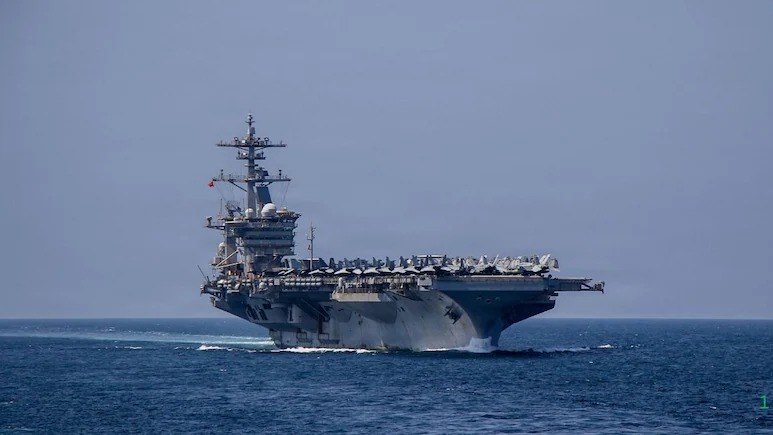
The United States Navy is undertaking a significant operational shift in the Middle East, deploying the Pacific-based aircraft carrier USS George Washington to replace the USS Abraham Lincoln. This strategic rotation comes amidst mounting concerns over the mental health and supply issues plaguing the crew of the USS Abraham Lincoln, which has been engaged in an unusually prolonged deployment supporting American military operations against Iran.
The USS George Washington departed Da Nang, Vietnam, last week, as confirmed by a Navy statement. Accompanied by a cruiser and a destroyer, the carrier has since been observed transiting the Singapore Strait and is now reportedly in the Strait of Malacca, charting a course towards the Indian Ocean. This movement confirms earlier reports from the Wall Street Journal indicating the Washington’s role in relieving the Lincoln, which has been stationed in the Middle East as one of two primary US aircraft carriers.
The Strain of Extended Deployment
The decision to replace the USS Abraham Lincoln stems from a deepening crisis regarding troop morale and welfare. Naval deployments typically span six to nine months; however, the Lincoln has been continuously at sea for over 260 days, marking one of the longest aircraft carrier deployments in modern naval history. This extended period has led to widespread concern among the families of deployed service members and US legislators.
Reports from military-focused outlets such as Navy Times and Stars and Stripes have highlighted a worsening mental health crisis onboard the 5,000-person vessel. These accounts include multiple attempts by service members to jump off the ship, underscoring the severe psychological toll of prolonged separation and operational stress. The Lincoln originally deployed from San Diego in November 2025, arriving in the Middle East in January 2026, shortly before the commencement of the Iran conflict on February 28.
Supply Chain Disruptions and Official Responses
The Navy has acknowledged that the ongoing conflict created a "highly contested environment," which significantly disrupted traditional supply hubs across the Middle East. This disruption directly contributed to shortages of essential items and a loss of mail delivery aboard the aircraft carrier. In response, leadership prioritized "mission-critical supplies," focusing first on food, then hygiene items, and finally mail.
Despite these admissions, US Defence Secretary Pete Hegseth has publicly dismissed reports of poor conditions on the Lincoln, labeling them as "completely misrepresented." During a visit to Panama, Hegseth asserted that the Navy ensures every ship and crew receives all possible provisions. He expressed profound respect for sailors enduring extended deployments in austere conditions with fewer port calls, calling their service "incredible."
Congressional Scrutiny and Calls for Accountability
Hegseth’s remarks, however, have not quelled the concerns of several Democratic lawmakers, who are now demanding accountability from the Pentagon. These legislators are calling for thorough investigations, greater transparency, and more detailed information regarding the conditions aboard the ship, which was initially slated to return home in May.
Senator Richard Blumenthal of Connecticut, a member of the Senate Armed Services Committee, penned a letter to Navy leadership seeking answers to several questions. He emphasized the particular significance of the Lincoln’s prolonged deployment, noting its occurrence within the context of ongoing military operations against Iran and the potential for substantial US naval forces to be required in the region for an extended duration. Arizona Senator Ruben Gallego, a Marine Corps veteran, voiced his outrage on social media, stating that the treatment of sailors is "not just disgusting; it’s dangerous." He expressed his intent to lead a bipartisan delegation on an official oversight visit to the carrier.
The Geopolitical Chessboard: Strait of Hormuz
These internal military challenges unfold against a backdrop of persistent geopolitical tensions in the Strait of Hormuz, a critical maritime choke point. US President Donald Trump has repeatedly claimed American control over the strait, vowing to "keep it." While renewed hostilities between the US and Iran have seen a recent calming, the Navy has reimposed a blockade on Iranian ports within this crucial waterway.
The Trump administration has offered little clarity on its strategy for de-escalating or concluding the war. Defence Secretary Hegseth has even suggested that the US possesses the capability to maintain the blockade "indefinitely." This lack of a clear exit strategy exacerbates the strain on military personnel and equipment, raising fundamental questions about the sustainability of such prolonged engagements.
Editorial Context
The unfolding situation aboard the USS Abraham Lincoln, culminating in its replacement, transcends a mere logistical naval rotation; it represents a critical juncture for US military policy and personnel welfare. The prolonged deployment, coupled with documented mental health crises and supply shortages, casts a stark light on the human cost of sustained military engagements, particularly in regions of high geopolitical volatility like the Middle East. This incident forces a re-evaluation of deployment durations, support systems for service members, and the long-term sustainability of maintaining a robust forward presence without clear strategic objectives or exit strategies.
For the United States, the implications are profound, touching upon military readiness, recruitment, and the credibility of its commitment to troop welfare. Internationally, the episode underscores the inherent risks and challenges of projecting power globally, especially when domestic support systems are strained. The congressional calls for accountability signal a growing recognition that the well-being of service members cannot be decoupled from strategic military objectives. Over the long term, how the Pentagon addresses these systemic issues will not only shape the future of naval deployments but also influence public trust in military leadership and the nation’s capacity for enduring global leadership.
TL;DR
- The USS George Washington is replacing the USS Abraham Lincoln in the Middle East due to severe morale and mental health issues among its crew.
- The USS Abraham Lincoln has been deployed for over 260 days, one of the longest carrier deployments in modern history, amidst the US war against Iran.
- Reports indicate mental health crises, including suicide attempts, and significant supply shortages onboard the Lincoln.
- Defence Secretary Pete Hegseth dismissed these reports, but Democratic lawmakers are demanding investigations and greater transparency from the Pentagon.
- The situation highlights the strain of prolonged military engagements and the lack of a clear exit strategy for the US conflict with Iran and the blockade of the Strait of Hormuz.
- Congressional leaders are calling for oversight visits and accountability regarding the welfare of service members.