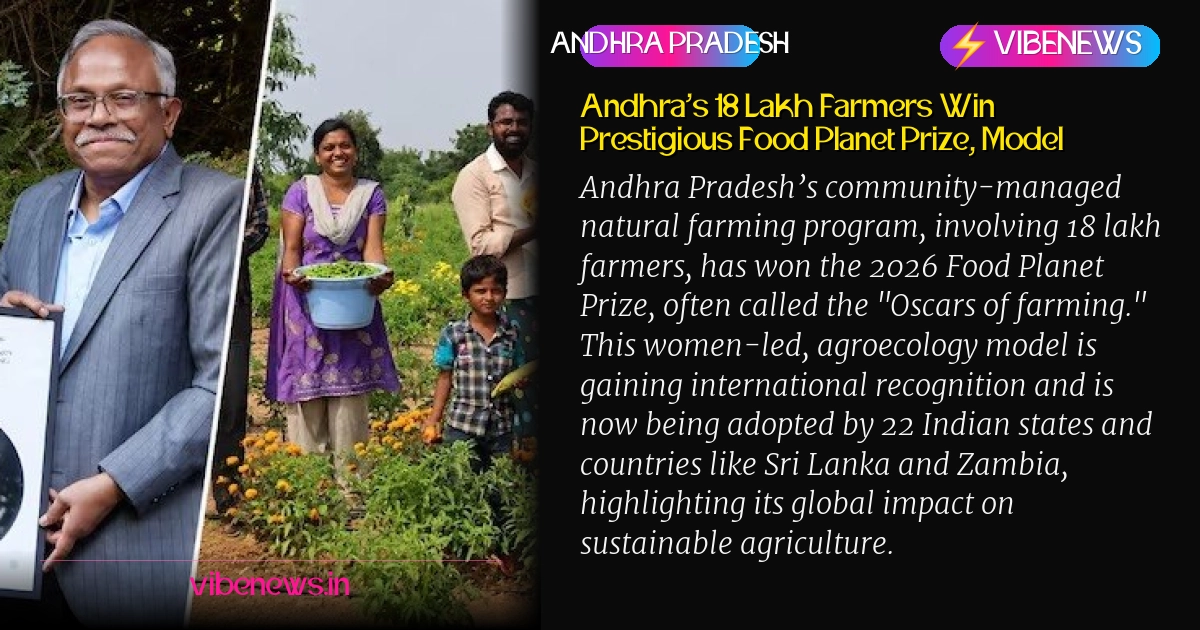
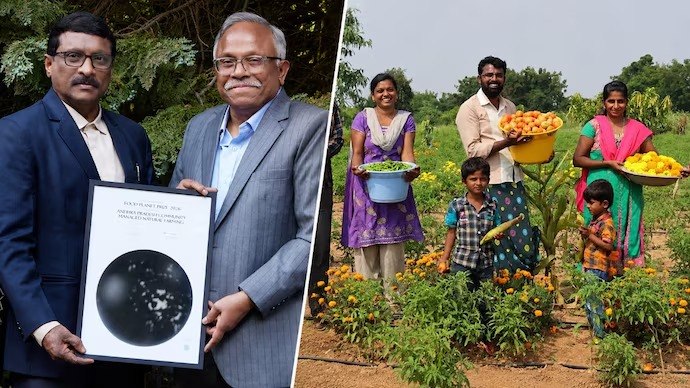
Andhra Pradesh’s pioneering community-managed natural farming program, involving a remarkable 18 lakh farmers, has been awarded the prestigious 2026 Food Planet Prize in Sweden. This significant international recognition highlights the state’s innovative, women-led agroecology model as a global benchmark for sustainable agriculture.
Often dubbed the "Oscars of farming," the $1.5 million prize was presented by the Curt Bergfors Foundation in Bastad, Sweden, on June 2. The jury lauded the Andhra Pradesh Community Managed Natural Farming (APCNF) program as "one of the most ambitious agroecology transitions undertaken anywhere in the world," underscoring its potential to transform global food systems.
This accolade marks a pivotal moment, shifting major environmental honours from traditional scientific or conservation projects to a grassroots movement driven by small farmers. The Food Planet Prize, known as the world’s largest environmental award focused on food systems, annually celebrates initiatives capable of reducing environmental damage and fostering resilient food production.
The APCNF program champions natural farming practices that drastically reduce reliance on synthetic fertilisers and harmful pesticides. It empowers farmers to cultivate crops using natural inputs, improving soil health and making agriculture more resilient against climate-driven challenges like droughts, floods, and pest infestations. This approach directly addresses rising input costs and the environmental hazards associated with chemical-intensive farming.
The success of Andhra Pradesh’s model extends far beyond its borders. Its community-driven approach is currently being replicated in 22 other Indian states, demonstrating its national relevance. Internationally, countries like Sri Lanka and Zambia have also adopted the APCNF framework, recognizing its scalable pathway for improving livelihoods, enhancing resilience, and achieving positive environmental outcomes.
A cornerstone of the APCNF’s success is its robust women-led self-help groups and a vast network of over 10,000 farmer trainers. T Vijay Kumar, Executive Vice Chairman of Rythu Sadhikara Samstha (RySS), the implementing body, emphasized, "The magic is in the women. This journey did not begin with agriculture. It began with organising women, strengthening communities, and creating the foundation for change." These groups facilitate farmer-to-farmer learning, driving widespread adoption of natural farming techniques across more than 8,000 villages.
This international recognition aligns perfectly with Andhra Pradesh Chief Minister N Chandrababu Naidu’s ambitious vision to transform the state into a "100% natural farming state" by 2047. Launched in 2016 as part of his Swarna Andhra@2047 or Viksit Andhra Pradesh-2047 roadmap, the program underscores a long-term commitment to sustainable agricultural practices.
The award places an Indian farming model at the forefront of global discussions on climate-resilient agriculture, offering a viable alternative to conventional methods. As global demand for chemical-free food grows, the APCNF provides a proven, scalable solution that benefits both farmers and consumers. It demonstrates that large-scale agricultural transformation is achievable through community empowerment and ecological principles.
The $1.5 million prize money will be strategically invested to further expand the program’s reach and impact. Plans include establishing more demonstration farms, developing comprehensive implementation toolkits, fostering new research partnerships, and training future natural farming leaders. A key initiative involves strengthening a network of "farmer scientists" who conduct field experiments and meticulously document results, ensuring continuous improvement and knowledge sharing.
This award is more than just international recognition; it’s a powerful affirmation that a model built around small farmers, women’s collectives, and community institutions can effectively compete with and surpass some of the world’s most celebrated sustainability initiatives. Andhra Pradesh’s journey offers a compelling blueprint for other regions grappling with food security and environmental challenges, setting a precedent for how agriculture can thrive by working with nature.
TL;DR
- Andhra Pradesh’s APCNF program, involving 18 lakh farmers, won the 2026 Food Planet Prize, a major global environmental award.
- The $1.5 million prize recognizes the program’s women-led, community-driven agroecology model for its climate resilience and reduced chemical dependence.
- The model is being replicated in 22 Indian states and internationally in Sri Lanka and Zambia, showcasing its global applicability.
- Chief Minister N Chandrababu Naidu aims for Andhra Pradesh to achieve 100% natural farming by 2047, building on this success.
- The program emphasizes natural fertilisers, pesticides, and soil regeneration, significantly reducing cultivation costs and improving farm resilience.
- Women’s self-help groups and over 10,000 farmer trainers are central to the program’s success, driving farmer-to-farmer learning.
- The prize money will fund expansion of demonstration farms, research, training, and a network of "farmer scientists."