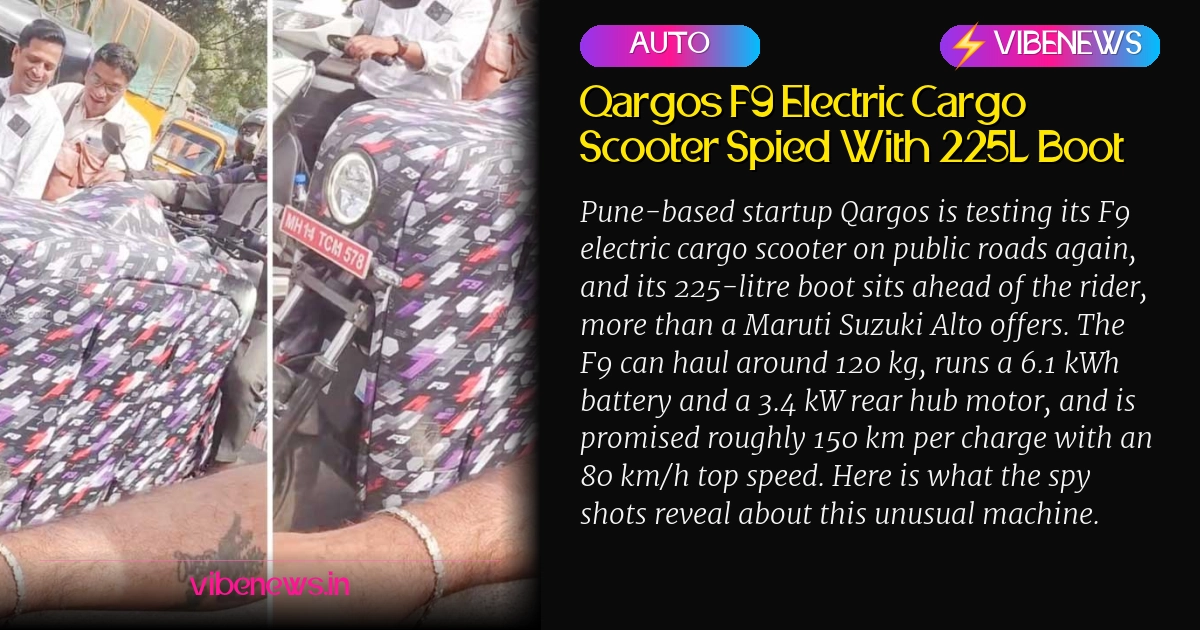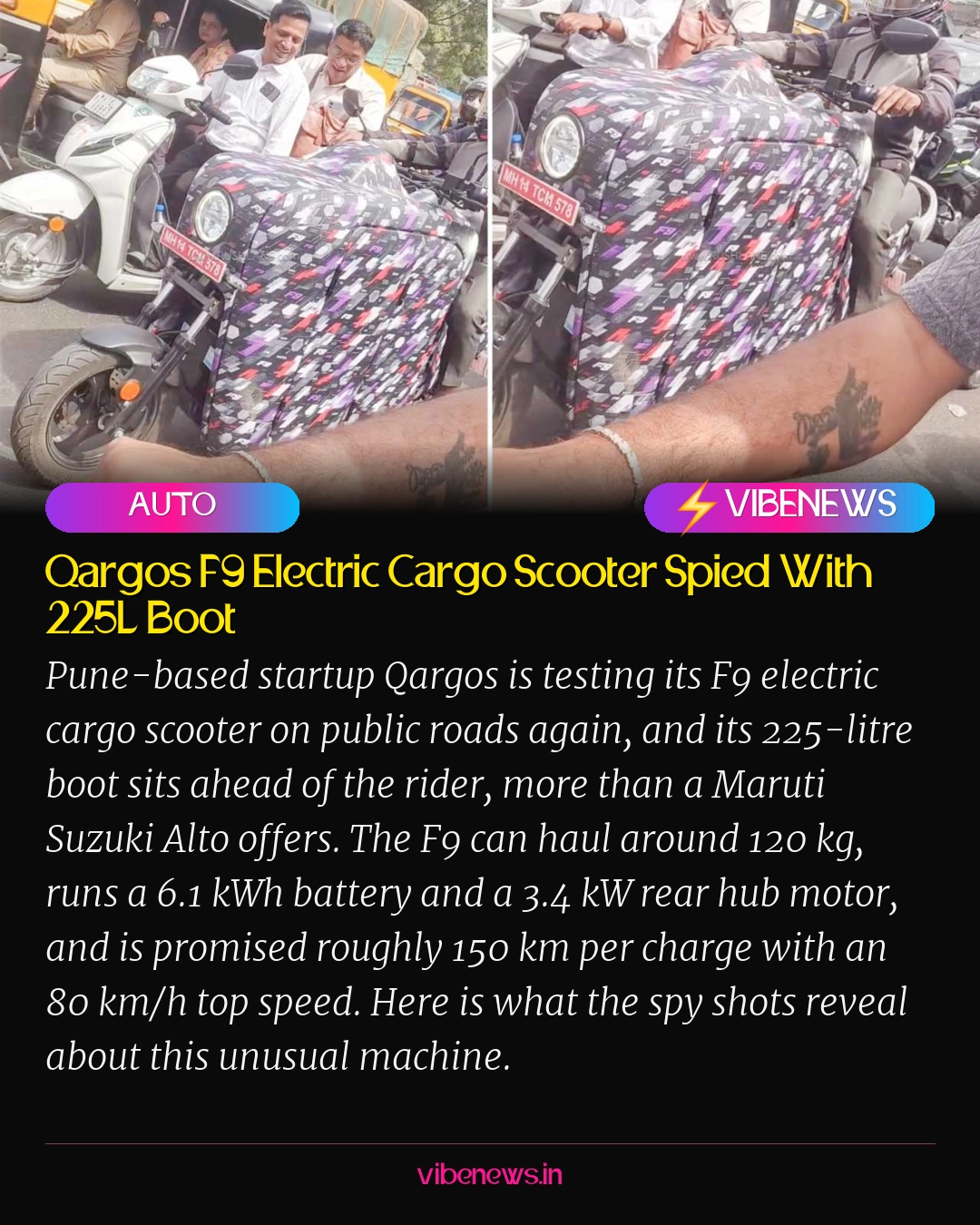

Pune-based electric mobility startup Qargos has been spied testing its F9 electric cargo scooter on public roads again, and the machine is hard to ignore. It has a 225-litre boot built right into the front of the scooter, and that single detail is what makes it stand out.
Most electric scooters are built to carry a rider and maybe a small bag. The F9 flips that idea. Its storage sits ahead of the rider’s seat, and the rider sits behind the cargo space. Qargos designed the vehicle for last-mile delivery, logistics and other commercial work, so the storage is the whole point.
A boot bigger than a Maruti Suzuki Alto
The numbers are what grab attention. A 225L boot is more than what you get in a car like the Maruti Suzuki Alto, and it is close to what you find in the S-Presso, a car that is marketed as an SUV. For a scooter, that comparison sounds almost absurd. For readers in the US, UK and Australia, where a boot is usually part of a car, it makes the F9 feel like a small van that happens to have two wheels.
The spy shots show a test mule with compartmentalised storage. Two hinged doors give access to two separate compartments. The storage area is concealed and illuminated, which suggests Qargos wants the space to feel usable rather than like an afterthought bolted onto a scooter frame.
Qargos also says the F9 does not just offer volume. It can carry around 120 kg of cargo inside that 225L space. That is a load that would change how a delivery rider works through a busy day, and it is the kind of figure that makes logistics managers take a second look.
Beyond deliveries
The boot is not limited to parcels. According to the details available, the space can be modified to work as a mobile refrigerator or a mobile store, along with many other applications. That opens the door to street vendors, small food sellers and anyone who needs to move goods and sell them from the same vehicle.
"It is purely function-over-form and gets a dedicated storage ahead of the rider’s seat with 225L boot space."
Design that looks like nothing else on the road
The F9 does not look like a typical scooter. The scooter extends far ahead of the rider, and the spy shots draw comparisons to the long bonnet of a Mercedes-Benz SLS AMG. The handlebar and instrument cluster sit close to the rider, and the rider’s ergonomics appear comfortable enough for a full day of operations.
Other visible details include a circular LED headlight setup, LED turn indicators, RSU telescopic front forks, a rear grab rail, large wheels that could be 14-inch units, a front disc brake and a rear hub motor. Each part points to a machine built for working hours, not weekend rides.
What powers it
The F9 runs on a 6.1 kWh battery pack that sends power to a 3.4 kW BLDC hub motor at the rear. Qargos promises a range of around 150 km on a single charge. The top speed is said to be 80 km/h, which is a respectable number for a cargo scooter that is expected to carry heavy loads.
Those figures suggest the F9 is aimed at riders who cover real distances in cities rather than short hops around a neighbourhood. A range of 150 km gives a delivery rider room to finish a full shift without constant charging stops, at least on paper.
Why the testing matters
India’s electric two-wheeler market has grown fast, and most of the attention has gone to commuter scooters and premium models. Cargo-focused electric scooters have existed, but the reports say none of them come with a 225L boot. That gap is what makes the F9 worth watching.
The scooter is still in testing. The reports based on the spy shots do not confirm a launch date, pricing or a final production design. What they do show is that Qargos is willing to test a bold, unusual shape on public roads, where other drivers and riders can see it and react to it.
That reaction is part of the story. Spotted testing a second time, the F9 still draws stares from other road users. For an oddball vehicle built around storage rather than style, that kind of attention is a sign that the design is working as a conversation starter.
The bottom line for buyers and watchers
The Qargos F9 is not trying to be a sleek commuter. It is a practical cargo machine with a boot that rivals small cars, a claimed 120 kg load capacity, a 150 km promised range and an 80 km/h top speed. If those numbers hold up in production, the F9 could change how small businesses and delivery riders think about what a scooter can carry.
TL;DR
- Qargos F9 electric cargo scooter was spied testing on Indian public roads again.
- The Pune-based startup’s scooter has a 225-litre boot placed ahead of the rider’s seat.
- That boot is larger than what a Maruti Suzuki Alto offers and close to the S-Presso.
- The F9 can carry around 120 kg of cargo and may be modified into a mobile store or refrigerator.
- It runs a 6.1 kWh battery and a 3.4 kW rear hub motor, with a promised range of about 150 km.
- Top speed is said to be 80 km/h. No launch date or price has been confirmed.