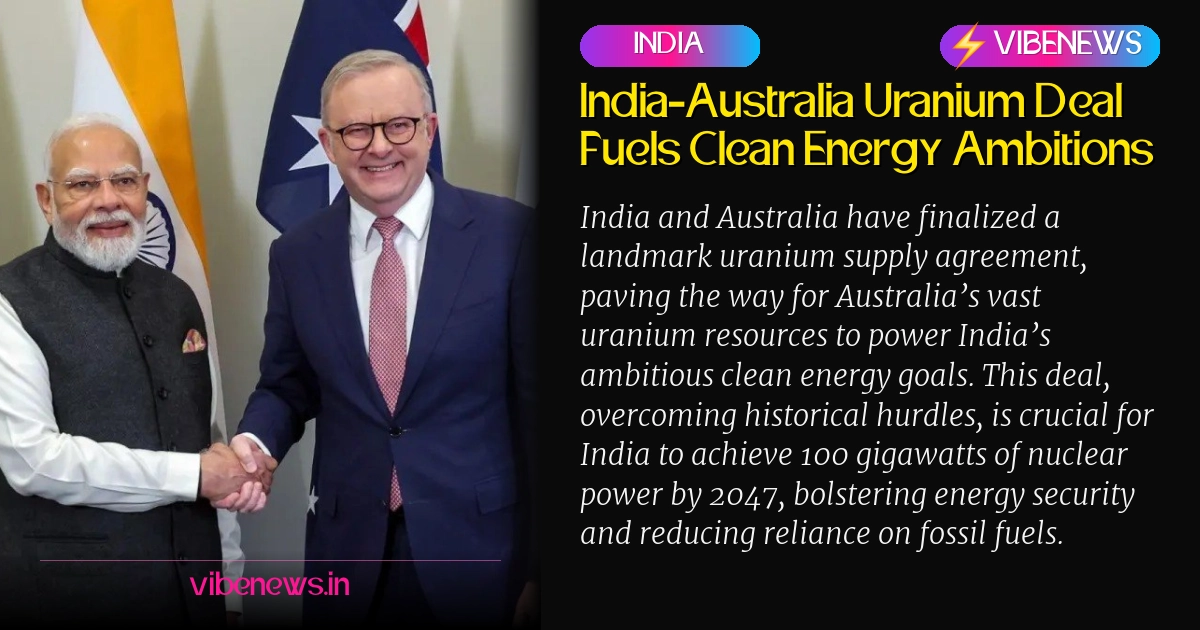
India has secured a crucial uranium supply agreement with Australia, a move vital for its clean energy future and ambitious target of 100 gigawatts of nuclear power by 2047. This landmark deal, finalized during Prime Minister Narendra Modi’s visit, unlocks Australia’s vast uranium reserves for India’s exclusively peaceful nuclear energy program, promising to significantly enhance energy security across states like Telangana and Andhra Pradesh.
The agreement addresses India’s growing electricity demand, which is critical for its economic development and improving quality of life for its 1.4 billion citizens. For regions like Hyderabad and other rapidly urbanizing areas in Telangana, a stable and clean energy supply from nuclear power can support industrial growth, reduce carbon emissions, and lessen the strain on existing fossil fuel-based power grids.
Why This Uranium Deal Matters for India’s Energy Future
Australia possesses approximately 28 percent of the world’s known uranium resources, yet it does not utilize nuclear power domestically. This makes it a critical supplier for nations like India, which are aggressively pursuing nuclear energy to meet their clean energy targets and reduce dependence on coal and other fossil fuels.
The deal, announced by PM Modi and his Australian counterpart Anthony Albanese, is a cornerstone for India’s long-term energy strategy. It ensures a stable and predictable supply of nuclear fuel, which has historically been a challenge for India due to international sanctions and non-proliferation concerns.
Overcoming Decades of Nuclear Diplomacy Hurdles
India’s journey to secure uranium supplies has been complex. As a non-signatory to the Nuclear Non-Proliferation Treaty (NPT), India faced significant international restrictions on nuclear trade following its nuclear tests in 1974 and 1998.
A pivotal shift occurred in 2008 when the Nuclear Suppliers Group (NSG) granted India a waiver, allowing it to engage in nuclear commerce with member states. This waiver paved the way for bilateral agreements, including the 2015 deal with Australia, which Thursday’s administrative agreement now fully enacts, removing previous obstacles.
India’s Ambitious Nuclear Power Targets and Local Impact
India aims to install 100 gigawatts of nuclear power capacity by 2047, a substantial increase from its current approximately 7.5 gigawatts. This expansion is crucial for powering an estimated 60 million Indian homes and supporting the nation’s rapid industrialization.
For states like Telangana, which are experiencing significant economic and population growth, enhanced nuclear power capacity translates into more reliable electricity for homes, businesses, and agricultural needs. This reduces the pressure on local power grids and contributes to a cleaner environment by lowering reliance on thermal power plants, which often contribute to air pollution in urban centers like Hyderabad.
Geopolitical Implications: Beyond Energy Security
Beyond energy, the uranium deal underscores the deepening strategic partnership between India and Australia. Both nations share a common interest in maintaining stability and a rules-based order in the Indo-Pacific region, particularly in light of growing geopolitical complexities.
The agreement, alongside strengthened defense cooperation and plans for a temporary space tracking terminal on Australia’s Cocos Keeling Islands, signals a robust alliance. While neither country explicitly mentioned China, these moves are widely seen as part of a broader strategy to diversify partnerships and balance regional influence.
What’s Next for India-Australia Strategic Ties?
The uranium supply agreement is a significant milestone, but it also opens doors for further collaboration. Both nations are committed to bolstering supply chains for critical minerals and enhancing defense cooperation, indicating a multifaceted strategic partnership.
The focus on clean energy and strategic autonomy will likely drive future engagements. This sustained collaboration is expected to yield benefits not just in energy security but also in technological exchange and regional stability, impacting India’s overall development trajectory.
TL;DR
- India and Australia signed a landmark uranium supply agreement during PM Modi’s visit, crucial for India’s clean energy goals.
- The deal enables Australia, holding 28% of global uranium, to export to India for peaceful nuclear energy purposes under <strong>International Atomic Energy Agency (IAEA)</strong> safeguards.
- This agreement is vital for India’s target to install <strong>100 gigawatts</strong> of nuclear power by <strong>2047</strong>, significantly boosting its non-fossil fuel capacity.
- It overcomes historical diplomatic hurdles, including India’s non-signatory status to the <strong>Nuclear Non-Proliferation Treaty (NPT)</strong>, facilitated by a 2008 <strong>Nuclear Suppliers Group (NSG)</strong> waiver.
- The pact strengthens India-Australia strategic ties, aligning with broader geopolitical interests in the Indo-Pacific region, and promises enhanced energy security for Indian states like Telangana.