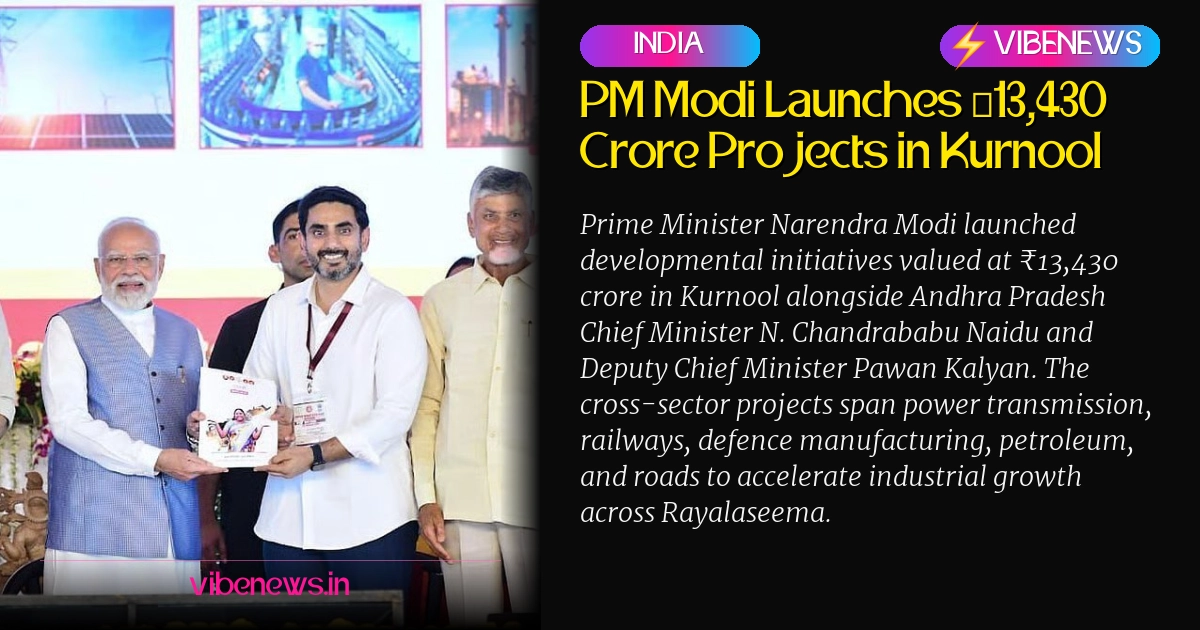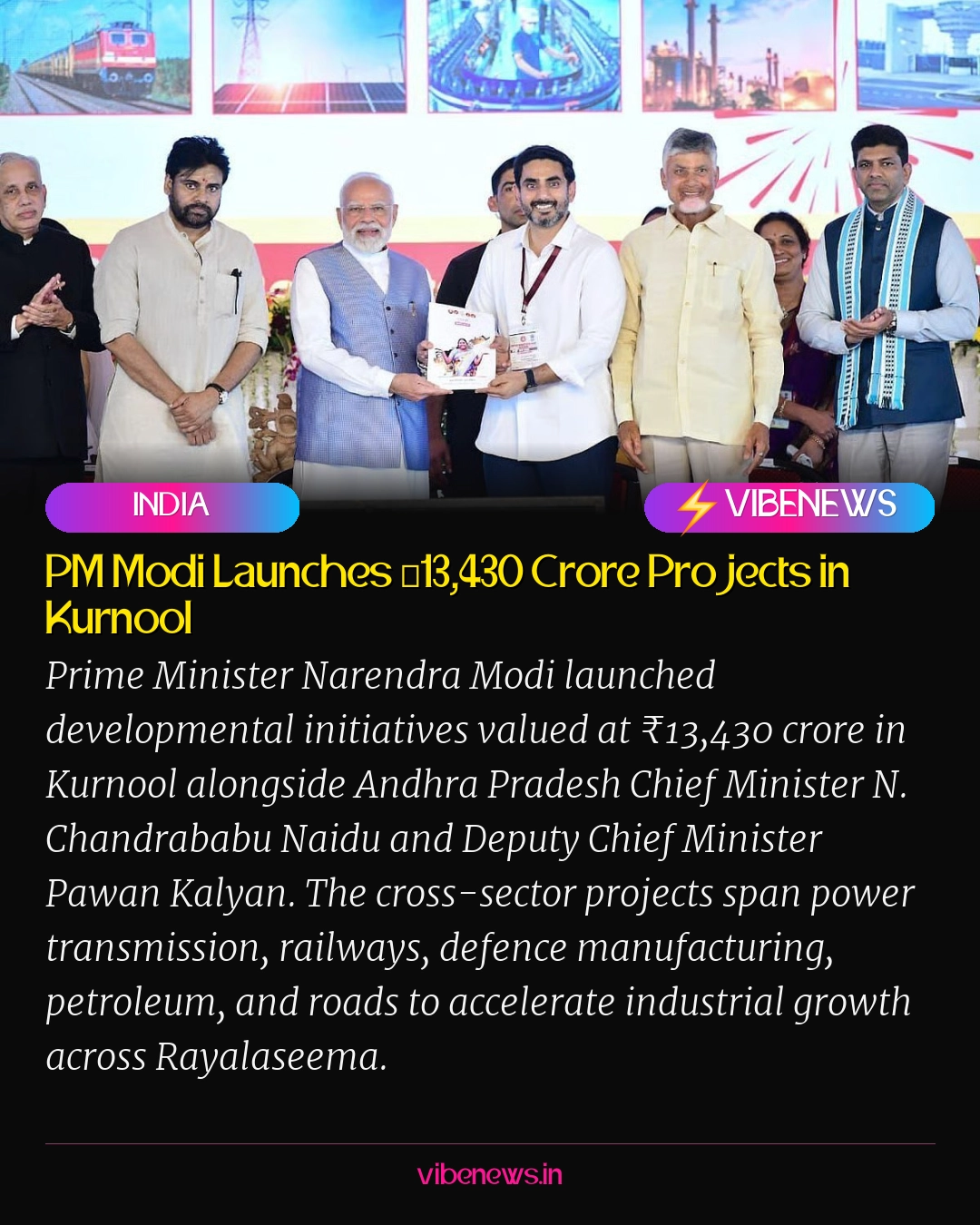
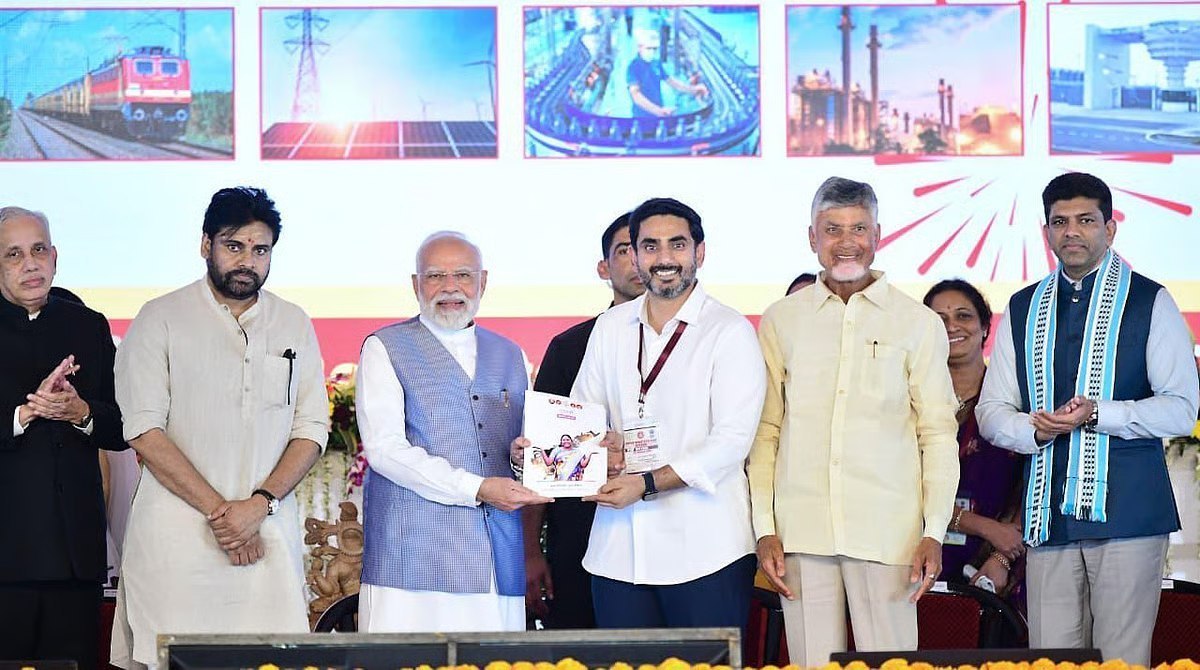
Prime Minister Narendra Modi laid the foundation stone and inaugurated multiple infrastructure and industrial initiatives valued at ₹13,430 crore in Kurnool, Andhra Pradesh, on Thursday. The event marked a major joint public appearance of the National Democratic Alliance leadership in the state, bringing Chief Minister N. Chandrababu Naidu, Deputy Chief Minister Pawan Kalyan, and Minister Nara Lokesh together on stage alongside the Prime Minister to present an integrated developmental blueprint.
Multi-Sector Capital Inflow Into Rayalaseema
The projects inaugurated across the state cover a wide array of core sectors, focusing heavily on power transmission, road corridors, railway modernization, defence manufacturing, and petroleum infrastructure. The capital allocations are structured to upgrade logistical efficiency across the southern districts of Andhra Pradesh, easing freight movement, enhancing supply chains, and attracting manufacturing operations to regional hubs.
During the public convention titled ‘Super GST – Super Savings,’ Prime Minister Modi pointed to visible markers of regional growth, including heightened power consumption, broader rural electrification coverage, and high-capacity infrastructure projects such as the Chittoor LPG facility and the Sheelanagar highway. Modi framed these industrial ventures as foundational components supporting India’s broader target of becoming a developed nation under the Viksit Bharat 2047 initiative, ensuring sustained central backing for state-level enterprise.
Statewide Impact and the Transformation of Kurnool
For Andhra Pradesh, and specifically the Rayalaseema region, the central allocations represent a coordinated push toward long-term administrative and economic decentralization. Addressing the gathering, Chief Minister Chandrababu Naidu unveiled concrete administrative goals for Kurnool, explicitly announcing plans to establish a High Court Bench in the historic city while working toward turning Rayalaseema into India’s green energy capital. The convergence of new industrial works with administrative infrastructure seeks to reverse historical regional disparities across southern Andhra districts.
Naidu credited Modi’s economic management with propelling India to its standing as the fourth-largest global economy. Speaking on domestic financial measures, the Chief Minister underscored the role of unified indirect taxation, describing ongoing reforms as a festival of savings that yields tangible economic relief to household budgets across Andhra Pradesh.
Long-Term Coalition Alignment
Beyond capital deployment, the Kurnool gathering emphasized sustained political stability. Deputy Chief Minister Pawan Kalyan highlighted the strategic purpose of the regional-national alliance, asserting that the political partnership extends far past electoral calculus to ensure lasting institutional progress.
“This coalition is not just for elections, it’s for the next 15 years of development.”
Echoing these sentiments, Minister Nara Lokesh linked Kurnool’s historical heritage with modern industrial aspirations. Lokesh noted that policies prioritizing self-reliance under Atmanirbhar Bharat and structured taxation models provide local industries the stability necessary to compete globally. With major investments locked in across heavy manufacturing, energy distribution, and transport, the alliance leadership projected a unified trajectory aimed at maintaining high-velocity industrial development throughout Andhra Pradesh.
TL;DR
- Prime Minister Narendra Modi inaugurated ₹13,430 crore development projects in Kurnool.
- The investments target power transmission, railways, defence manufacturing, petroleum, and road networks.
- Chief Minister Chandrababu Naidu announced plans to establish a High Court Bench in Kurnool.
- Naidu outlined an ambitious vision to transform the Rayalaseema region into India’s green energy capital.
- Deputy CM Pawan Kalyan affirmed the alliance is built for 15 years of continuous development.