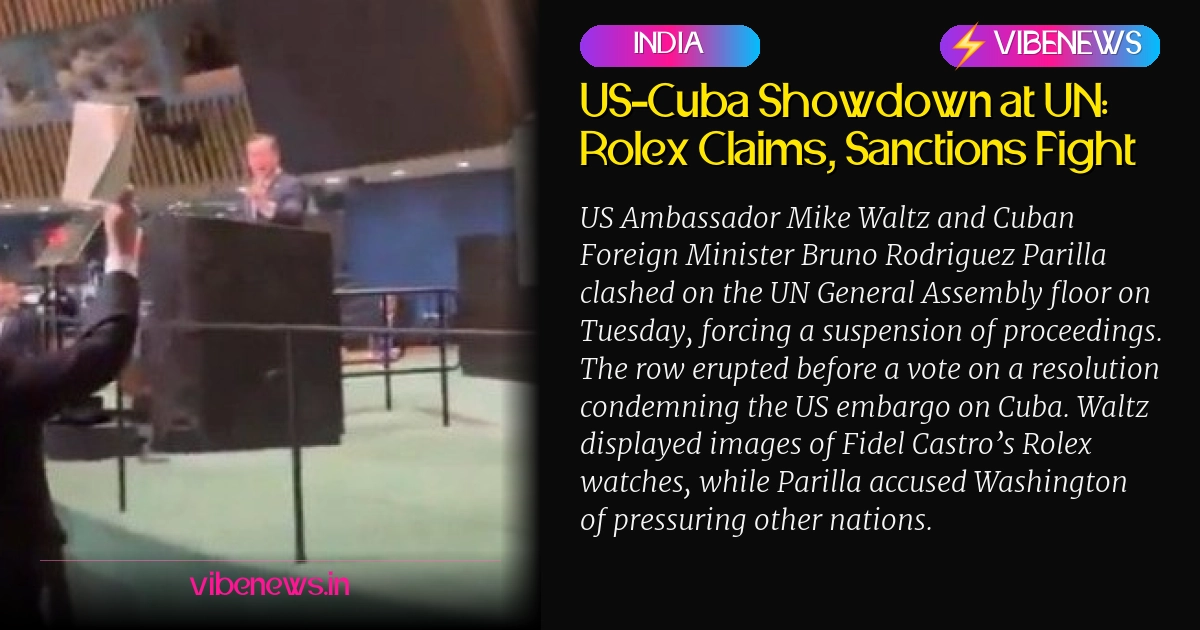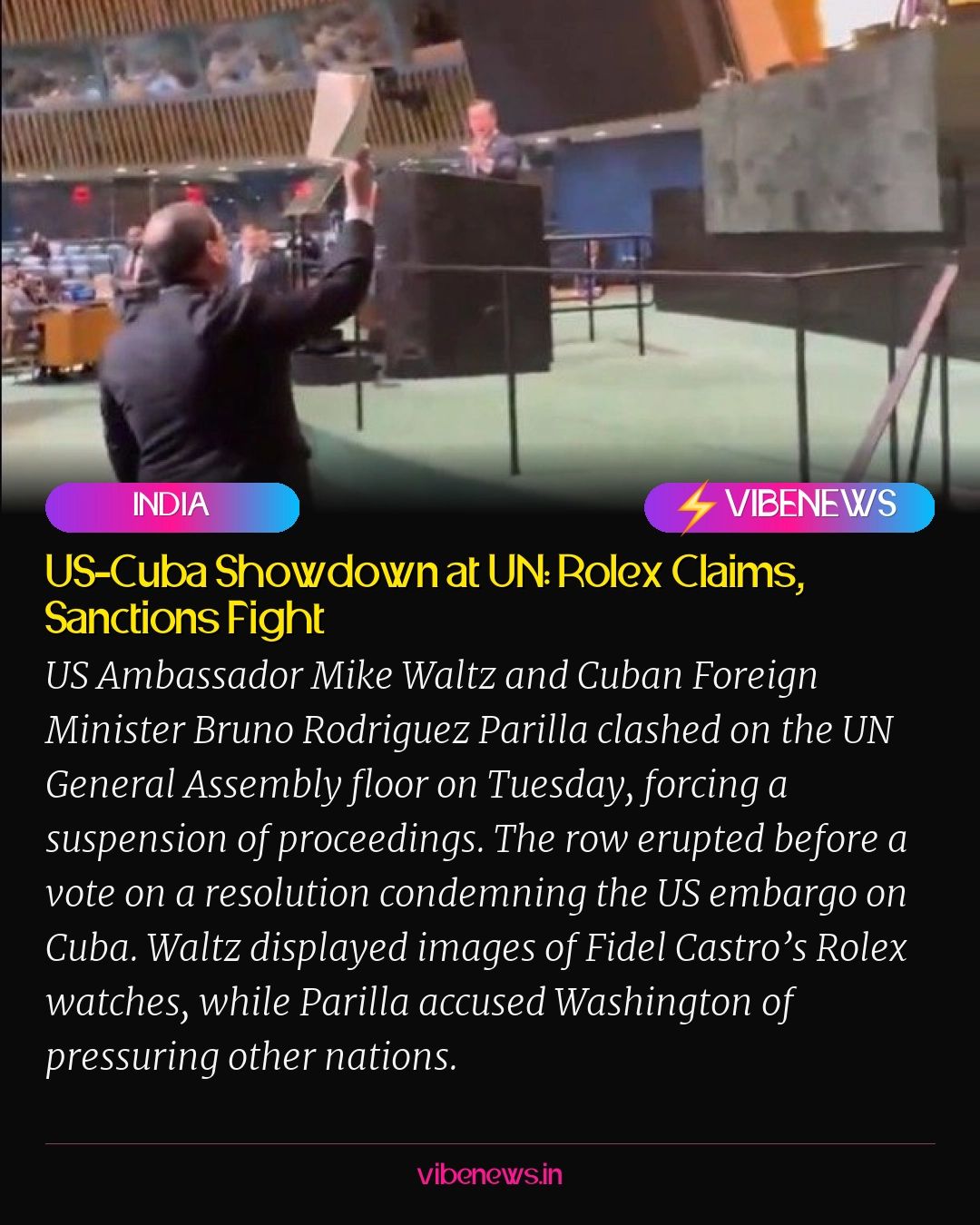

US Ambassador to the United Nations Mike Waltz and Cuban Foreign Minister Bruno Rodriguez Parilla got into a bitter confrontation on the floor of the UN General Assembly on Tuesday, and the session had to be suspended.
The clash came just before a vote on a resolution condemning the decades-old US economic and trade embargo on Cuba. What began as a procedural debate turned into a personal, public shouting match in the chamber.
Castro’s watches and a claim about wages
Waltz opened his remarks by putting a photo of former Cuban leader Fidel Castro on the screen. In the picture, Castro was wearing two Rolex watches. Waltz said each watch cost around 40,000 US dollars.
He then cited figures attributed to the Cuban government. According to Waltz, the two watches together were equal to 55 years of earnings for an average Cuban citizen. He used the image to make a broader charge: that the Cuban government is corrupt and that its leaders live lavishly while ordinary people struggle.
The attack was aimed at the country’s leadership, not just its past. It was a sharp rhetorical choice in a forum built on diplomatic restraint, and it set the tone for everything that followed.
A second photo, and a charge of hypocrisy
Waltz then displayed a picture of Cuba’s current president, Miguel Diaz-Canel. He alleged that the president also wears a Rolex. He told the assembly that the problem did not start with Castro and continues under the present government.
That line drew an immediate response. Parilla moved toward the podium while Waltz was still speaking. He accused the US envoy of lying.
Point of order at the podium
Parilla invoked Rule 71 of the General Assembly’s procedural rules and raised a point of order. Under that rule, delegates can register a procedural objection, and the presiding officer must consider it.
Waltz did not accept the objection. He said the Cuban foreign minister was upset because he did not like the bitter truth. He then told Parilla that he could try to intimidate as much as he wanted, but that he should step back from the podium.
The exchange escalated quickly. Waltz turned toward the General Assembly president, Khalilur Rahman, and said the Cuban foreign minister was trying to intimidate him. He demanded that Parilla be removed from the podium.
’Do you understand who you are talking to? This is the United States of America. Step back.’
Parilla answered with a single line: ‘You are lying.’ Waltz repeated his demand that he step back. With the row showing no sign of cooling, the General Assembly suspended its proceedings.
Allegations spill beyond the chamber
The confrontation did not stay on the podium. A video that surfaced after the session reportedly showed a physical altercation involving a spokesperson for the US ambassador, JP Freire.
According to the allegations, a member of the Cuban delegation attacked Freire while he was recording the incident. The person reportedly also tried to snatch his iPhone. These claims come from the reported footage and allegations as described in the source material. They have not been independently confirmed in the reporting available here.
Havana’s case: fuel curbs and a humanitarian squeeze
Parilla’s side of the story centered on the resolution itself. He accused the United States of pressuring other countries to vote against the text, which condemns the embargo that has been in place against Cuba for decades.
Parilla also argued that recent US fuel-related restrictions have worsened Cuba’s economic and humanitarian crisis. In his account, the restrictions have added strain to the country’s health services and put lives at risk across the island.
Those are Cuba’s arguments, delivered from the same podium that Waltz had just challenged. They frame the embargo not as a distant policy dispute but as a daily pressure on hospitals and households.
Where the fight stands
The reporting available does not say how the resolution vote ultimately turned out. What is clear is that the vote was the reason for the fight. Washington used the chamber to attack Havana’s leadership over luxury and corruption, while Havana used it to accuse Washington of bullying other nations and deepening a humanitarian emergency.
For readers following UN diplomacy, the episode is a reminder of how quickly a procedural vote can turn into a direct confrontation. A debate about sanctions became a clash over who gets to speak, who gets pushed back from the microphone, and who is allowed to call the other side a liar on the world’s most watched diplomatic stage.
TL;DR
- US Ambassador Mike Waltz and Cuban Foreign Minister Bruno Rodriguez Parilla clashed on the UN General Assembly floor on Tuesday, forcing a suspension of proceedings.
- The row erupted before a vote on a resolution condemning the decades-old US embargo on Cuba.
- Waltz showed a photo of Fidel Castro wearing two Rolex watches, claiming each cost about 40,000 US dollars.
- Waltz said the two watches equalled 55 years of an average Cuban’s earnings, citing Cuban government figures.
- Parilla invoked Rule 71 and accused Waltz of lying, then moved to the podium as Waltz kept speaking.
- Waltz told Parilla to step back, saying ‘This is the United States of America.’
- Parilla accused Washington of pressuring countries to vote against the resolution and blamed US fuel curbs for worsening Cuba’s crisis.
- A video reportedly showed a scuffle involving a US spokesperson, JP Freire, which has not been independently confirmed.