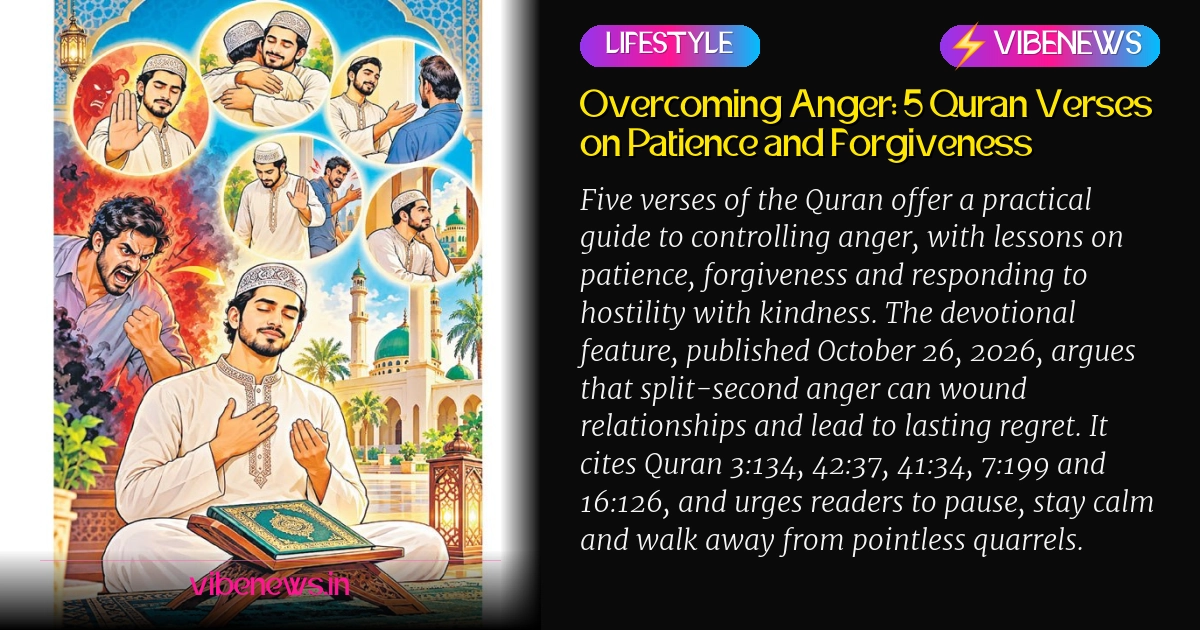

A Telugu-language devotional feature published on October 26, 2026 lays out five verses from the Quran as a practical guide for controlling anger, with lessons on patience and forgiveness.
The piece opens with a blunt warning: anger damages a person’s ability to think clearly. Words spoken in a heated moment can hurt people for years, and decisions taken in fury can leave a lifelong sense of regret.
The remedy, according to the article, lies in the qualities the Quran teaches. Those include restraining anger, forgiving others, practicing patience and answering evil with good. The writer presents these not as distant ideals but as tools for the exact moment when a sharp reply rises to the tongue.
Forgiveness as strength, not surrender
One of the central ideas is that forgiveness is not weakness. The article cites Quran 3:134, which describes people who control their anger and pardon others, and says God loves such people. It also cites Quran 42:37, which describes those who forgive even when they are angry.
Forgiveness is not weakness; it is a sign of self-control.
That line sums up the feature’s core argument. Restraint is not passivity. In the article’s framing, holding back a retaliatory reaction is a form of inner discipline, and it reveals more about a person’s character than any argument won in the heat of the moment.
The article acknowledges the natural impulse behind anger. When someone hurts us, the urge to strike back can feel immediate and justified. The feature suggests that the real test comes in that moment, when a person chooses to forgive rather than retaliate.
Turning an enemy into a friend
The feature’s most striking claim draws on Quran 41:34, which advises responding to evil with what is best. According to the article, a person who does this may see someone who was an enemy become a close friend.
That promise is presented as a direct result of choosing a better response, not as a guarantee that every hostile relationship will change. The message is that kindness has a power that anger does not.
Why arguments escalate
The article makes a simple observation about conflict. When one person speaks in anger and the other replies in the same tone, the dispute grows. Each reaction feeds the next.
A calm and respectful reply, the feature argues, can change the direction of a conversation entirely. It draws on Quran 7:199, which advises pardoning, enjoining what is good and staying away from those who behave ignorantly.
The piece also makes a point that many readers will recognize from daily life. There is no need to win every argument. Stepping away from needless quarrels that disturb peace of mind is described as wisdom, not cowardice.
Patience as the better path
The article’s verses on patience draw on Quran 16:126, which says that patience is far better for those who practice it. For the writer, patience is not a passive wait. It is an active choice to hold one’s ground emotionally while refusing to let anger take over.
The practical steps are concrete. Do not respond immediately when anger rises. Take a moment before speaking. Control the words you use. Think carefully before making a decision. The feature argues that each of these steps protects relationships and prevents damage that cannot easily be undone.
What readers can take from it
The article is written in a devotional register, so its framework is spiritual. Its advice, however, is grounded in everyday human experience: pause, guard your speech, delay major decisions and choose forgiveness when you can.
For readers looking for calmer days and steadier relationships, the message is direct. Anger tends to ask for an immediate response. The feature asks for a second thought first. Five verses, five lessons, and one practical instruction that runs through all of them: do not let a passing moment of rage decide what your life looks like afterward.
TL;DR
- Five Quran verses offer a practical guide to controlling anger through patience and forgiveness.
- Anger can damage judgment, and words spoken in a moment of rage can hurt people for years.
- Quran 3:134 and 42:37 link forgiveness and self-restraint with strength of character.
- Quran 41:34 suggests responding to evil with good, and an enemy may become a close friend.
- Quran 7:199 and 16:126 advise pardoning, avoiding needless quarrels and valuing patience.
- The core advice: pause before reacting, control your words and think before deciding.