A Dystopian Setting Wrapped in Hyper-Violence
Director Srikanth Odela’s period action drama The Paradise, starring Nani as a marginalized leader in 1980s Secunderabad, released in theaters on September 24, 2026. Produced by Sudhakar Cherukuri under Venkateshwara Cinemas, the film attempts to capture a grand cinematic struggle for identity, basic human rights, and political recognition, yet struggles to establish a meaningful emotional connection with its audience.
At the heart of the film lies a striking nomenclature paradox. While the title implies a realm of peace and refuge, the world crafted on screen is a hellish, dystopian environment dominated by extreme violence and systemic oppression. Set within the Paradise locality of Secunderabad during the 1980s, the narrative focuses on the Savaari, a nomadic tribe of roughly 5,000 people living in the shadow of urban civilization without voting rights or official status. Far from a sanctuary, this setting subjects its marginalized community to brutal torment under the feudal control of Shikanja Maalik, played by Mohan Babu, and his ambitious son Vikram, played by Raghav Juyal. The gap between the hopeful title and the bleak, graphic reality creates a framing that emphasizes shock over substance.
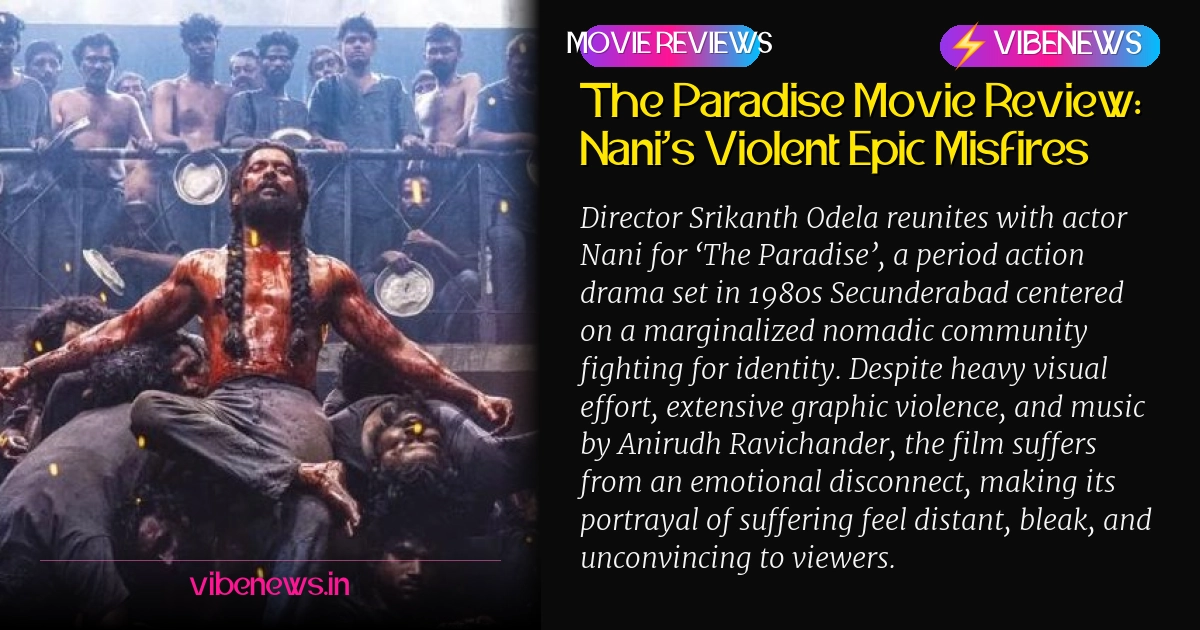
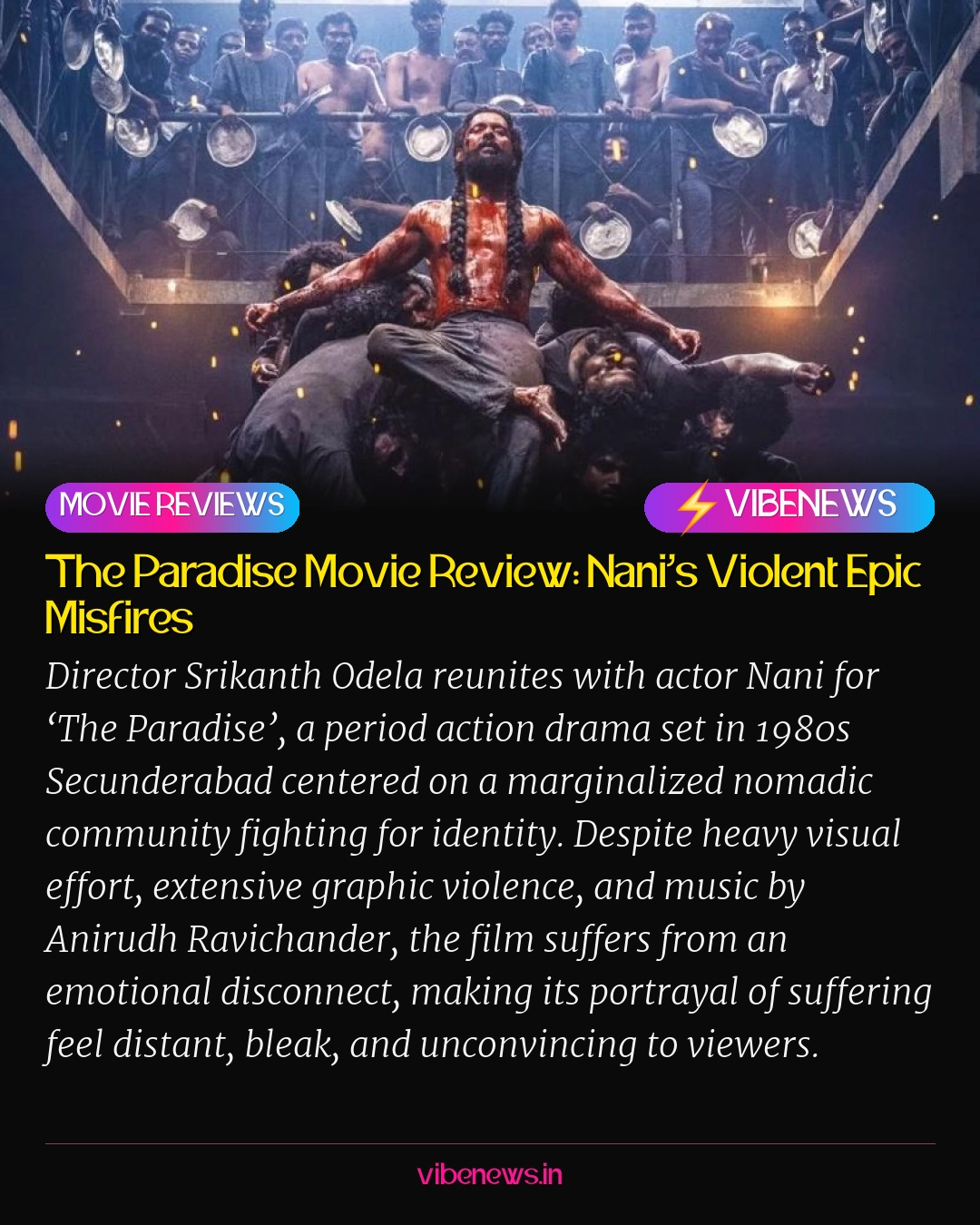
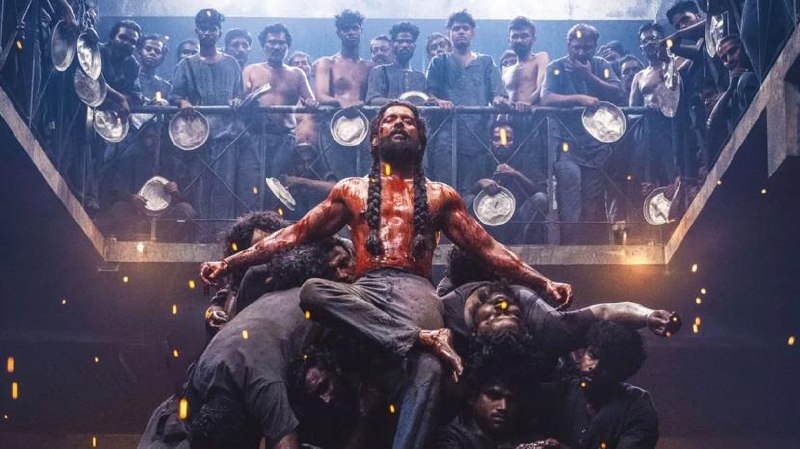
This stark setting contributes to an overarching feeling of emotional distance, as the film frequently prioritizes hyper-violent set pieces over heartfelt character development. The story follows Jadal, played by Nani, who returns to his community after serving 14 years in prison. Jadal harbors intense bitterness toward his mother Sammakka, portrayed by Sonali Kulkarni, who was the first woman in the tribe to raise her voice against their oppressors. Marked by a forced tattoo on his forearm and wearing a distinctive pigtail hairstyle, Jadal eventually shifts his focus from personal vengeance toward leading an uprising for his people. However, because the narrative relies heavily on graphic depictions of torture, including close-up scenes of electrocution, severed limbs, and extreme bloodshed, the violence desensitizes the viewer rather than evoking genuine sympathy for the tribe’s plight.
"What the film lacks, though, is the emotional heft to translate its ambitious ideas into an absorbing narrative."
The narrative anchors itself in a distinct regional context with deep roots in Telangana. Set against the textured backdrop of 1980s Secunderabad and Hyderabad, the film makes frequent references to local culture, including the famous Paradise biryani and the retro Liberty Cafe. The opening sequence pays explicit tribute to revolutionary Telangana poet Gummadi Vittal Rao, better known as Gaddar, alongside other legendary cinema figures. Furthermore, the narrative integrates brief political cameos clearly inspired by real-life Telugu political giants NT Rama Rao and K Chandrasekhar Rao, linking the fictional tribe’s struggle directly to the political history of Andhra Pradesh and Telangana.
Technically, the project boasts impressive visual scale due to Ch. Sai’s mood-driven black-and-brown cinematography and symbolism contrasting preying eagles with lowly crows. However, composer Anirudh Ravichander’s background music feels unnecessarily loud in several sequences, at times overpowering the dialogue. Intermittent post-production flaws, such as sudden editing shifts and muffled audio mixing, further hinder the narrative flow during high-stakes moments. While specific scenes like the pre-intermission sequence and the ‘Aaya Sher’ musical track offer momentary intrigue, they fail to sustain the broader narrative momentum.
Performative highlights are largely confined to Nani and Sonali Kulkarni. Nani undergoes a radical physical transformation to shed his traditional boy-next-door image, yet the thin script leaves his character without sufficient emotional grounding. Secondary roles featuring Kayadu Lohar as Subbalakshmi, Sampoornesh Babu as Biryani, and Sathyaraj fail to leave a lasting impact. Ultimately, The Paradise remains a well-intentioned but flawed experiment that struggles to balance its heavy socio-political ambitions against an overwhelming cycle of violence.
TL;DR
- Director Srikanth Odela reunites with Nani for the 1980s Secunderabad period action drama The Paradise.
- The narrative follows Jadal and the Savaari nomadic tribe fighting for basic identity rights against ruthless local oppressors.
- Visuals feature extreme graphic violence and a grim aesthetic, paired with an intense background score by Anirudh Ravichander.
- Critics note a severe lack of emotional depth, leaving key characters and social conflicts feeling distant and unconvincing.
- Performances by Nani and Sonali Kulkarni highlight the cast, but chaotic writing hampers the story’s overall impact.